






Vintage Postal Balance
These vintage postal balance instruments are functional desk antiques that combine polished brass with timber bases, offering a tangible connection to nineteenth and early twentieth century correspondence.
Vintage Postal Balance
A vintage postal balance is a weighing device designed for letters and parcels, spanning the Victorian and Edwardian eras. These pieces sit on wooden or stone bases and often retain their original brass weights.
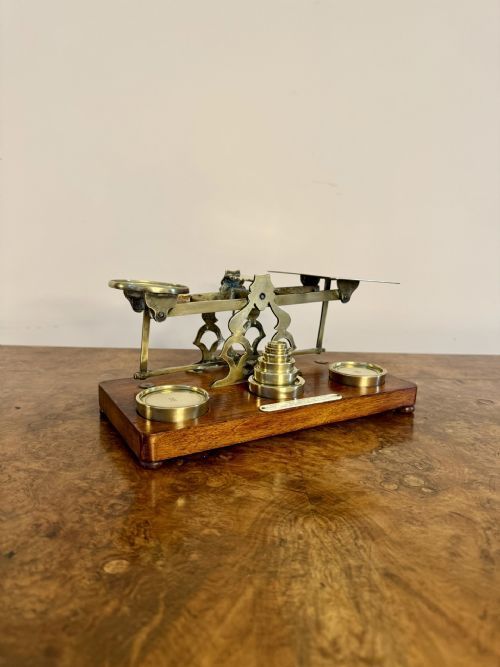
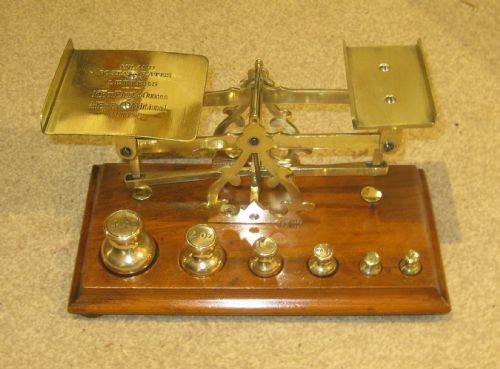
The versions most commonly met on this page are mounted on mahogany, oak, or walnut boards, frequently featuring brass scale pans and lever mechanisms. Examples range from compact desk models to very large formats intended for heavier post.
Originating primarily from British workshops, these postal scales reflect the administrative needs of past households and offices. Collectors encounter variations spanning from eighteen fifty up to nineteen ten.
Materials and construction methods
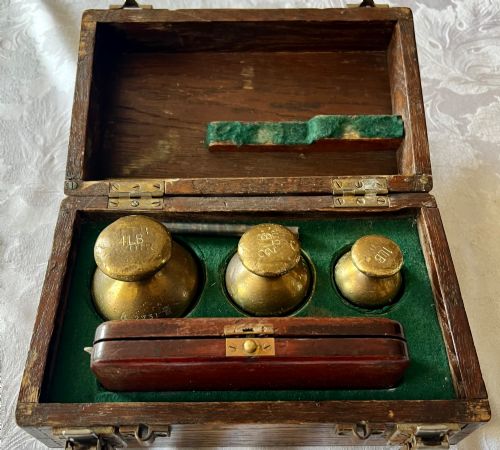
Makers fashioned the bases from solid hardwoods such as mahogany, oak, and walnut, frequently shaping the timber to house matching sets of brass weights in dedicated recesses. Selected examples incorporate decorative stones like malachite and marble into the design.
The weighing mechanisms utilise cast and polished brass, employing levers and swing arms to register letter weights accurately. Inscription details were typically stamped or engraved directly onto the metal components by the maker.
Vintage Postal Balance Retail Price Guide 2026
Typical asking prices for vintage postal balance among the pieces listed under this phrase on Sellingantiques today, from the lower quarter to the upper quarter. They describe what is for sale here now, not the wider market.
Some Victorian postal scales were disguised as candlesticks, letting households weigh their evening mail by candlelight before the morning post arrived.
Distinctions in quality
Quality rests upon the presence of a complete, matching set of original brass weights and the crispness of the maker's stamp on the metal or wood. Finer specimens display superior casting in the brass arms and careful selection of figured timber for the base.
The proportion and scale of the piece dictate its visual impact, with larger formats and unusual configurations commanding greater attention from collectors. Solid construction without replacement parts separates standard desk models from superior examples.
S Mordan London·S Mordan Co London·Ratcliff Birmingham
The Vintage Postal Balance Glossary
- Postal scale
- A device calibrated to weigh letters and small parcels for postage rates. These instruments use balance mechanisms rather than springs.
- Base board
- The wooden platform supporting the weighing mechanism and weights. These are typically formed from mahogany, oak, or walnut.
- Weights
- The calibrated metal pieces used to counterbalance the item being weighed. They are often stored in custom recesses cut into the wooden base.
- Edwardian
- A period spanning the reign of King Edward VII, noted here through items dated around nineteen hundred and nineteen ten. Pieces from this era often display refined brasswork.
- Victorian
- The period covering the reign of Queen Victoria, represented by items dating from eighteen fifty to eighteen eighty. This era produced diverse scales in mahogany and brass.
Vintage Postal Balance: Frequently Asked Questions
How do vintage postal scales work?
These scales operate on a lever balance principle where the letter is placed on one platform and calibrated weights are added to the other until the arm levels. The precision depends on the clean movement of the brass pivot points.
Most domestic models were calibrated to measure in ounces and grams to match historical postal tariffs. The physical movement relies entirely on mechanical counterweights rather than internal springs.
How do I date a postal balance?
Dating relies on stylistic clues, timber choices, and maker signatures stamped into the metal or wood. Victorian examples often feature rich mahogany boards, while Edwardian pieces frequently utilise solid oak.
Maker marks and registration numbers can narrow down the production decade considerably. Comparing the style of the brasswork to known manufacturing periods provides further verification.
Are original weights usually included?
Many surviving scales retain their original matching brass weights, often nested neatly within fitted slots on the wooden base. Finding a complete set enhances the integrity of the piece.
When weights are missing, finding exact period replacements that fit the designated wooden slots can prove challenging. Collectors prefer pieces that preserve their complete original complement.
Where should I display postal scales?
These items suit placement on a desk, library table, or sideboard where their polished brass and timber can be appreciated up close. Their sturdy construction makes them stable for surface display.
Keeping them away from direct heat sources protects the original wooden finishes and prevents the timber from warping over time. Periodic dusting keeps the brass surfaces bright.