







Brass Postal Scales
These brass postal scales sit on timber or stone bases, built to weigh letters accurately on a writing desk.
Brass Postal Scales
Brass postal scales are desk instruments designed for weighing correspondence to calculate postage rates accurately. When you search for brass postal scales, you encounter functional objects that served offices and homes during the Victorian and Edwardian eras. These pieces typically comprise a brass balance mechanism mounted on a fitted base.
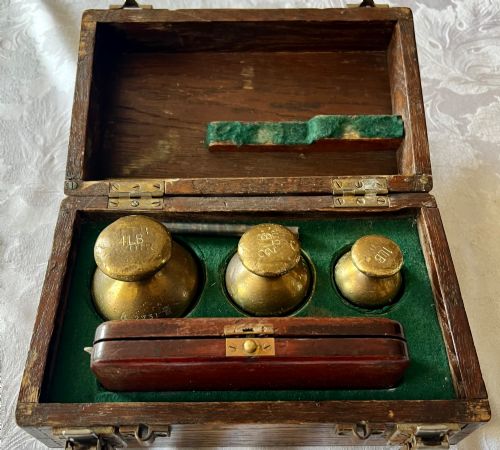
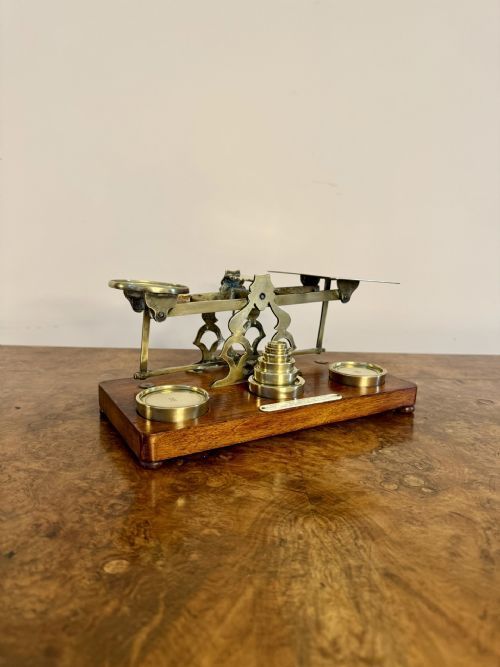
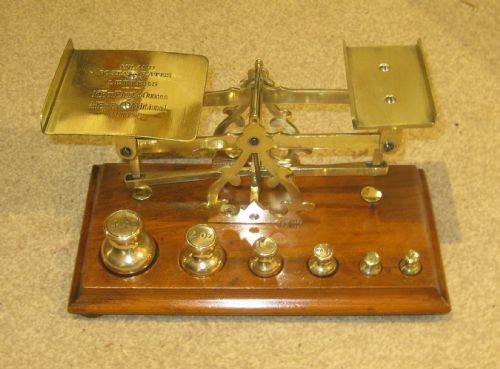
The version you are most likely to meet on this page is mounted on a rectangular wooden base, often housing graduated weights in dedicated slots. Mahogany, walnut, and oak form the most common timber foundations for these mechanisms. Variants extend to circular or shaped bases incorporating stone panels or candlestick designs.
Originating primarily from nineteenth and early twentieth-century workshops, these scales reflect the growth of postal services and letter writing. Surviving examples range from plain utilitarian models to ornate pieces with engraved brass plates and decorative mineral inlays.
How They Were Made
Makers constructed the balance arms and pans from cast and polished brass, often pairing them with seasoned hardwoods such as mahogany, walnut, and oak for the foundation boards. Selected pieces incorporate ornamental materials like malachite, onyx, or marble into the base structures.
Mechanisms rely on precise counterbalances, pivot points, and suspended brass plates to measure ounces reliably. Matching sets of weights, frequently shaped as stacked cylindrical or waisted dump forms, accompany the scales to complete the instrument.
Brass Postal Scales Retail Price Guide 2026
Typical asking prices for brass postal scales among the pieces listed under this phrase on Sellingantiques today, from the lower quarter to the upper quarter. They describe what is for sale here now, not the wider market.
Listings feature brass postal scales mounted on mahogany, walnut, oak, malachite, and marble bases from the Victorian and Edwardian periods.
What Varies in Quality
The standard of execution separates standard utility pieces from fine workshop productions. Finer specimens display crisp engraving on the brass balance beams and precise joinery in the timber bases.
Maker signatures inscribed upon the brass plates indicate higher workshop provenance. The presence of a complete matching set of original weights alters the integrity and completeness of the surviving instrument.
S Mordan·S Mordan Co·John Heath·J E Ratcliff
The Brass Postal Scales Glossary
- Postal scale
- A mechanical balance instrument designed specifically for weighing letters and parcels to determine postage requirements. These devices sit on desks and utilise calibrated brass weights.
- Waisted dump weight
- A cylindrical brass weight with a narrowed middle section, shaped for secure handling with fingers. These weights fit into recessed slots on the wooden scale base.
- Candlestick postal scale
- An upright design where the central support resembles a brass candlestick while incorporating the balance beam at the top. This form combines desk lighting aesthetics with functional weighing.
- Steelyard balance
- A weighing device utilising a unequal length lever arm where a sliding weight moves along a graduated scale. Some postal balances adopt this principle for measuring letter weights.
Brass Postal Scales: Frequently Asked Questions
How do brass postal scales work?
These instruments operate on a simple balance beam principle where a letter is placed on one brass pan and calibrated weights are added to the other until the pointer aligns centrally.
The matching weights correspond to historical postal tariff steps, allowing the user to determine the correct stamp requirements for domestic or international mail.
What woods were used for the bases?
Makers selected dense hardwoods that could withstand daily office use while providing a stable platform for the brass balance mechanism. Mahogany and walnut appear frequently in nineteenth-century examples.
Later Edwardian specimens often utilise solid oak or incorporate decorative stone elements such as malachite, onyx, and marble into the design.
How do I date a set of scales?
Dating relies on stylistic clues, materials, and maker marks stamped into the brass components. Victorian examples often feature deeper mahogany bases and ornate cast brass ornamentation.
Edwardian pieces tend toward simpler oak or walnut foundations with cleaner lines. Registration numbers stamped on the metal can narrow the production period to specific years.
Where should I display postal scales?
These pieces suit placement on a wooden desk, bookshelf, or side table where their brass components catch ambient light. They integrate naturally into traditional studies and home office settings.
Keeping them on a flat, level surface ensures the balance arm rests correctly when not in use.