






Antique Postal Balance
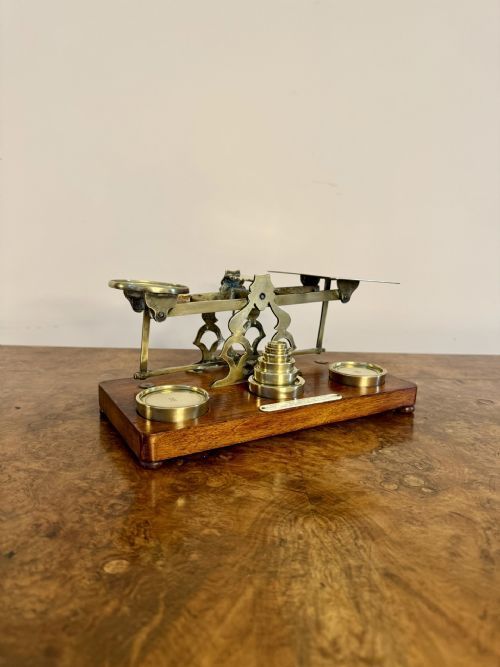
These antique postal balance scales are precision instruments of brass and hardwood designed for weighing letters, combining Victorian utility with handsome desk presence.
Antique Postal Balance
An antique postal balance represents the practical desktop technology used to weigh correspondence before the widespread adoption of digital weighing systems. These pieces primarily date from the Victorian and Edwardian eras, spanning from the mid-nineteenth century up to the early twentieth century.
Buyers searching for an antique postal balance will most frequently encounter sets mounted on wooden bases made of mahogany, oak, or walnut, paired with brass mechanisms. Some examples take the form of specialised designs, including candlestick configurations or striking variants incorporating malachite and marble.
The objects listed on this page originate from nineteenth and early twentieth-century workshops, often retaining their original weights or matching brass pans. Their forms range from standard flat-based letter scales to large, imposing formats designed for heavy office use.
How they were made
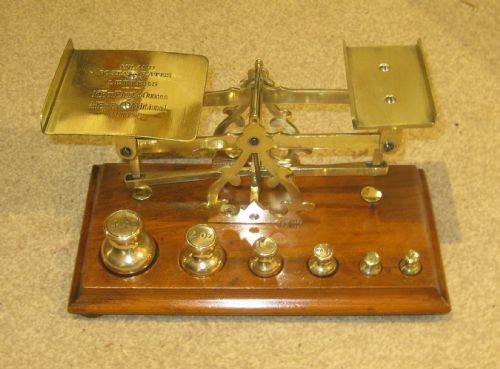
The construction relies heavily on polished brass for the working balance arms, pans, and calibrated weights, offering both durability and a bright finish. Makers mounted these metal components onto seasoned wooden plinths shaped from dense hardwoods like mahogany, oak, and walnut.
Cabinetmakers and metalworkers joined these materials using precise joinery to ensure the base remained entirely level, a fundamental requirement for accurate weighing. Finer models incorporated decorative stones such as malachite and marble into the base structures to elevate their visual appeal for fashionable Victorian desks.
Antique Postal Balance Retail Price Guide 2026
Typical asking prices for postal balance among the pieces listed under this phrase on Sellingantiques today, from the lower quarter to the upper quarter. They describe what is for sale here now, not the wider market.
Victorian desk clerks could weigh their letters by candlelight using a clever scale that doubled as a candlestick.
What varies in quality
Quality in an antique postal balance rests upon the precision of the metalwork and the grade of the materials chosen for the base. Finer examples display crisp maker signatures, substantial brass casting, and carefully selected hardwoods with rich grain patterns.
The presence of a complete set of matching weights significantly elevates the integrity of a piece. Simpler utilitarian designs sit at the lower end, while specialist forms and decorative materials like malachite represent the upper tier of production.
S Mordan·S Mordan and Co·Ratcliff Birmingham
The Antique Postal Balance Glossary
- Postal balance
- A mechanical device used to determine the correct postage for letters by measuring weight against standard brass masses. These instruments sat on writing desks in homes and offices throughout the nineteenth century.
- Brass pan
- The shallow dish suspended from the balance arm to hold the letter or parcel during weighing. They are typically cast from solid brass and polished to a bright finish.
- Candlestick scale
- A specialised hybrid design incorporating a candle holder alongside the weighing mechanism to save desk space. This inventive form combines domestic lighting with office utility.
- Hardwood base
- The heavy wooden plinth that supports the brass lever mechanism and provides stability. Commonly fashioned from mahogany, oak, or walnut to withstand daily use.
Antique Postal Balance: Frequently Asked Questions
What do these scales weigh?
These instruments were designed specifically to weigh letters and small parcels to calculate correct postal rates.
They utilise calibrated brass weights placed on one side to determine the exact mass of the correspondence on the other.
How do I date a postal balance?
Dating relies on stylistic clues, wood types, and any maker marks stamped into the brass or wood. Victorian examples often feature mahogany bases, while Edwardian versions frequently utilise solid oak.
Stamped inscriptions naming specific makers or registration marks provide the most precise indication of origin and date.
Are original weights usually included?
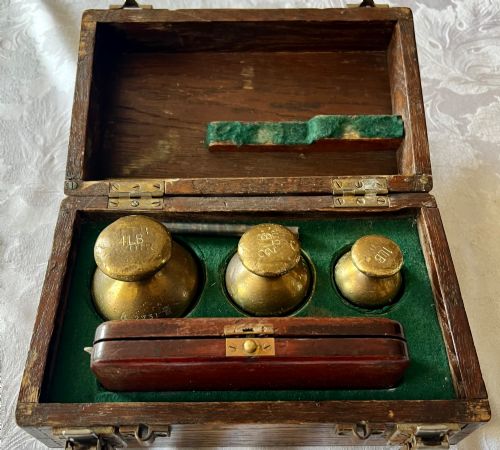
Many surviving sets retain their matching brass weights, often stored in dedicated slots within the wooden base. Finding a complete and original set of weights enhances the completeness of the instrument.
Some examples survive as the balance alone without the accompanying mass pieces.
Where were they used?
These balances were standard equipment in Victorian and Edwardian household writing desks, club rooms, and commercial offices. Their primary function was managing daily correspondence before postal services automated the process.
Today, they serve as decorative desktop objects with a strong historical character.