





Vintage Desk Scales
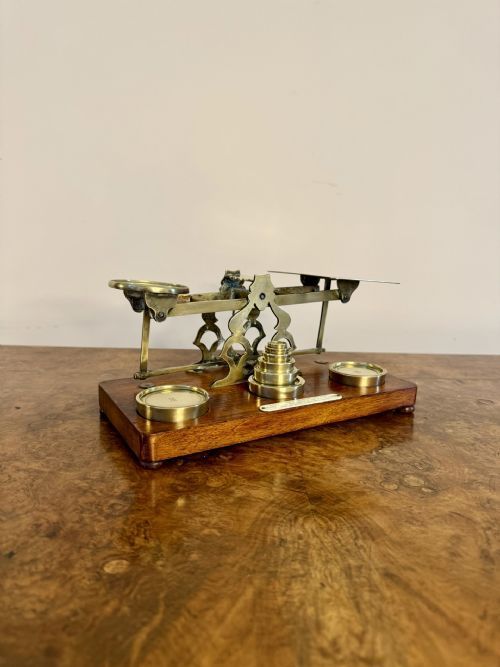
These vintage desk scales are functional brass and timber instruments designed for weighing letters, and collectors prize them for their polished period utility.
Vintage Desk Scales
Vintage desk scales are practical desktop instruments designed to weigh correspondence and parcels, appearing frequently in Victorian and Edwardian iterations. The surviving examples on this page are predominantly postal scales paired with matched sets of weights, often mounted on timber bases.
Makers utilised various durable materials to house the weighing mechanisms, resulting in combinations of brass, mahogany, oak, and occasionally malachite or glass. These pieces reflect the functional writing desk requirements of the nineteenth and early twentieth centuries.
How they were made
Manufacture relied upon cast or sheet brass for the balance beams, pans, and indicator arms, paired with seasoned hardwoods such as mahogany, oak, and walnut for the platform bases. The metals were polished or lacquered, while the wooden plinths received turned edges and fitted compartments to house individual brass weights.
Makers integrated precise mechanical pivots and counterbalances to ensure accurate weighing, occasionally incorporating decorative brass galleries or cast neoclassical details around the perimeters of the wooden bases.
The listings show postal scales mounted on diverse wooden bases, including mahogany, oak, and walnut, frequently paired with cast brass beams.
What varies in quality
The standard of materials and the presence of the original matching set of brass weights largely dictate the quality of these instruments. Fine examples feature substantial cast brass components and dense hardwood bases with crisp, turned mouldings rather than simplified replacement parts.
Maker attribution elevates the desirability of a piece, particularly when bearing the stamp of established nineteenth-century makers. The overall scale, proportion, and survival of the original patination across both the timber and the brass further distinguish superior pieces.
S Mordan·S Mordan Co London
The Vintage Desk Scales Glossary
- Postal scales
- Desktop weighing instruments designed specifically for determining postage rates for letters and small parcels. They typically feature a balanced beam with a flat pan at each end or a single platform mounted before an upright indicator.
- Brass
- A yellow alloy of copper and zinc widely utilised for the moving parts, pans, and decorative mounts of nineteenth-century desk accessories. It polishes to a bright finish and provides the necessary rigidity for balance mechanisms.
- Mahogany
- A durable tropical hardwood with a reddish-brown tone frequently employed for the desk bases of Victorian instruments. Its stability made it an ideal foundation for fitted wooden trays and scale platforms.
- Victorian
- Pertaining to the reign of Queen Victoria, spanning the mid to late nineteenth century, a period noted for ornate and functional desk equipment. Pieces from this era often exhibit robust construction and decorative brass detailing.
Vintage Desk Scales: Frequently Asked Questions
How do vintage postal scales work?
These instruments operate on a traditional balance beam principle, where placing a letter on the brass pan raises or tilts the indicator against a calibrated scale. The user reads the weight directly from the positioned arm or compares it against individual loose weights.
Most surviving examples retain their original configuration of balance arms and pivots, allowing the mechanism to move freely. They were calibrated to historical postal weight increments rather than modern metric standards.
Are original weights usually included?
Many surviving desk scales retain their matched sets of brass weights, which typically fit neatly into designated slots carved directly into the wooden base. These sets add significant interest for collectors.
When weights are missing, finding period-correct replacements matching the exact maker specifications can prove challenging. Collectors prefer pieces that preserve their complete original complement of weights.
What woods were used for the bases?
Cabinet makers utilised dense hardwoods such as mahogany, oak, and walnut to construct the stable platforms that supported the brass weighing mechanisms. These timbers were selected for their durability and attractive grain patterns.
The wooden plinths often feature carved mouldings, rounded corners, or sunken wells designed to secure the weights during use. Regular polishing with traditional wax helps maintain the deep lustre of the timber.
How do I date an antique scale?
Dating relies on stylistic clues such as the form of the brass casting, the profile of the wooden base, and any stamped maker marks or patent details. Victorian pieces often display heavier cast brass mounts and classical revival motifs.
Edwardian iterations tend to show slightly cleaner lines while maintaining traditional brass and hardwood construction. Comparing the design against dated historical catalogues helps narrow the period of manufacture.