







Antique Desk Scales
Antique desk scales are precise measuring instruments that bring both utility and history to a study or bureau.
Antique Desk Scales
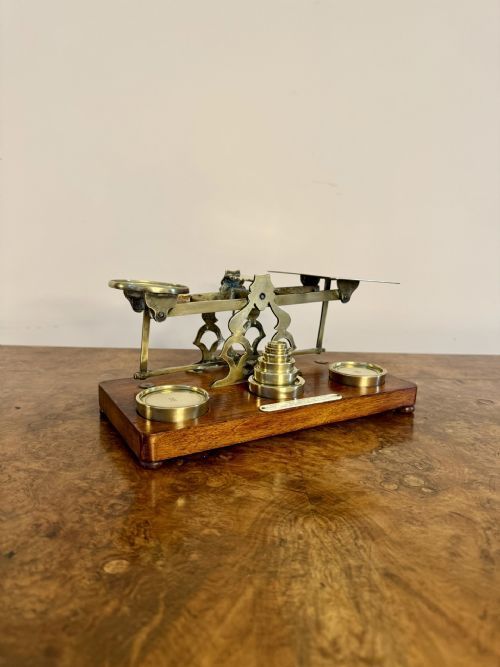
When you search for antique desk scales, you encounter brass and oak mechanisms designed for weighing letters and small parcels. These instruments date primarily from the Victorian and Edwardian eras, reflecting a period when postal correspondence required careful measurement.
The most common forms on this page include brass postal scales mounted on mahogany or oak bases, often accompanied by their original sets of weights. Makers such as S. Mordan and Ratcliff of Birmingham produced these reliable writing-desk accessories for everyday use.
Beyond standard postal scales, the category occasionally spans materials like malachite and walnut. Each piece demonstrates the heavy brass beams and counterweights characteristic of nineteenth-century office equipment.
Materials and Construction
Makers constructed the platforms and beams of these instruments primarily from cast and polished brass, ensuring durable balance points. Wooden bases were turned or joined using dense hardwoods like mahogany, oak, and walnut.
Fitted weights were cast in matching brass and often stored in dedicated slots within the wooden plinths. Detail work included engraved maker inscriptions and careful calibration to maintain accuracy.
Antique Desk Scales Retail Price Guide 2026
Typical asking prices for desk scales among the pieces listed under this phrase on Sellingantiques today, from the lower quarter to the upper quarter. They describe what is for sale here now, not the wider market.
Listings for antique desk scales feature materials including brass, mahogany, oak, walnut, and malachite across the Victorian and Edwardian periods.
Markers of Quality
Quality in these instruments depends upon the crispness of the brass casting and the retention of the complete, matching set of weights. Finer examples display refined joinery on the hardwood bases and clear maker stamps.
The integrity of the central balance mechanism and the smooth patina of the metal separate utilitarian workshop pieces from refined desk accessories.
S Mordan and Co London·Ratcliff Birmingham
The Antique Desk Scales Glossary
- Postal Scales
- Weighing devices specifically calibrated for letters and small packages. They typically feature a flat platform on one side and a weight pan on the other.
- Plinth
- The solid wooden base upon which the brass scale mechanism rests. These are frequently fashioned from mahogany or oak.
- Brass Beam
- The horizontal pivoting bar that holds the scale pans and determines the balance point. Its sensitivity governs the accuracy of the instrument.
- Mahogany
- A durable hardwood commonly utilised for the construction of nineteenth-century desk accessories and furniture bases.
Antique Desk Scales: Frequently Asked Questions
How do I use antique postal scales?
Place the letter or small parcel upon the brass platform and add calibrated weights to the opposite pan until the beam balances level.
Ensure the mechanism moves freely without friction on the central pivot before taking any measurement.
What woods were used for the bases?
Maker workshops utilised dense hardwoods such as mahogany, oak, and walnut to provide stable and heavy foundations for the brass mechanisms.
Selected examples also incorporated decorative minerals like malachite alongside the primary timber.
How do I date Victorian postal scales?
Examine the style of the brasswork, the shape of the wooden plinth, and any stamped maker details or registration marks present on the metal.
Victorian models often feature heavy mahogany or walnut bases paired with elaborate cast brass beams.
Are original weights usually included?
Many surviving sets retain their matching brass weights, which fit neatly into dedicated recesses carved directly into the wooden base.
Complete sets with matching fractional weights significantly enhance the historical interest of the instrument.