





Victorian Letter Scales
Victorian letter scales are functional desk accessories in brass and hardwood that bring precision engineering to nineteenth-century correspondence.
Victorian Letter Scales
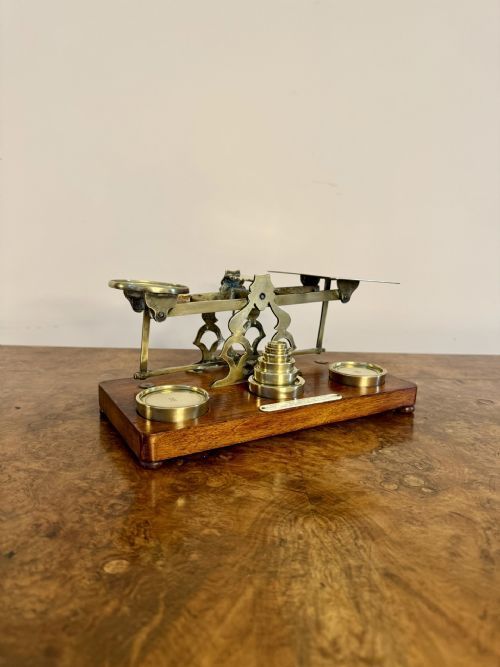
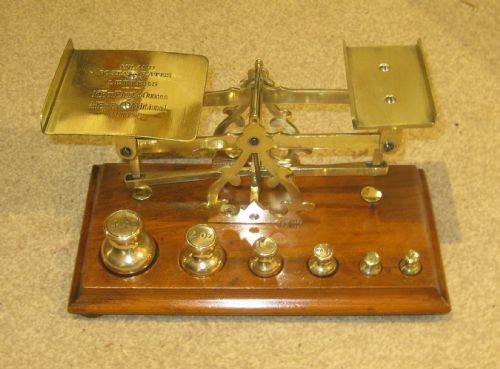
When you search for Victorian letter scales, you are looking at desktop measuring instruments designed to weigh mail before postage stamps became uniform. These pieces typically combine a brass balancing mechanism with a fitted wooden or stone base.
The versions you are most likely to meet on this page date from the mid-nineteenth century through to nineteen hundred. They appear in forms ranging from simple brass plates on mahogany mounts to elaborate arrangements featuring malachite panels and cast brass frames.
How they were made
Maker workshops constructed these balances using cast brass for the working levers and pans, mounted onto turned or slab bases of mahogany, walnut, and hardwood. Some examples incorporate decorative mineral inlays such as malachite or slate into the plinth.
Makers integrated fitted compartments directly into the wooden bases to hold matching sets of brass weights. Engraved detailing on the brass plates and stamped maker signatures distinguish the work of prominent firms like S. Mordan.
Victorian Letter Scales Retail Price Guide 2026
Typical asking prices for victorian letter scales among the pieces listed under this phrase on Sellingantiques today, from the lower quarter to the upper quarter. They describe what is for sale here now, not the wider market.
Recorded materials include polished malachite stone inserts alongside cast brass and traditional English timbers.
What varies in quality
The distinction between standard utility items and high-end specimens lies in the weight of the casting and the crispness of the brass engraving. Heavier brass balances with substantial mahogany or walnut mounts represent superior workshop output.
The presence of matching original brass weights and distinctive decorative materials like malachite elevates an example above plain utilitarian versions. Finer pieces also retain clear maker signatures stamped into the metalwork.
S Mordan London·S Mordan Co London·Ratcliff Birmingham
The Victorian Letter Scales Glossary
- Letter scales
- A desktop device used to weigh correspondence to determine postal rates. These instruments rely on a central pivot and balancing beam.
- Brass balance
- The metal pivoting arm that holds the weighing pans on either end. This component is typically cast and polished.
- Base
- The wooden or stone platform that supports the weighing mechanism. Bases are frequently fashioned from mahogany, walnut, or marble.
- Weights
- The small denomination pieces used on the scale platform to counterbalance the letter. These are usually stored in fitted wells on the wooden base.
Victorian Letter Scales: Frequently Asked Questions
How do Victorian letter scales work?
These instruments operate on a simple beam balance principle where an item placed on one platform is countered by calibrated weights on the other. The pivoting needle points to a centre mark when equilibrium is reached.
Most surviving examples retain their original matching brass weights stored neatly in the wooden base. Users placed letters on the top plate to check the required postal charge before sending.
What materials were used for the bases?
Makers predominantly used dense hardwoods such as mahogany and walnut for the foundational platforms. These woods provided a stable and heavy plinth to support the brass mechanism.
More decorative versions incorporated polished stone panels like malachite, slate, or marble into the design. The contrast between bright polished brass and dark wood or green stone defined the aesthetic.
How can I identify a maker?
Maker details appear as stamped signatures directly onto the brass beam or platform plate. Names such as S. Mordan and Ratcliff of Birmingham are found on specific examples.
These stamps indicate the workshop responsible for the metal casting and assembly. Unsigned pieces remain common and reflect standard manufacturing output of the period.
Were these scales used in offices?
Postal balances served as essential equipment in nineteenth-century writing rooms, banks, and merchant offices. Every piece of outgoing mail required accurate weighing to comply with postal regulations.
Their presence on a desk reflected the administrative needs of a literate commercial society. Today they function as decorative objects for traditional interiors.