



Victorian Postal Scale Brass
These Victorian postal scale brass designs combine heavy metalwork with fitted wooden bases, offering a functional desk accessory with distinct period character.
Victorian Postal Scale Brass
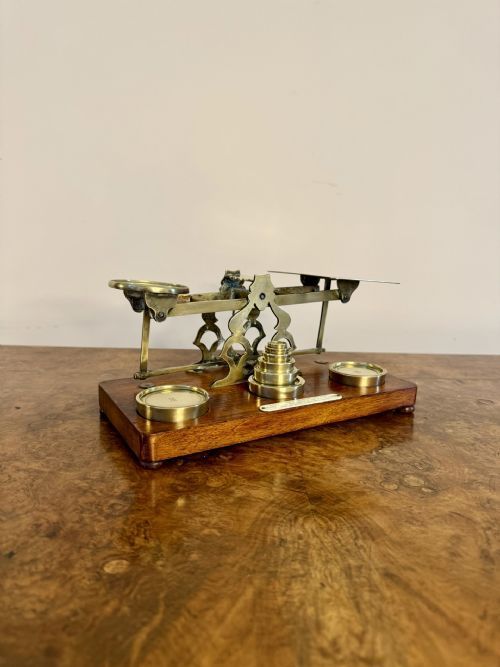
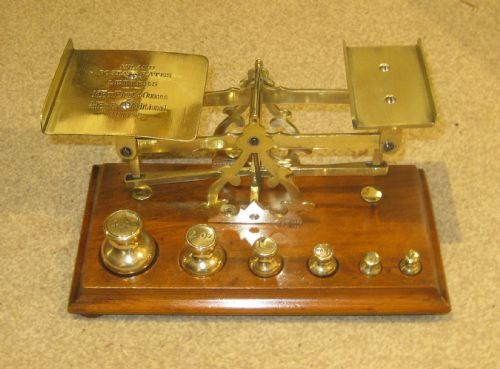
Victorian postal scale brass pieces appear primarily as mounted platform balances or distinctive candlestick forms. These desk accessories served domestic and commercial writing desks for weighing correspondence accurately.
The most common formats on this page combine cast or sheet brass lever mechanisms with shaped wooden bases in mahogany, walnut, or hardwood. Specialised examples incorporate decorative mineral stones such as malachite, onyx, and marble alongside gilded surfaces.
Dating spans from mid nineteenth century examples through to the Edwardian period at the turn of the twentieth century. Makers such as S. Mordan, Ratcliff Birmingham, and Avery produced these utilitarian objects with varying degrees of ornamentation.
Construction and Materials
Makers utilised cast and sheet brass for the operating beams, scale pans, and square weights. This metalwork was frequently polished, engraved, or gilded to enhance its appearance upon a desk.
Wooden platforms were shaped from dense timbers including mahogany, walnut, coromandel, and general hardwood. These bases often incorporated fitted compartments designed to hold matching sets of graduated brass weights.
Listings feature brass combined with mahogany, walnut, hardwood, malachite, marble, and onyx across Victorian and Edwardian periods.
Judging Quality
Quality rests upon the crispness of the brass casting, the sharpness of any engraved decoration, and the integration of the wood and metal components. Maker attribution through signatures or stamps adds significant distinction to an example.
Material variation also dictates status, moving from standard mahogany and brass combinations to uncommon applications of malachite, onyx, and enamel work.
S Mordan and Co·Ratcliff Birmingham·Avery
The Victorian Postal Scale Brass Glossary
- Letter balance
- A mechanical weighing device using a pivoted beam and suspended pan to determine postage rates. These balances rely on counterweights rather than spring mechanisms.
- Candlestick scale
- A vertical post design combining the visual form of a lighting stick with a functioning balance beam at the top. This clever dual format saved desk space.
- Square weights
- Flat, graduated metal pieces designed to stack neatly within a wooden base compartment. They correspond to specific postal weight tiers of the period.
Victorian Postal Scale Brass: Frequently Asked Questions
How do these postal scales work?
Letters or documents placed upon the small brass pan pull down one side of the pivoting beam. The matching square weights are added to the opposite side until the indicator needle centres.
This balance system relies on exact counter-lever physics established during the nineteenth century for postal tariff measurement.
Are the brass weights always included?
Many surviving examples retain their original graduated brass weights stored within fitted wooden base recesses. Some pieces appear without weights due to separation over the decades.
Checking listings carefully reveals whether a matched set accompanies the scale mechanism.
What woods were used for the bases?
Makers employed dense hardwoods such as mahogany and walnut to anchor the heavy brass mechanisms. Exotic materials like coromandel and decorative stones also appear.
These varied timbers provided stable foundations and polished surfaces suitable for formal nineteenth century writing desks.
How do I spot an earlier Victorian piece?
Earlier nineteenth century examples often feature heavier cast brass elements, hand engraving, or unusual materials like enamel and onyx. Later Victorian and Edwardian iterations tend toward simplified production.
Maker signatures stamped into the metalwork help confirm specific production decades.