




Vintage Brass Letter Balance
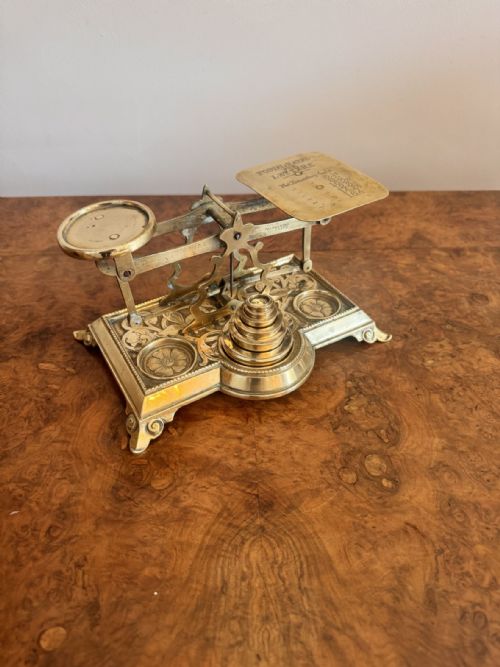
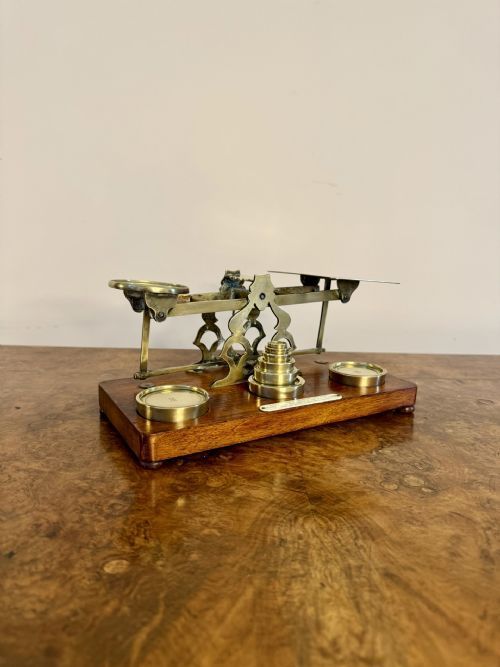
A vintage brass letter balance measures correspondence with absolute mechanical precision, combining utilitarian function with the rich materiality of the nineteenth and early twentieth centuries.
Vintage Brass Letter Balance
A vintage brass letter balance is a precision instrument designed to weigh post before envelopes were universally pre-sorted by weight bands. These domestic and office tools date from the Victorian and Edwardian eras, spanning from eighteen fifty up to nineteen ten.
Makers such as S. Mordan and Co supplied the high-end market, while many surviving pieces bear the marks of regional manufacturers like Ratcliff of Birmingham. Irish variants also appear among the selection, reflecting regional differences in nineteenth-century desk accessories.
How they were made
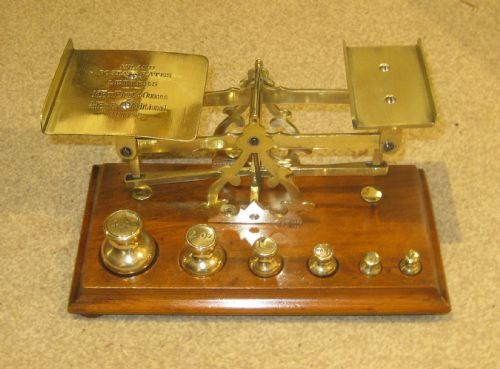
Makers relied on heavy cast brass for the balance arms, pans, and adjustment components, ensuring the mechanical integrity required for accurate weighing. This metalwork was frequently polished to a bright finish or left with the deeper patination acquired over decades of use.
The brass mechanisms are mounted onto dense hardwoods including mahogany, oak, and walnut, frequently shaped with moulded edges and recessed wells to hold the corresponding brass weights securely.
Specialist examples integrated decorative stone elements, setting brass balance assemblies into solid bases of green malachite or polished marble to appeal to affluent Victorian desk owners.
Listings span from eighteen fifty to nineteen ten, incorporating Victorian and Edwardian production eras.
What varies in quality
Superior quality balances demonstrate refined casting work on the brass arm and crisp stamping on the maker's mark, whereas lesser examples show softer detailing and simpler construction. The inclusion of the correct, matching set of original brass weights elevates an individual piece significantly.
The choice of base material marks a clear distinction in grade, moving from standard polished hardwoods to heavily figured walnut, quarter-sawn oak, or decorative minerals like malachite. Larger proportions and complex combined functions, such as the dual-purpose candlestick scales, represent the more ambitious end of nineteenth-century manufacture.
S Mordan London·Ratcliff Birmingham
The Vintage Brass Letter Balance Glossary
- Letter balance
- A mechanical scale designed specifically to determine postage rates by weighing letters and small parcels. These devices use a pivoting beam or spring mechanism rather than hanging pans.
- Postal weights
- The calibrated flat or cylindrical brass pieces designed to sit alongside a letter balance. Complete matched sets are particularly valued by collectors.
- S
- Mordan and Co. A prominent London manufacturing firm renowned for producing high-quality Victorian writing accessories, pencils, and postal scales. Their stamped name denotes a superior commercial standard.
- Base
- The wooden or stone plinth that supports the brass weighing mechanism. These range from simple mahogany boards to elaborate moulded walnut and marble platforms.
Vintage Brass Letter Balance: Frequently Asked Questions
How do vintage brass letter balances work?
These instruments operate on a pivoting mechanical beam where placing a letter on the brass pan raises a graduated indicator or shifts the balance against calibrated weights. The design allows the user to read the exact postal tariff required for the item.
Most domestic versions were calibrated to handle standard correspondence weights of the nineteenth century, ensuring letters conformed to postal regulations before dispatch.
Are the brass weights usually original to the scale?
Many surviving balances retain their matching set of brass weights, which often nest neatly into dedicated slots carved directly into the wooden base. Because weights were easily separated or lost over generations, finding a fully unified set is a notable advantage.
Replacement weights do occur, though collectors naturally prefer examples where the wear, brass composition, and maker details match the scale itself.
How should I clean a vintage brass letter balance?
Maintenance generally requires nothing more than gentle dusting with a dry microfibre cloth to protect the accumulated patina on both the brass and the timber base. Aggressive metal polishes should be avoided as they remove the historic finish and can damage stamped maker marks.
Wood bases benefit from occasional applications of appropriate furniture wax to nourish the grain of the mahogany, oak, or walnut without affecting the metal components.
What is the difference between Victorian and Edwardian postal scales?
Victorian examples often feature heavier mahogany or walnut platforms with ornate brass casting, reflecting the elaborate aesthetic of the nineteenth century. Maker signatures such as S. Mordan are frequently found on these pieces.
Edwardian scales tend toward cleaner lines, sometimes utilising solid oak or simpler architectural forms while maintaining the functional precision required for daily postal sorting.