


Brass Mounted Stationery Casket
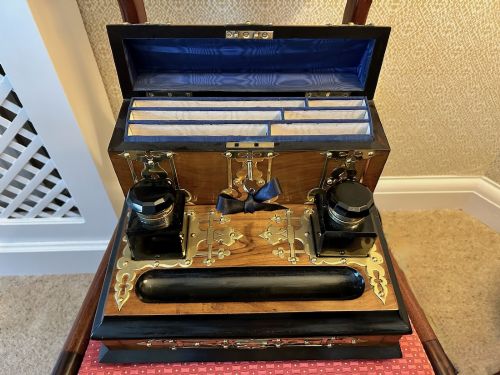
These brass mounted stationery caskets are sturdy Victorian desk boxes built to organise letters and papers with metal mounts.
Brass Mounted Stationery Casket
When you search for a brass mounted stationery casket, you encounter Victorian desk accessories designed to hold writing paper and envelopes. Most examples date from the nineteenth century, spanning periods such as the eighteen-fifties through to eighteen-ninety.
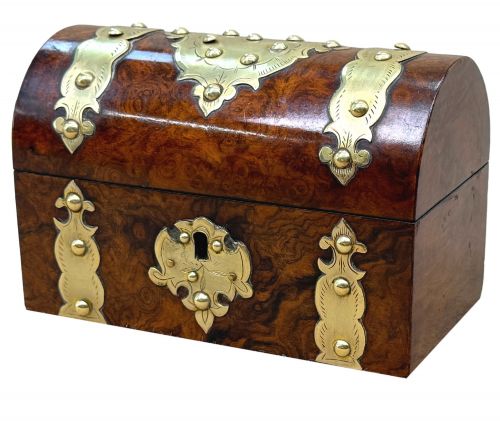
The version you are most likely to meet on this page is a wooden box with a hinged lid, often featuring a domed profile. These pieces sit upon a desk or table to keep correspondence tidy.
Makers shaped these items from dense timbers and fitted them with heavy metal strapwork, corners, and hinges. Their primary purpose was utilitarian, yet they served as ornamental objects for the nineteenth century home or office.
How they were made
Cabinetmakers constructed these caskets using a timber carcass, frequently veneered in burr walnut, pollard oak, or exotic coromandel wood. Solid oak and mahogany also appear among the selections.
Mounts made from brass or ormolu reinforce the corners, edges, and lids, fastened with small pins or screws. Some pieces incorporate inset porcelain plaques, agate cabochons, or tooled leather panels to enhance the exterior.
Some nineteenth-century letter boxes include secret compartments hidden beneath the stationery dividers for keeping private notes.
What varies in quality
The choice of timber creates a fundamental distinction in quality across these pieces. Highly figured burr walnut and richly grained coromandel command greater attention than plain oak or standard mahogany.
The weight and detail of the brass mounts also signal the standard of manufacture. Heavy, finely cast mounts indicate a higher grade of production than thin, stamped metal work.
Trussell Brighton·Pugin
The Brass Mounted Stationery Casket Glossary
- Stationery box
- A desk accessory designed with internal dividers to hold writing paper, envelopes, and stamps. These boxes protect correspondence from dust and keep desks orderly.
- Coromandel wood
- A dense, heavy timber from Asia featuring dark brown grain with dramatic black stripes. Cabinetmakers utilised this material for high-end Victorian desk boxes.
- Burr walnut
- Wood taken from a growth on a walnut tree, yielding complex, swirling grain patterns. It forms a decorative veneer on many nineteenth-century caskets.
- Gothic Revival
- An architectural and decorative style popular during the Victorian era that drew inspiration from medieval forms. Pieces in this style often display pointed arches and heavy metalwork.
- Ormolu
- Gilded bronze used for decorative mounts and fittings on fine furniture and boxes. It provides a bright, gold-coloured finish that does not tarnish easily.
Brass Mounted Stationery Casket: Frequently Asked Questions
What is a stationery casket?
A stationery casket is a Victorian desk box built to hold writing paper, envelopes, and correspondence. These pieces feature hinged lids and internal dividers.
They stood on desks in studies and drawing rooms during the nineteenth century. Their purpose was to keep writing materials organised and protected.
How do I date a stationery box?
Dating relies on timber choices, construction methods, and stylistic cues such as Gothic Revival shaping. Materials like coromandel and burr walnut point directly to the Victorian period.
Hardware styles also help determine the age. Heavy cast brass mounts and specific lock mechanisms provide clues to the decade of manufacture.
What woods were used?
Cabinetmakers selected dense, decorative hardwoods for these boxes. Burr walnut and coromandel appear frequently among higher quality pieces.
Other examples utilise oak, pollard oak, or mahogany. These timbers often received a polished finish to highlight the natural grain patterns.
How should I clean my box?
Maintenance involves dusting the wooden surfaces gently with a dry, soft cloth. Avoid using harsh chemical sprays or modern polishes that can damage antique finishes.
Brass mounts benefit from careful wiping without abrasive cleaners. Keeping the box out of direct sunlight prevents the wood and veneers from drying out.