




Brass Mounted Desk Set
A brass mounted desk set organises correspondence with metalwork fitted to timbers, stone and shell.
Brass Mounted Desk Set
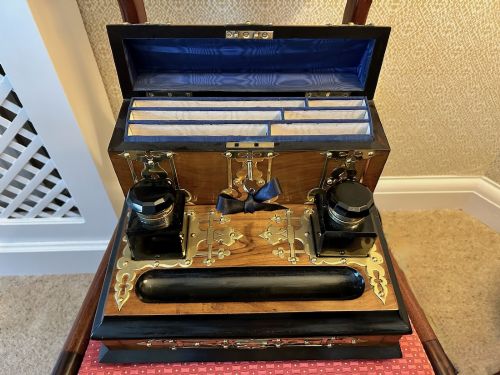
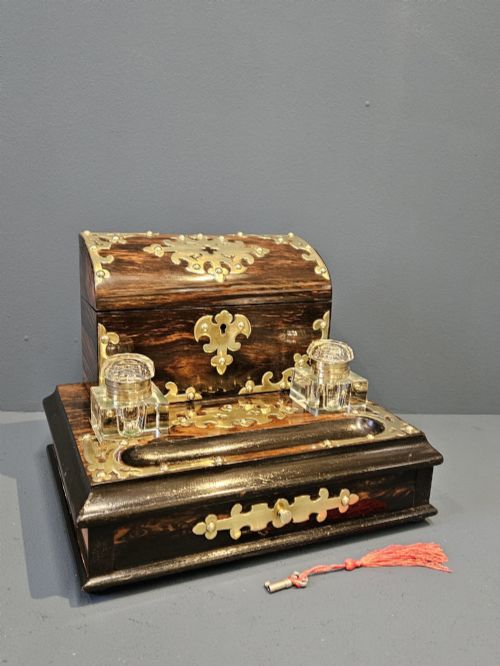
A brass mounted desk set comprises inkstands, stationery boxes and clock garnitures designed for the writing table. The pieces found here range from eighteenth-century French examples to late Victorian oak and walnut desk accessories.
Victorian pieces in coromandel, burr walnut and ebonised wood dominate the selection, often incorporating cut glass inkwells and pen trays. French Empire and Napoleon III designs also appear, featuring ormolu mountings and vert marble.
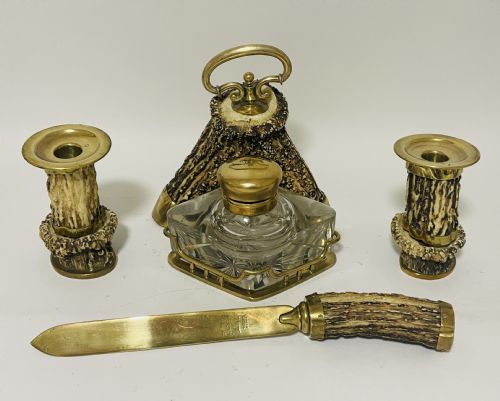
Functional items such as double-sided desk sets and stationery stands sit alongside decorative mantel clocks and clock garnitures. Materials extend to tortoiseshell, agate cabochons, malachite and even antler, reflecting nineteenth-century taste.
Materials and construction
Cabinet makers utilised dense hardwoods like walnut, coromandel, oak and ebonised timber as foundations for brass mounts, ormolu and tortoiseshell inlay. Fine brass work and cast ormolu are secured to wooden carcasses and stone bases.
Cut glass and crystal form the inkwells, frequently fitted with hinged brass collars and lids. Agate cabochons and malachite provide inset detail within the metal frameworks.
Assessing quality
The standard of a brass mounted desk set depends upon the crispness of the cast metalwork and the selection of figured timbers like burr walnut and coromandel. Superior pieces display precise inlay and heavy gauge brass or ormolu mounts.
Completeness dictates value, as matched inkwells, intact glass liners and original keys elevate an inkstand or stationery box. The integration of luxury materials such as tortoiseshell and malachite distinguishes finer nineteenth-century examples.
The Brass Mounted Desk Set Glossary
- Ormolu
- Gilded bronze used widely for decorative mounts in French furniture and desk accessories. It provides a rich golden surface that contrasts with marble and exotic woods.
- Coromandel
- A dense, dark cabinet wood imported from Asia, heavily figured with contrasting dark brown and caramel streaks. It forms the body of many high-end nineteenth-century inkstands.
- Inkstand
- A tray or stand holding inkwells, sanders and pen troughs for a writing desk. These vessels form the central component of most desk sets.
- Garniture
- A set of matching ornamental objects for a mantelpiece or desk, usually consisting of a clock flanked by candelabras or urns. They appear in marble and metal variations.
- Cabochon
- A gemstone or mineral polished into a convex, rounded shape rather than faceted. Agate examples are often set directly into nineteenth-century brass mounts.
Brass Mounted Desk Set: Frequently Asked Questions
What pieces comprise a desk set?
A desk set typically incorporates inkstands, stationery boxes and pen trays designed to coordinate on a writing table. Some larger suites include matching clocks and barometers.
Materials range from oak and walnut to ormolu-mounted marble and coromandel.
How do I date a Victorian inkstand?
Nineteenth-century inkstands often display characteristic secondary woods, brass mount styles and locking mechanisms. Examining the cut glass of the inkwells and the timber grain helps narrow the decade.
Maker styles shift from early French Empire influences to later Victorian Gothic and aesthetic movements.
What is coromandel wood?
Coromandel is a heavy, exotic timber featuring dramatic dark grain patterns against a warm background. Cabinet makers used it extensively for luxury nineteenth-century stationery boxes.
Its rich appearance made it a preferred substrate for brass and ormolu mounts.
Were clock garnitures used on desks?
Clock garnitures and mantel clocks appear alongside desk accessories in nineteenth-century studies and libraries. They matched the materials of the writing sets to create a cohesive interior.
Marble and ormolu versions offer a heavier decorative presence than portable wooden inkstands.