




Brass Mounted Etagere
A brass mounted etagere brings tiered elegance and gleaming metal trim to a room, offering display space with undeniable French flair.
Brass Mounted Etagere
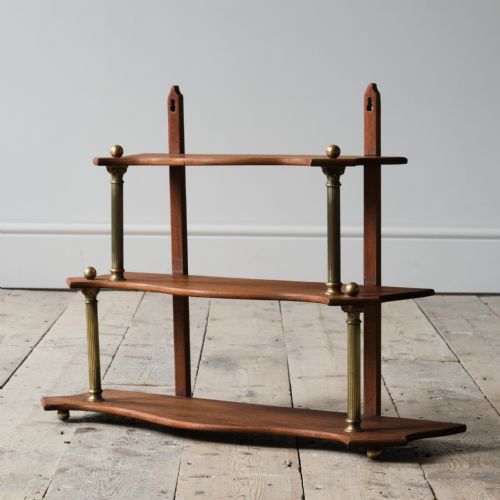
A brass mounted etagere functions primarily as an open display shelf or occasional table, designed to showcase precious small objects across multiple tiers. Buyers seeking these pieces encounter multi-tiered stands originating from the mid-nineteenth century through the early twentieth century, spanning Victorian and Edwardian periods.
The prevailing aesthetic draws heavily on French taste, encompassing French Revival, Belle Epoque, Napoleon III, and Rococo Revival styles. Alongside standard etageres, related forms include side tables, display shelves, and campaign washstands featuring characteristic metal mounts.
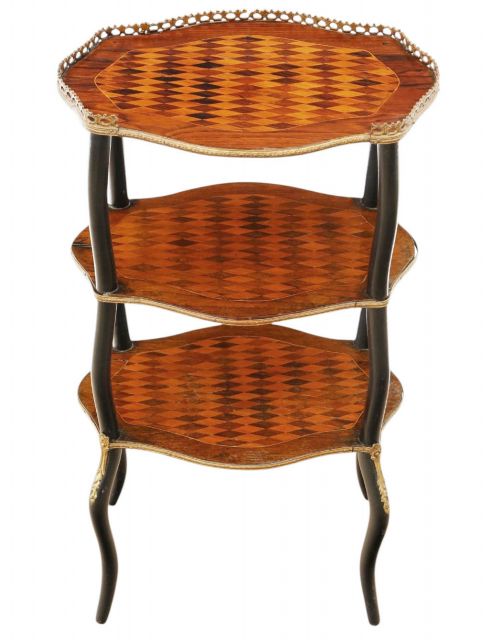
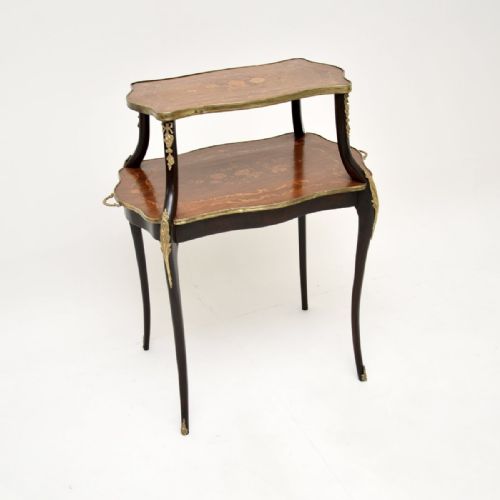
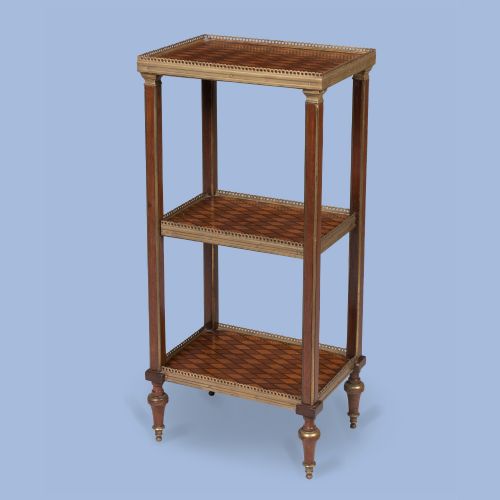
Makers utilised rich decorative schemes, frequently incorporating floral marquetry, parquetry inlay, and contrasting timbers such as walnut, rosewood, amboyna, and ebonised wood. Surviving examples range from two-tier occasional tables to three-height display pieces finished with ormolu or brass mounts.
Construction and materials
Cabinetmakers constructed these frames using a variety of woods, applying veneers of walnut, rosewood, satinwood, kingwood, and amboyna over solid structural timber. Mixed timber parquetry and intricate floral marquetry inlay provide surface pattern, complemented by polished walnut and ebonised wood surfaces.
Structural elements are secured and decorated with brass or ormolu mounts, corner brackets, and gallery rails designed to retain items on the tiers. Marble tops occasionally appear on turn-of-the-century examples, adding weight and a cool tactile surface to the uppermost tier.
Brass Mounted Etagere Retail Price Guide 2026
Typical asking prices for brass mounted etagere among the pieces listed under this phrase on Sellingantiques today, from the lower quarter to the upper quarter. They describe what is for sale here now, not the wider market.
Listings feature pieces spanning the mid-nineteenth century to the early twentieth century, utilising walnut, rosewood, and amboyna.
Distinctions in quality
The refinement of the marquetry and parquetry inlay separates standard production from superior work, with tight joints and varied timber tones indicating skilled cabinetmaking. Hand-chiselled ormolu mounts and heavy cast brass detailing provide a crisper profile than mass-produced stamped metal fittings.
Proportion and structural balance dictate the visual success of multi-tiered pieces, ensuring the upright supports integrate harmoniously with the shelves. The depth of polish applied to timbers like rosewood and walnut alters how light catches the grain across different heights.
The Brass Mounted Etagere Glossary
- Etagere
- A piece of furniture consisting of a set of open shelves for displaying small objects. The form emerged in France during the eighteenth century and remained popular through the Victorian era.
- Marquetry
- Decorative woodwork where pieces of veneer are fitted together to form pictorial or geometric designs. Craftsmen used contrasting woods like satinwood and rosewood to achieve tonal shading.
- Parquetry
- A geometric mosaic of wood pieces used for floors and furniture surfaces. It creates repeating patterns across table tops and shelf tiers.
- Ormolu
- Gilded bronze applied to furniture mounts and decorative hardware. The technique involves treating metal with a mercury-gold amalgam to produce a durable golden finish.
Brass Mounted Etagere: Frequently Asked Questions
What is a brass mounted etagere used for?
These tiered stands serve as display furniture for ceramics, small bronzes, and decorative objects in a drawing room or salon. The multiple shelves maximise vertical display space without heavy cabinetry.
Historically, they held ornaments, books, or tea accessories, functioning as decorative focal points rather than heavy storage units.
How do I date an antique etagere?
Dating relies on identifying timber combinations, construction methods, and stylistic cues such as French Revival or Belle Epoque influences. Mid-nineteenth century pieces often show simpler walnut or mahogany frames, while later Victorian and Edwardian examples feature complex floral marquetry.
Examining the underside, screw types, and the casting quality of the brass mounts also helps narrow the period of manufacture.
Where should I place an etagere?
Position these open shelves against a flat wall or in a corner where light can catch the polished timber and brass mounts. Avoid placing them in direct sunlight to protect sensitive veneers like rosewood and kingwood from fading.
Because the shelves are open on all sides, they work well as room accents rather than heavy room dividers.
Are these pieces purely French?
While the design vocabulary is predominantly French in manner, English and continental makers produced many pieces influenced by French styles. Makers often adopted French Rococo Revival or Napoleon III aesthetics for an international clientele.
Design attributions sometimes point to specific makers or workshops working within these established European traditions.