


Brass Lacquered Table Clock
These brass lacquered table clock pieces bring decorative Chinoiserie ornament and striking movements into domestic interiors.
Brass Lacquered Table Clock
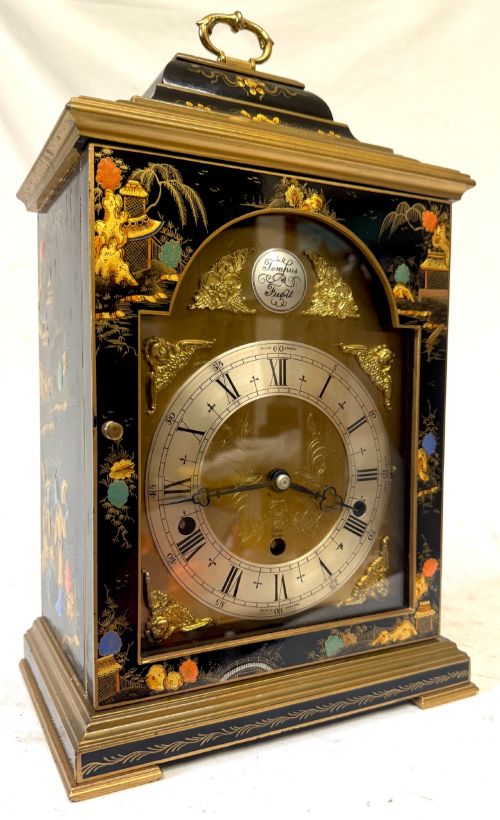
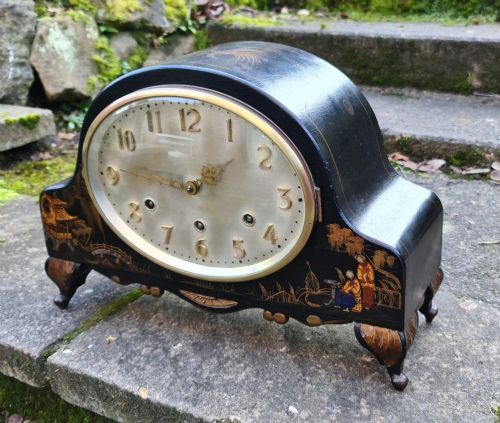
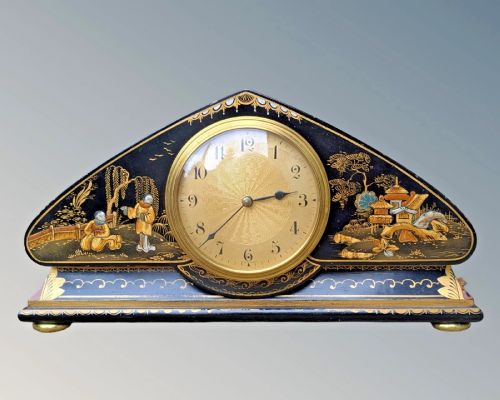
A brass lacquered table clock combines timekeeping with applied lacquer finishes, frequently rendered in the Chinoiserie taste across various centuries. When you search for a brass lacquered table clock, you encounter forms that function primarily as mantel and bracket clocks designed for surface display rather than wall hanging. The selection spans from earlier eighteenth century London bracket clocks to twentieth century mantel pieces in diverse colourways.
The aesthetic leans heavily on decorated casework, including black, cream, green, and red grounds accented with gilt motifs. Many examples adopt historicist revivals, such as seventeenth century styles produced around nineteen hundred alongside Edwardian and Georgian interpretations. These portable timepieces sit on desks, brackets, and mantelpieces, serving as both functional horology and decorative focal points.
How they were made
The construction relies on timber or metal carcases treated with layers of lacquer to achieve smooth, pigmented surfaces. Artisans applied decorative painting, often featuring oriental figures and landscapes in gold, over black, red, green, or cream grounds. Faux tortoiseshell finishes also appear, demonstrating alternative surface treatments applied to the structural body.
Internal movements required precise mechanical engineering, incorporating brass plates, gear trains, and escapements. Enamel dials and silvered metal components provided clear reading surfaces for the hours, whilst brass fittings and bezels framed the glass panels protecting the face. Makers sometimes paired English bracket clock forms with French movements to achieve reliable performance.
Materials recorded across the inventory include brass, glass, wood, lacquered wood, lacquer, enamel, red lacquer, and silvered metal.
What varies in quality
Quality reveals itself in the depth and execution of the lacquer work and hand-painted Chinoiserie detailing. Finer examples display crisp, intricate gilt ornamentation on smooth coloured grounds, whilst simpler pieces show more basic surface decoration. The richness of the colour, whether deep red, glossy black, or subtle green, dictates the visual impact of the case.
Mechanical sophistication marks another distinction between standard production and superior horology. Clocks featuring three train musical movements or striking mechanisms with alarms represent higher complexity than simple time-only models. The integration of quality brass fittings and substantial casework elevates the piece from a decorative accessory to a serious horological object.
Elliott London·James Smith·Chater And Son
The Brass Lacquered Table Clock Glossary
- Bracket clock
- A portable domestic clock originally designed to sit upon a wall bracket or table. They typically feature mechanical movements and substantial decorative cases.
- Chinoiserie
- A European decorative style influenced by Chinese artistic traditions. It employs motifs of figures, pavilions, and landscapes painted or applied onto lacquered furniture and clocks.
- Mantel clock
- A household clock designed to stand on the mantelpiece above a fireplace. These domestic timepieces developed various decorative styles throughout the nineteenth and twentieth centuries.
- Train
- A series of gears in a clock movement that transmits power from the mainspring to the escapement. Clocks with multiple trains can drive striking or musical functions.
- Escapement
- The mechanism within a clock that controls the release of power from the gear train. It converts the rotary motion of the wheels into the ticking impulses that drive the hands.
Brass Lacquered Table Clock: Frequently Asked Questions
What is a bracket clock?
A bracket clock is a portable mechanical timepiece originally built to sit on a wooden wall bracket or a tabletop surface.
These clocks frequently incorporate striking mechanisms and decorative cases finished in wood, veneer, or lacquer.
How do Chinoiserie clocks look?
Chinoiserie clocks feature painted surface decoration inspired by eastern art, typically showing figures, buildings, and natural scenes.
They appear in colours such as black, red, green, and cream with contrasting gilt details.
Where should I place a mantel clock?
Mantel clocks suit flat surfaces like mantelpieces, sideboards, desks, and dedicated wall brackets.
Ensure the location is stable and away from direct heat sources to protect the mechanical movement and lacquered finish.
How do I wind an old clock?
Winding requires a matching key inserted into the dial holes to tension the mainspring inside the movement.
Turn the key gently until resistance is felt, avoiding over-winding to prevent damage to the internal gears.
What causes differences in clock periods?
Clock periods reflect changing design tastes, from eighteenth century Georgian bracket forms to twentieth century revival pieces.
Materials, movement types, and decorative palettes evolved to match the domestic interior styles of each respective era.