




Gilded Carriage Table Clock
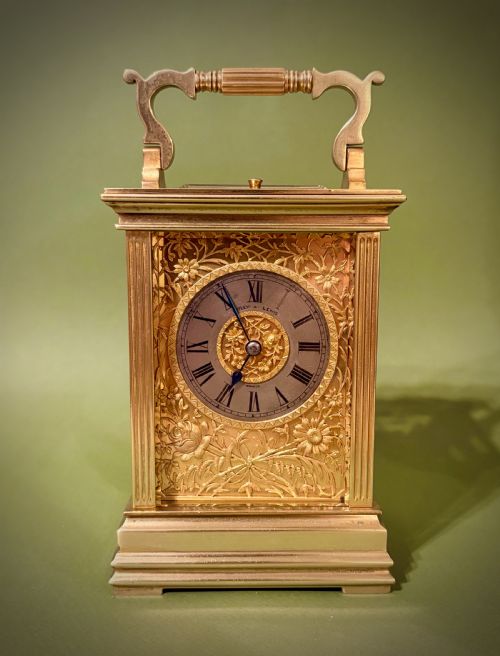
A gilded carriage table clock combines travelling utility with heavy gilt metalwork and glass panels.
Gilded Carriage Table Clock
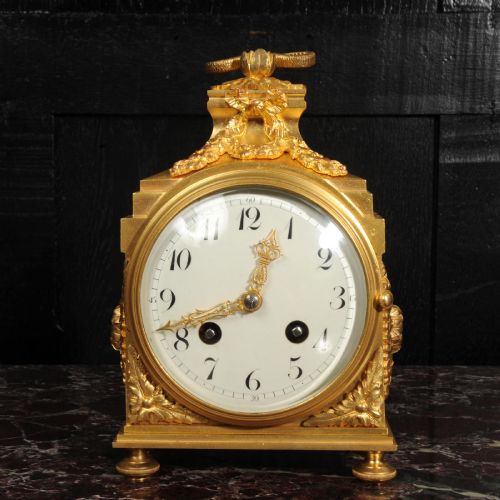
A gilded carriage table clock is a portable timepiece housed in a brass, ormolu, or gilt bronze case with glazed sides. The selection here spans the Victorian era and the late nineteenth century, reaching into the early twentieth century with French carriage clocks and four-glass mantel models.
Most examples originate from French workshops, taking forms such as standard carriage clocks, repeating clocks, and gorge-cased designs with alarm functions. Buyers encounter everything from miniature bedside pieces to large travelling clocks fitted with enamel dials and bronze panels.
Construction and materials
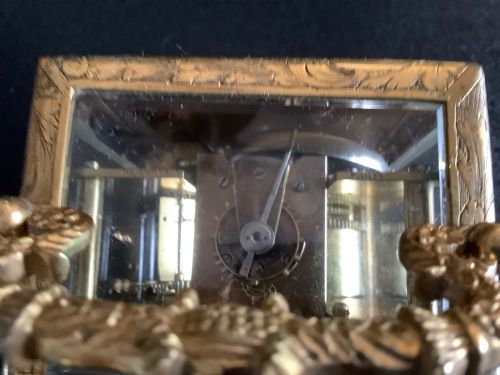
Metalworkers cast brass, ormolu, and bronze into rigid frames, finishing the surface with heavy gilding to produce a brilliant metallic shine. Bevelled glass panels fit snugly into the sides and top, allowing light to illuminate the mechanical movement within.
Dial faces utilise white enamel painted with numerals, often paired with finely blued steel hands. Complex inner mechanisms require precise gear cutting, escapements, and strike or repeat trains housed securely inside the metal chassis.
Listings feature brass, gilt bronze, ormolu, and glass materials across Victorian and late nineteenth-century French periods.
Quality differences
The weight and thickness of the gilt brass or ormolu case separate standard models from high-end pieces. Heavier castings hold crisp chasing and deep relief work better than thinner metals.
Movement complexity dictates upper tiers, particularly clocks featuring strike, repeat, and grande sonnerie functions alongside alarm mechanisms. The clarity of the enamel dial and the presence of signed maker plates also elevate the standing of a piece.
Tiffany·Samuel Marti·Paul Garnier
The Gilded Carriage Table Clock Glossary
- Gorge case
- A distinct carriage clock case style featuring a stepped top moulding and a rounded handle base. This shape became standard for better quality nineteenth-century French travelling clocks.
- Repeating clock
- A timepiece with a mechanism that sounds the last hour or quarter-hour on demand when a pendant or button is pressed. This complication allowed time-checking in the dark.
- Ormolu
- Finely ground gold-mercury amalgam applied to a bronze base, creating a rich golden surface finish. It appears frequently on French nineteenth-century clock cases.
- Pendule d'Officier
- A military-style desk or travel clock featuring a distinctive top carrying handle and a rectangular case. These trace their origins to the Napoleonic period.
- Grande sonnerie
- A complex striking train that chimes both the hours and the quarters automatically as they pass. It represents a high level of horological craftsmanship.
Gilded Carriage Table Clock: Frequently Asked Questions
What is a carriage clock?
A carriage clock is a small, portable spring-driven timepiece originally designed for travellers during the nineteenth century. They feature glass panels on all sides to allow visibility of the movement from multiple angles.
These clocks rely on a balance wheel rather than a pendulum, making them stable enough to run while moving. Most sit within a brass or gilt frame equipped with a sturdy top handle for carrying.
How do repeating mechanisms work?
Repeating mechanisms allow the clock to chime the current time on demand by pressing a button or lever on the case. This complex gear train sounds the hours and quarters without needing to adjust the hands.
Clocks with this feature typically require more intricate inner parts and signal a higher grade of manufacture. They were particularly useful at night before electric lighting became common.
How do I date a French clock?
Dating relies on stylistic clues, case proportions, dial signatures, and movement stamps left by the maker. Nineteenth-century pieces often display specific casting styles, such as Rococo Revival motifs or plain gorge frames.
Makers frequently stamped their backplates with exhibition medals or serial numbers that anchor their production to specific decades. Comparing the escapement type and dial enamel also helps narrow the manufacturing period.
Where should I place a carriage clock?
Carriage clocks suit stable, level surfaces such as mantelpieces, desks, or bedside tables where they remain free from vibration. Avoid spots exposed to direct sunlight, dampness, or extreme temperature shifts that could affect the delicate enamel and metalwork.
Because they were built to be portable, they occupy little space while adding a formal nineteenth-century accent to a room. Ensure the key or winding mechanism remains accessible wherever you station it.