





Brass Gallery Etagere
A brass gallery etagere brings tiered display space and polished metalwork to a room, offering elegance alongside practical surface area.
Brass Gallery Etagere
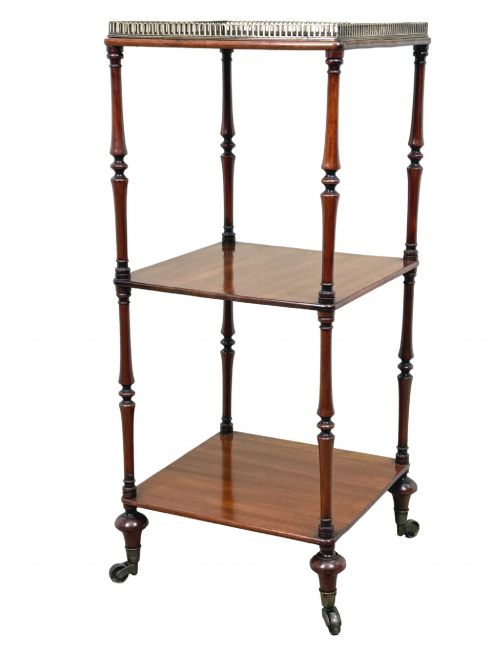
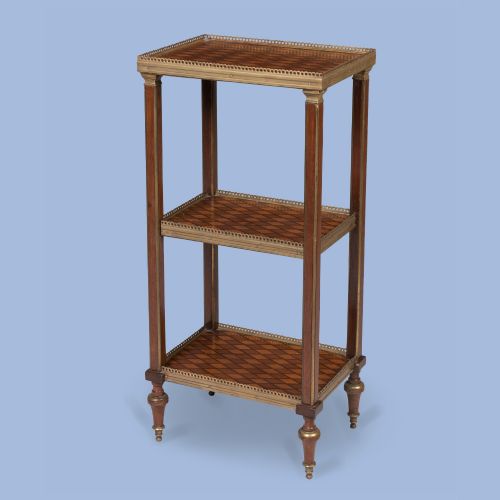
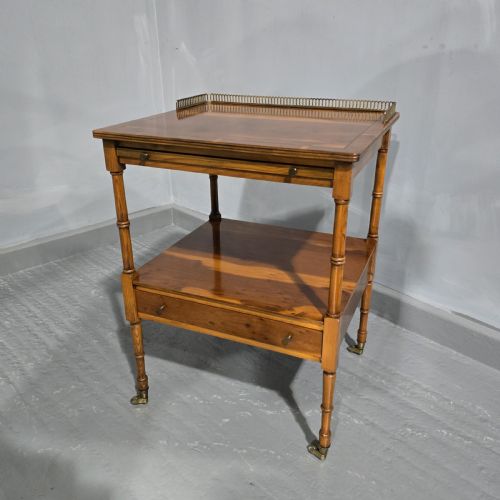
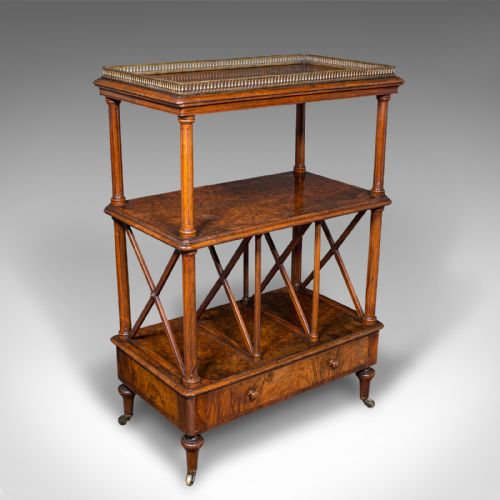
A brass gallery etagere provides open tiered shelving topped with a delicate pierced metal border, serving as an etagere, whatnot, or display stand. These open furniture pieces function as side tables, occasional tables, or lamp tables within a room.
The versions met most frequently on this page date from the nineteenth century, including Victorian, Regency, Edwardian, and periods up to nineteen-twenty. They draw upon French Napoleon III, Louis XV style, Louis XVI, and Regency Revival aesthetics.
Makers and workshops across England and France constructed these multitiered pieces to hold books, ornaments, and drinks. The inclusion of a brass gallery protects displayed items from sliding off the edge of each tier.
How they were made
Cabinet makers utilised dense hardwoods such as mahogany, walnut, rosewood, amboyna, yew, and ebonised wood to build the tiered frameworks. Marquetry veneer and intricate inlays frequently decorate the surfaces of these items.
Metalworkers cast and shaped brass mounts, ormolu, and gilt metal to create the signature gallery rails encircling the shelves. Glass panels and marble tops also appear across the surviving pieces on this page.
Listings feature woods spanning mahogany, walnut, rosewood, amboyna, and yew, alongside ebonised finishes and marquetry veneer.
What varies in quality
The fineness of the marquetry inlay and the crispness of the cast brass gallery distinguish superior examples from simpler utilitarian pieces. Wood selection, such as figured walnut or rich mahogany, dictates the visual depth of the tiers.
Proportion and the integration of secondary materials, including marble tops or mirrored backs, separate standard production from masterwork French and English pieces.
Donald Ross
The Brass Gallery Etagere Glossary
- Brass gallery
- A low, pierced metal railing surrounding the edge of a shelf to keep objects secure. This decorative border defines the primary aesthetic of the pieces listed here.
- Etagere
- A piece of furniture consisting of a set of open shelves for displaying small objects or ornaments. These tiered stands emerged in France during the eighteenth century.
- Whatnot
- A nineteenth-century multi-shelved stand used for storage or display in a drawing room. The terms etagere and whatnot often overlap in period descriptions.
- Marquetry
- Decorative woodwork where pieces of veneer are fitted into a ground to form ornamental patterns. Makers utilised this technique on tabletops and shelves.
- Ormolu
- Gilt bronze or brass mounts applied to furniture for decorative effect. French nineteenth-century pieces frequently incorporate these metallic ornaments.
Brass Gallery Etagere: Frequently Asked Questions
What is a brass gallery etagere used for?
These multitiered pieces serve primarily as display stands for ornaments, books, or small decorative items in a drawing room or parlour. The open shelves allow light to pass through while keeping objects organised across multiple levels.
Historically, they also functioned as lamp tables, side tables, or drinks tables in reception rooms. The surrounding metal rail ensures that items remain safely on each shelf.
How do I identify a Victorian etagere?
Victorian examples frequently draw upon French styles such as Napoleon III or Louis XV, utilising woods like rosewood, walnut, and ebonised timber. They often feature detailed marquetry inlay and cast brass mounts.
Earlier Regency pieces tend to rely on solid mahogany or yew wood with cleaner architectural lines. Examining the timber grain and the method of veneer application helps determine the manufacturing era.
What is the difference between an etagere and a whatnot?
While both terms describe multi-shelved open furniture, an etagere often leans toward French decorative design with refined metal mounts and marquetry. A whatnot is a traditional English term for a similar tiered stand used for general display.
In practice, makers and dealers used both names interchangeably throughout the nineteenth century. The presence of a brass gallery remains the unifying feature across these variants.
Where should I place an etagere in my home?
An etagere suits corners, wall spaces, or positions beside seating where its open tiers add height and display capacity without blocking light. Smaller tabletop versions sit comfortably upon larger cabinets or desks.
Because these pieces feature finished detailing on multiple sides, they integrate smoothly into living rooms and hallways as occasional tables.