




Brass Gallery Davenport Desk
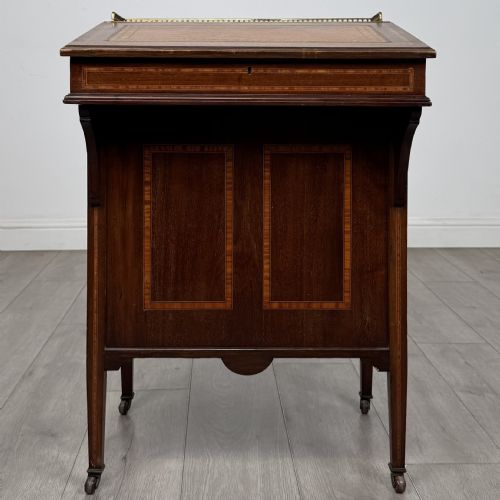
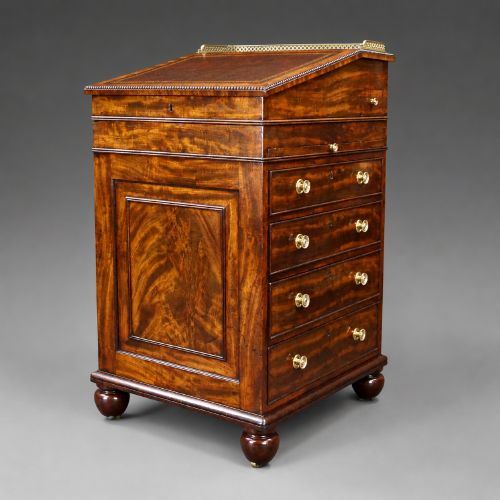
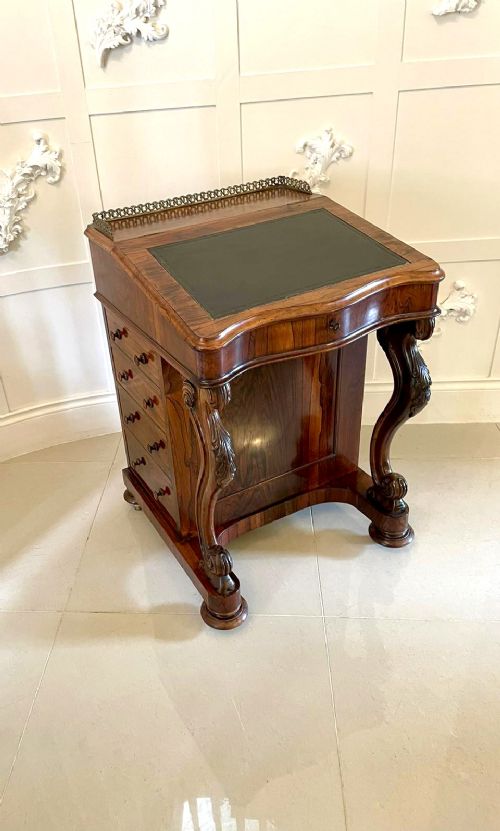
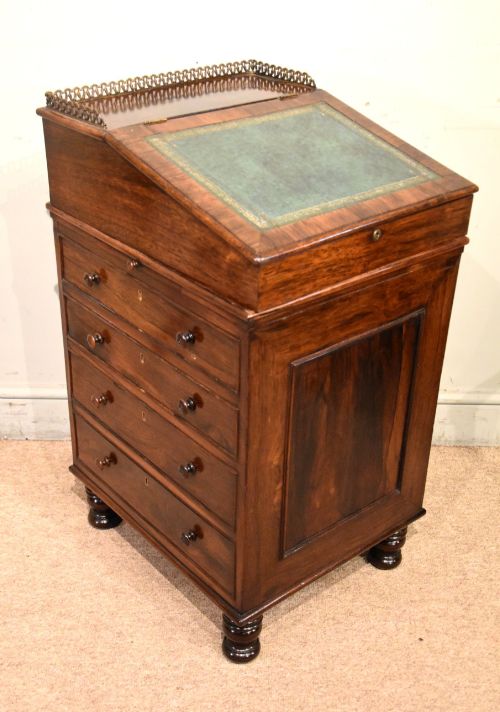
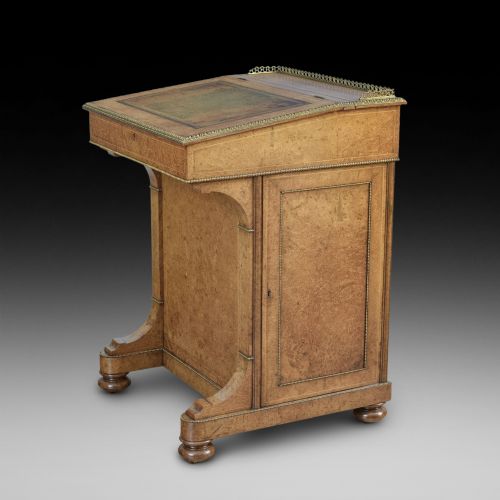
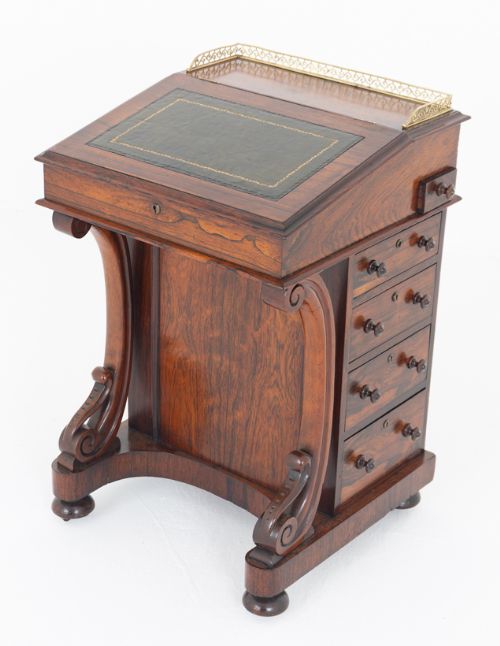
A brass gallery davenport desk is a compact writing cabinet fitted with a decorative rail, offering a superb combination of private storage and writing surface.
Brass Gallery Davenport Desk
A brass gallery davenport desk provides a sloping writing surface above a set of drawers, designed primarily for personal correspondence and home administration. These charming small desks emerge most frequently from the Regency and Victorian periods, carrying the hallmarks of 19th-century cabinet making.
The defining feature of a brass gallery davenport desk is the decorative metal rail mounted on top, which prevents inkwells and writing implements from sliding off the superstructure. Rosewood, mahogany, and burr walnut form the main bodies of these pieces, often paired with leather writing inserts.
Buyers encounter examples ranging from simple Georgian prototypes to elaborate late Victorian iterations featuring amboyna and pollard oak. Freestanding versions and those with sliding tops appear regularly across the selection.
How they were made
Cabinet makers utilised dense timber foundations such as mahogany and rosewood, applying veneers of burr walnut, amboyna, or pollard oak to create richly figured exterior surfaces. These woods were hand-polished to accentuate the natural grain patterns.
Cast brass components, including pierced galleries and drawer handles, were fitted to secure the upper deck and provide functional hardware. Leather writing slopes were typically tooled with gilt borders to finish the work surface.
Some desks hide secret compartments for private correspondence behind the seemingly ordinary stationary drawers.
What varies in quality
The distinction between standard and superior pieces rests on the choice of timber veneer and the crispness of the brass fittings. Finely pierced galleries and meticulously matched burr walnut or rosewood veneers indicate higher workshop standards.
Interior configuration also sets pieces apart, such as secondary drawers lined in burr maple or fitted with original keys. The precision of the joinery in the sliding mechanisms and internal pigeonholes reveals the original maker's skill.
Gillows
The Brass Gallery Davenport Desk Glossary
- Brass gallery
- A decorative openwork metal rail fitted to the top shelf or superstructure of a desk to secure small objects. It is usually cast or pierced.
- Crossbanded
- A border technique where thin strips of veneer are laid around the perimeter of a panel so the grain runs perpendicular to the centre.
- Superstructure
- The raised compartment or stationery box mounted on the rear upper section of the desk, often enclosed by a lid or fitted with pigeonholes.
- Sliding top
- A mechanism allowing the writing slope to advance forward independently of the main pedestal, providing extra legroom for the writer.
Brass Gallery Davenport Desk: Frequently Asked Questions
How do I use a davenport desk today?
A brass gallery davenport desk functions well as a laptop workstation or a dedicated spot for letter writing in a study or sitting room.
The sloping lid opens to reveal interior pigeonholes, while the side drawers keep stationery and small accessories neatly organised out of sight.
What period are most davenport desks from?
The majority of pieces date from the Regency and Victorian eras, spanning the early to late 19th century.
Earlier Georgian examples appear less frequently, while late Victorian models extend into the final decades of the 1800s.
Are davenport desks freestanding?
Many examples are designed to be viewed from all sides, featuring dummy drawers on the reverse to allow placement in the centre of a room.
Other variations are intended to sit flush against a wall, with plain backboards concealing the structural joinery.
How do I care for the leather writing surface?
The leather slope requires protection from direct sunlight and excessive moisture to prevent the gilt tooling and hide from drying out.
A light application of appropriate leather cream helps maintain suppleness and preserves the finish over time.