
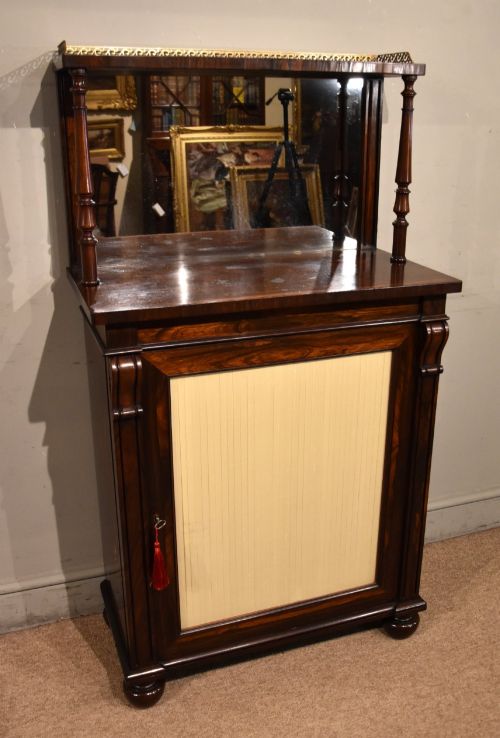
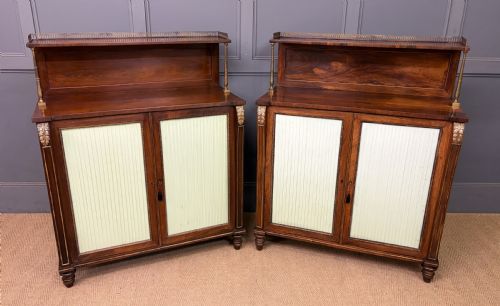
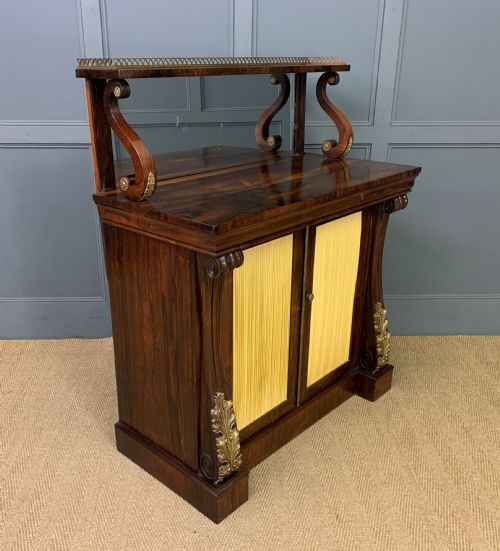
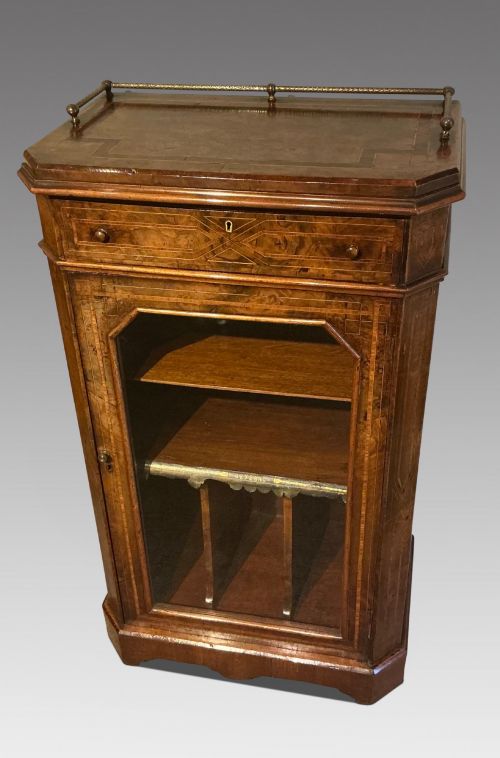


Brass Gallery Credenza
A brass gallery credenza brings refined storage to a room, offering both surface display and concealed shelving.
Brass Gallery Credenza
A brass gallery credenza unites the functional storage of a side cabinet or chiffonier with the distinctive perimeter rail known as a brass gallery. Buyers seeking this combination will find pieces spanning the Georgian, Regency, Victorian and Edwardian eras.
Makers and designers from these periods utilised rich timbers including amboyna, satinwood, and burr walnut, creating sophisticated furniture designed for dining rooms and drawing rooms alike.
Materials and construction methods
Cabinet makers built these pieces using solid and veneered hardwoods like mahogany, rosewood, and walnut, often applying boxwood inlay, marquetry, or parcel gilding to enhance the surface grain.
The characteristic brass gallery was fitted securely to the upper surface, accompanied by brass mounts, grilles, or stringing that contrasted with the dark timbers.
Secondary elements include marble tops, leather details, and specialised internal compartments such as writing drawers or music storage.
Listings feature woods spanning mahogany, rosewood, satinwood, burr walnut, and amboyna.
Evaluating craftsmanship and execution
The distinction between standard execution and superior work rests on the selection of timber figures and the precision of the inlay, such as fine boxwood stringing or complex marquetry.
Quality shows in the weight and finishing of the brass gallery and mounts, alongside the seamless integration of secondary materials like marble or leather.
Design complexity also elevates a piece, distinguishing simple sideboards from elaborate breakfront cabinets, secretaires, or pieces bearing attribution to notable workshops.
Gillows·John McClean·Edwards and Roberts·Howard And Sons·H Mower And Stephenson
The Brass Gallery Credenza Glossary
- Brass gallery
- A low metal rail fitted around the top surface of a sideboard or credenza to prevent items from sliding off. It typically consists of slender brass spindles supporting a top rail.
- Marquetry
- The art of applying pieces of veneer to a structure to form decorative patterns. Craftsmen used various tinted woods to create elaborate pictorial or geometric designs.
- Breakfront
- A cabinet design where the central section projects forward from the flanking sides. This architectural arrangement creates depth and visual balance on large sideboards.
Brass Gallery Credenza: Frequently Asked Questions
What is a brass gallery credenza used for?
These pieces served traditionally in dining rooms and parlours for storing china, linen, and silverware while providing a surface for serving food or displaying decorative objects.
Today, they function well in living spaces as media consoles, display units, or sophisticated storage cabinets that anchor a room's design.
How do I distinguish Regency from Victorian pieces?
Regency pieces often display restrained classical lines, rosewood veneers, brass inlay, and parcel gilding characteristic of the early nineteenth century.
Victorian examples tend to be heavier in proportion, frequently utilising burr walnut or mahogany with more exuberant carving and varied internal fittings.
Are brass galleries removable?
Galleries were constructed as permanent fixtures attached securely to the top surface of the cabinet during its manufacture.
Attempting to remove them can leave visible fixing holes in the timber or marble top, altering the original integrity of the piece.
How should I care for rosewood and mahogany surfaces?
Maintain the timber by keeping the cabinet away from direct sunlight and steady heat sources to prevent the veneer from drying or cracking.
Dust regularly with a dry, soft cloth and apply occasional high-quality beeswax to nourish the grain without buildup.