


Brass Desk Casket
A brass desk casket brings order to a writing desk, combining solid timber with metal mounts to secure correspondence and papers.
Brass Desk Casket
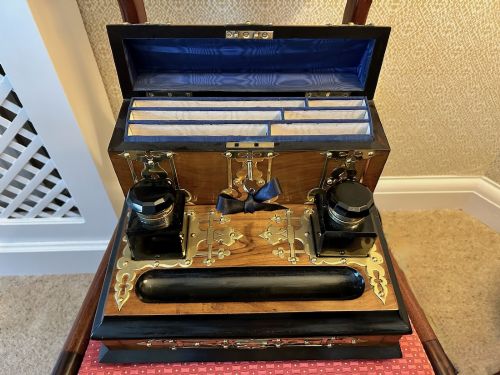
A brass desk casket is a sturdy tabletop container designed to hold stationery, letters, or small documents within a workspace. These pieces emerge predominantly from nineteenth-century workshops, spanning Georgian, Regency, and Victorian periods.
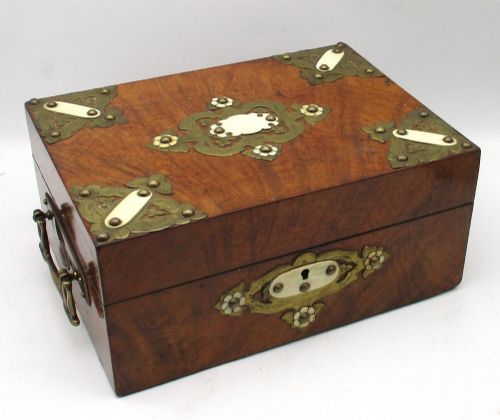
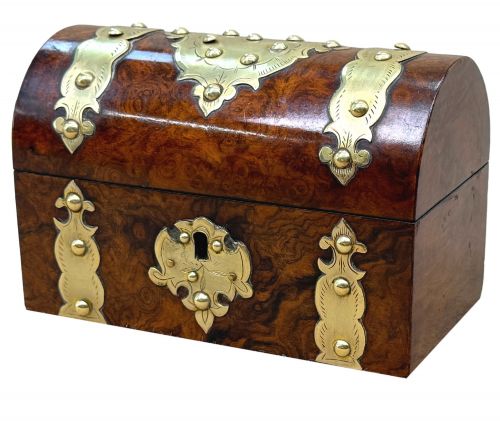
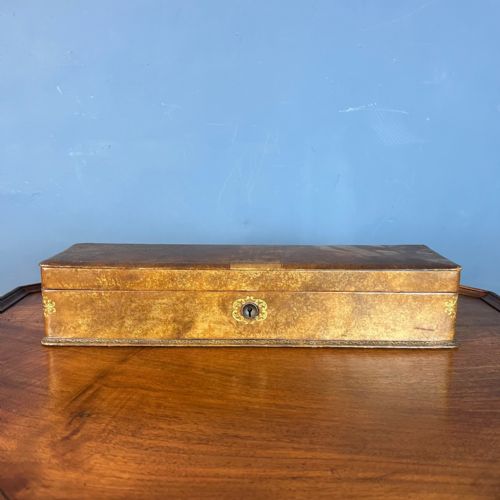
The versions most commonly met on this page combine timber carcasses with brass banding, corner braces, or decorative inlays. They appear in forms ranging from slant-front stationery boxes and domed letter cases to flat document chests.
Makers utilised dense hardwoods like burr walnut, rosewood, oak, and coromandel to build these receptacles. The addition of metal mounts gave structural strength and visual contrast to the polished wood surfaces.
Materials and Construction
Cabinet makers constructed the foundational boxes from native and exotic timbers, selecting figured veneers like burr walnut, amboyna, and pollard oak for decorative impact. Solid oak and mahogany also served for robust, utilitarian desk pieces.
Brass formed an essential structural and decorative element, appearing as flush corner straps, heavy escutcheons, and precision-cut inlay. Craftsmen set the metal flush into the wood surface or mounted it with small brass pins to reinforce corners against splitting.
Some nineteenth-century boxes hide secret push-button spring drawers beneath the stationery dividers for private notes.
Distinctions in Quality
Quality rests primarily in the selection of timber veneers and the precision of the metalwork. Superior examples display carefully matched wood grain across the lid and sides, whilst lesser pieces rely on plain timber planks.
The execution of the brass mounts also separates grades of work. Hand-engraved banding, tight joints, and well-fitted internal stationery dividers indicate skilled workshop production rather than hurried assembly.
C.G. Hope Hastings
The Brass Desk Casket Glossary
- Escutcheon
- A protective plate surrounding a keyhole, often cast or engraved in brass. It prevents the wood around the lock from splitting during daily use.
- Stationery Box
- A desk accessory fitted with stepped internal dividers to hold envelopes and writing paper upright. These containers often feature sloping lids or double doors.
- Coromandel
- A dense, heavily figured southeast Asian timber with dark brown and black streaks. Cabinet makers favoured it for high-status Victorian desk accessories.
- Ormolu
- Gilded bronze used for decorative mounts and feet on French and English boxes. It provides a bright golden contrast against dark timbers.
- Pietra Dura
- An inlaid technique using polished, cut coloured stones to form decorative pictures. On boxes, these stone panels are typically set directly into the lid.
Brass Desk Casket: Frequently Asked Questions
What went inside a desk casket?
These boxes held folded letters, writing paper, envelopes, and small sealing wax implements. They kept private correspondence tidy on a shared library table.
Larger versions accommodated folded foolscap documents and receipt books. Interior partitions kept different sizes of paper separated.
How do I date a brass box?
Dating relies on timber choice, lock design, and construction methods. Regency pieces often show precise brass stringing in rosewood, whilst mid-Victorian examples favour heavy corner straps on burr walnut.
Secondary woods inside the box, such as mahogany or pine drawer linings, also offer clues to the period of manufacture.
Were these boxes portable?
Many examples include recessed brass side handles for lifting or carrying between rooms. They functioned as portable writing desks or document chests for travellers.
Heavier stationery boxes designed for permanent desk placement omitted these carrying handles in favour of fixed decorative mounts.
Why use coromandel wood?
Coromandel offered exceptional hardness and dramatic dark grain patterns that appealed to wealthy nineteenth-century buyers. It resisted heavy wear on busy desks.
Because the timber became scarce, its presence usually indicates a high-grade commission with superior brass fittings.