




English Stationery Box
An English stationery box organises correspondence with period elegance, offering a refined desktop focal point for the modern study.
English Stationery Box
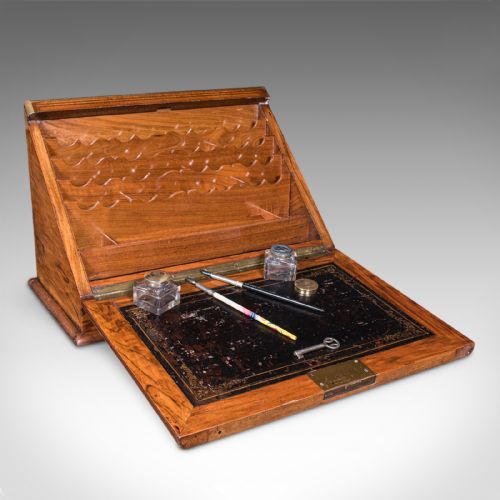
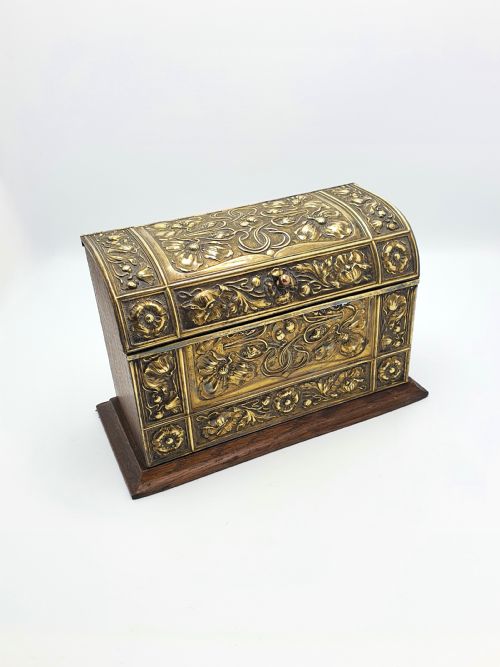
An English stationery box serves as a dedicated receptacle for letters, envelopes, and writing paper, appearing primarily across Victorian, Georgian, and Regency periods. The most common iteration encountered on this page is the walnut tabletop cabinet, often featuring a sloping front or a domed lid designed to house daily correspondence.
The historical scope spans the eighteenth century through the Edwardian era, capturing shifts in domestic administration and writing habits. Pieces frequently integrate related desk accessories, linking letter storage directly to slopes and inkstands.
Materials and Construction
Cabinetmakers constructed these pieces using dense timber frameworks of oak, walnut, or mahogany, frequently veneered with highly figured burr walnut, rosewood, or satinwood. Surface decoration often involved brass banding, inlaid Tunbridge ware, tortoiseshell, or boullework panels applied to the exterior carcase.
Interiors typically relied on fitted wooden partitions, leather-lined document sleeves, and glass inkwells, occasionally enhanced by hand-painted porcelain plaques or agate cabochons. Joinery methods matched the domestic standards of the period, employing sturdy dovetails and brass hardware to secure opening flaps and fall-front lids.
Certain Victorian boxes take the literal architectural form of miniature village post offices, complete with letter slots.
Assessing Quality and Execution
The distinction between standard examples and superior pieces rests on the choice of timber and the precision of decorative inlays. Finer items exhibit deeply figured burr walnut or meticulously matched satinwood veneers, whereas basic versions utilise plain oak or mahogany.
Maker attribution elevates an object, with branded pieces from established London firms demonstrating superior interior engineering and heavier brass mounts. The complexity of the mechanism, such as metamorphic rotating actions or integrated pull-out writing surfaces, also marks the upper tier of production.
Mappin and Webb·Gillows of Lancaster·Houghton and Gunn·Leuchars London·Chapman London·Briggs Piccadilly London
The English Stationery Box Glossary
- Writing slope
- A portable desk featuring a hinged, sloped writing surface that opens to reveal storage compartments for paper and ink. These items frequently double as stationery repositories.
- Fall-front
- A hinged front panel that drops downward to provide access to interior letter slots and pigeonholes. This configuration is standard on many tabletop stationery cabinets.
- Tunbridge ware
- A meticulous form of woodwork utilising thousands of tiny tinted wood blocks to create mosaic geometric or pictorial designs. It appears commonly on nineteenth-century box lids.
- Boulle
- An elaborate marquetry technique incorporating tortoiseshell and engraved brass, named after a French cabinetmaker but widely adopted in English Victorian design.
- Campaign box
- A sturdy wooden box fitted with flush brass handles and corner reinforcements, built for military travel and field use.
English Stationery Box: Frequently Asked Questions
How were stationery boxes used?
These boxes kept writing paper, envelopes, and incoming letters neatly sorted on a desk or table before the widespread use of manufactured envelopes and postal services.
Owners opened the fall front or lifted the lid to access partitioned compartments designed specifically for different sizes of correspondence.
Are these boxes suitable for modern desks?
Their internal compartments accommodate modern correspondence, cards, and small notebooks just as effectively as nineteenth-century paper stocks.
Placing one on a modern desk introduces period timber tones and conceals everyday clutter inside a structured wooden cabinet.
How do I tell a Victorian box from a Georgian one?
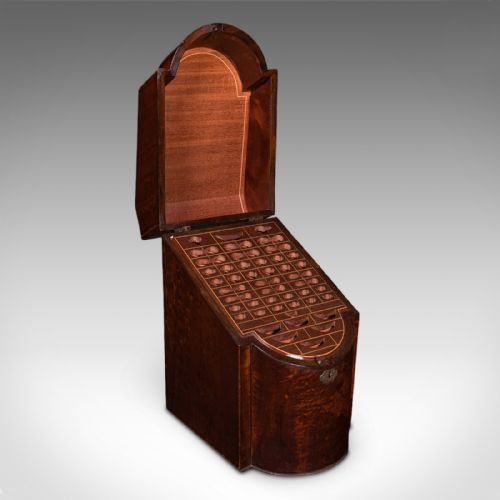
Georgian examples tend to display simpler linear forms in oak or mahogany, occasionally seen as converted knife boxes with sharp geometric angles.
Victorian pieces frequently favour heavily figured burr walnut, elaborate brass mounts, boullework, and complex domed or fall-front configurations.
What is the difference between a stationery box and a writing slope?
A writing slope opens to provide an inclined writing surface lined with leather for drafting letters directly on the closed box.
A stationery box functions primarily as a stationary storage cabinet for paper and envelopes rather than a portable writing desk.