
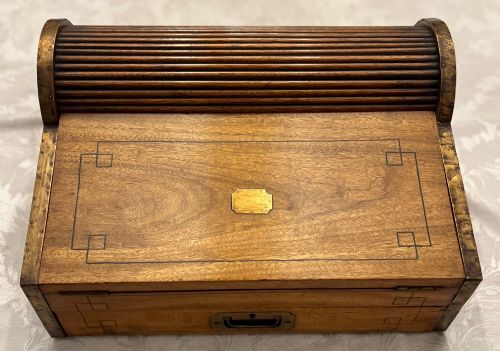
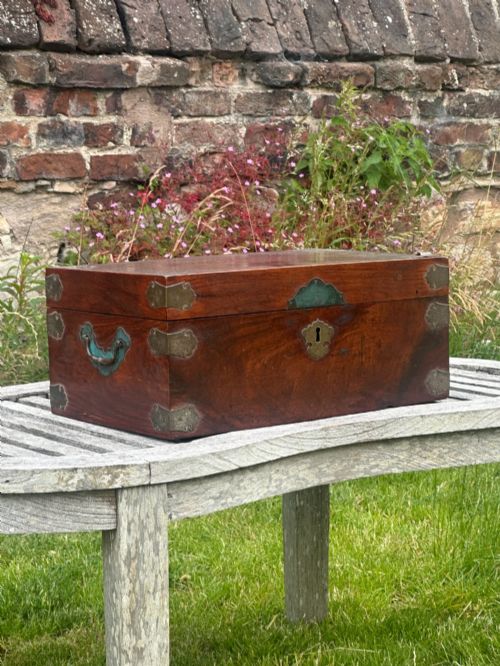
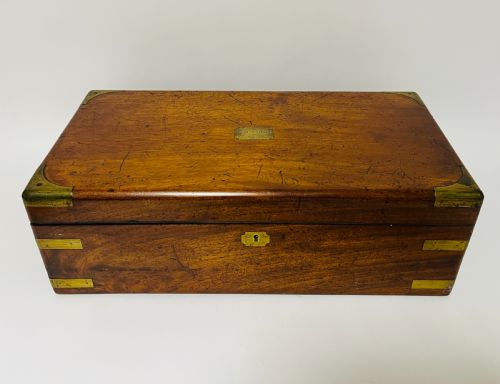


Brass Corner Writing Box
A brass corner writing box is a portable desk reinforced for travel, offering secure storage and a firm writing surface for the road.
Brass Corner Writing Box
A brass corner writing box combines practical portability with sturdy construction, designed to travel safely across rooms or continents. When searching for a brass corner writing box, buyers encounter examples originating from the Georgian and Victorian eras, alongside military campaign styles.
The selection on this page consists principally of writing slopes, writing boxes, and desk boxes. These objects take the form of timber cases fitted with metal mounts to protect the edges and corners during transit.
Materials span mahogany, walnut, padouk, camphorwood, and oak, often paired with fitted leather writing surfaces. Certain pieces incorporate secret drawers or function as metamorphic lap desks and lecterns.
How they were made
Cabinetmakers constructed these boxes using dense timbers such as mahogany, walnut, and padouk, selected for their stability and durability. Solid boards formed the structural carcase, shaped into slopes and rectangular desk boxes.
Brass corners, straps, and mounts were let flush into the timber and secured with small screws to absorb the knocks of travel. Interior compartments and secret drawers required precise joinery to fit neatly within the sloping or flat lids.
Several boxes hide secret drawers beneath internal fittings, designed to guard private correspondence from curious eyes.
What varies in quality
The choice of timber sets the baseline for quality, with highly figured walnut and dense padouk sitting above plain utility woods. Finer boxes display tighter dovetail joints and more ambitious interior engineering, such as hidden compartments or metamorphic mechanisms.
The weight and finish of the brass hardware also divide the standard of production. Substantial brass corners and flush-fitting mounts indicate a more careful original commission than thin, poorly set corner plates.
Fisher
The Brass Corner Writing Box Glossary
- Writing slope
- A box with an angled lid designed to hold paper and provide an inclined surface for handwriting.
- Campaign box
- Furniture built in sections or reinforced with metal mounts for military officers on the move.
- Padouk
- A heavy, durable tropical hardwood with a reddish tone, often found in Anglo-Indian pieces.
- Metamorphic lap desk
- A portable writing box that transforms or unfolds into different configurations for reading or writing.
Brass Corner Writing Box: Frequently Asked Questions
What is a brass corner writing box?
A portable desk reinforced with metal corners to protect the wood during travel. These boxes open to reveal compartments for ink, pens, and stationery.
They served travellers, officers, and writers who needed a reliable desk away from a fixed household study.
How were these boxes used?
Owners used them to store correspondence, documents, and writing materials while keeping a firm writing surface on their lap or a table.
The sloping lid positioned paper at a comfortable angle for handwriting using dip pens and liquid ink.
How do I date a writing box?
Dating relies on timber choice, construction methods, and the style of the brass mounts and escutcheons. Georgian and early nineteenth-century pieces often display simpler, heavier proportions than later Victorian examples.
Secondary woods inside the box and the style of interior drawers also help narrow down the period of manufacture.
What woods were used?
Cabinetmakers utilised sturdy hardwoods including mahogany, walnut, oak, camphorwood, and padouk. Figured veneers were frequently applied to the exterior lids for decorative effect.
Softer secondary woods like pine or cedar typically lined the interior compartments and secret drawers.