

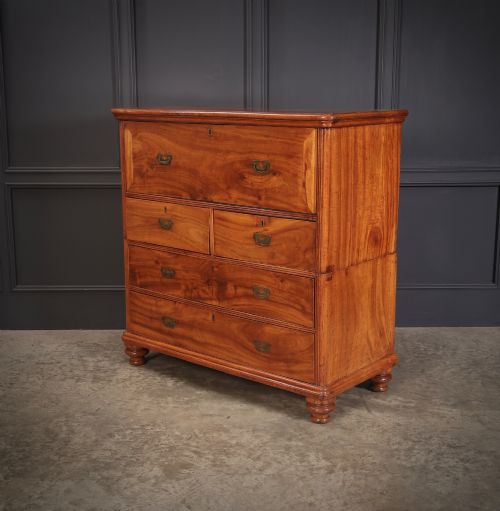

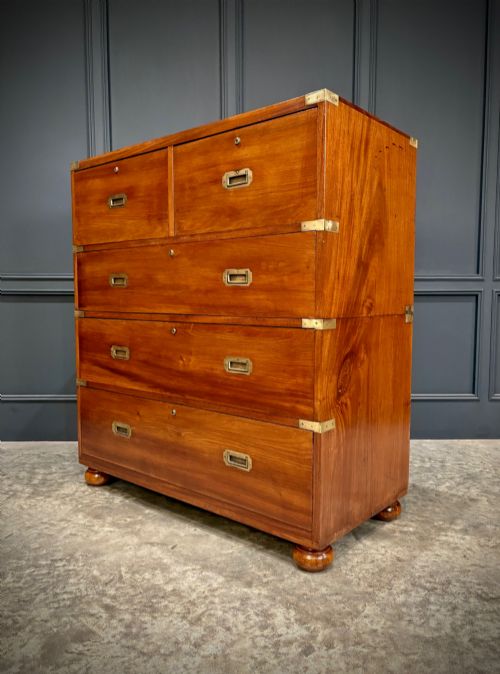
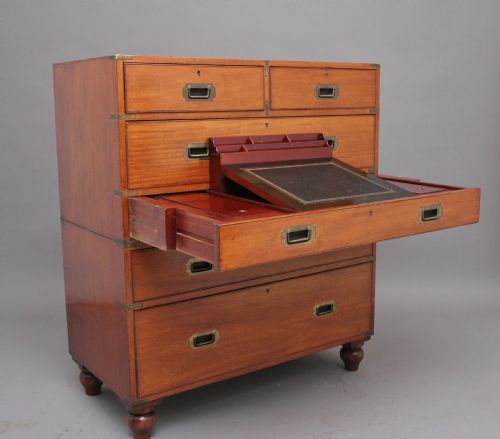


Brass Bound Secretaire
A brass bound secretaire is a sturdy travelling cabinet combining drawers and a fitted writing drawer, built for officers on the move.
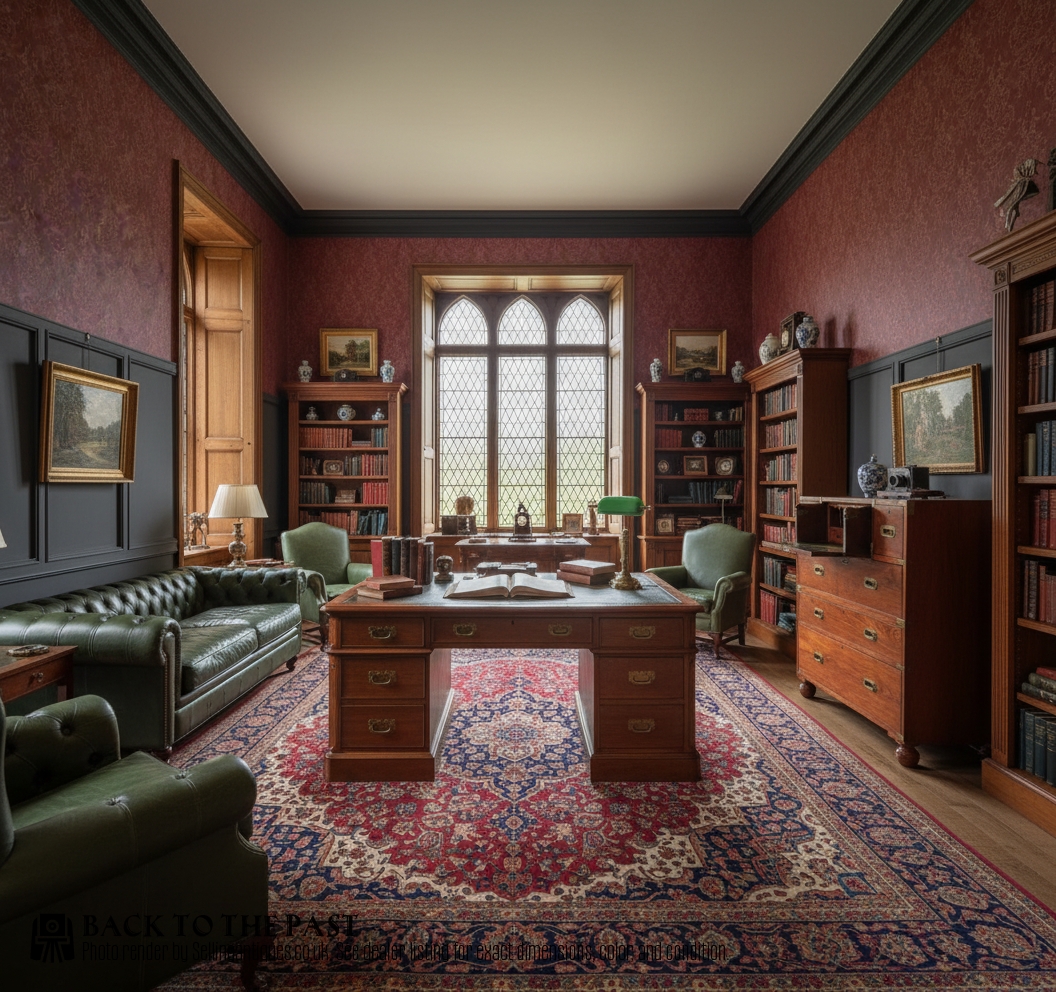
Brass Bound Secretaire
When you search for a brass bound secretaire, you are looking at campaign furniture designed to separate into two or more stacking sections for travel. These pieces typically take the form of a chest of drawers or a bureau, featuring a central drawer that drops down to reveal a writing surface and small internal pigeonholes.
The versions you are most likely to meet on this page hail from the nineteenth century and the Victorian era, particularly in styles labelled as military campaign, Anglo-Indian, or British colonial. They were constructed to withstand rigorous movement, equipped with flush recessed brass handles and corner brackets to protect vulnerable edges from knocks.
Most examples appear in dense timbers suited to distant postings, configured as modular chests where the upper secretaire section locks securely above lower drawer compartments. They bridge the gap between portable field equipment and refined domestic furniture, offering exceptional internal organisation within a robust exterior shell.
What Varies in Quality
Quality rests heavily on the choice of timber and the precision of the brass work, where tightly fitted mounts and dense, figured woods distinguish finer examples from standard utility pieces. The execution of the secretaire interior - ranging from simple shelves to intricate nest drawers with secret compartments - demonstrates the maker's skill.
Structural integrity also depends on the quality of the internal dust boards and the seamless joining of the sectional carcases. Superior pieces maintain crisp brass edges and smooth drawer actions even after decades of travel and environmental shifts.
Brass Bound Secretaire Retail Price Guide 2026
Typical asking prices for brass bound secretaire among the pieces listed under this phrase on Sellingantiques today, from the lower quarter to the upper quarter. They describe what is for sale here now, not the wider market.
The listings on this site span the nineteenth century, featuring timbers such as teak, camphor wood, mahogany, and rosewood.
Captain Fairbrother
The Brass Bound Secretaire Glossary
- Campaign furniture
- Portable furnishings built for military officers or colonial administrators on the move, characterised by sectional construction and protective metal hardware.
- Secretaire
- A desk or a cabinet featuring a pull-down or drop-front writing flap that conceals small drawers and pigeonholes.
- Flush mount
- Hardware such as a handle or bracket set directly into a recessed channel so that it does not project beyond the surface of the wood.
- Two-piece chest
- A modular cabinet built in stacked upper and lower halves designed to separate easily for packing and transit.
- Pigeonhole
- A small compartment within a desk or bureau used for sorting letters and papers.
Brass Bound Secretaire: Frequently Asked Questions
What is a brass bound secretaire?
A brass bound secretaire is a portable campaign chest featuring a drop-front writing drawer reinforced with brass corners and straps.
These pieces were constructed in sections so military officers could pack and transport their private desks during colonial postings.
How do you use a campaign secretaire?
The central section pulls down on hinges to create a writing ledge, while internal compartments organise letters, inkwells, and stationery.
Lower drawers provide generous storage for clothing or documents, functioning as a complete chest and desk combined.
How do I date a campaign chest?
Nineteenth-century examples display specific timber choices like camphor wood and teak, alongside hand-cut dovetails and solid brass corner mounts.
Victorian pieces often include registration marks or specific brass hardware designs characteristic of mid-century military supply.
Where should I place one at home?
These compact, flat-topped chests fit well in studies, living rooms, or hallways where their rich timbers and brass details add character.
Because they were designed to be freestanding and finished on all prominent sides, they do not require placement directly against a wall.