


Bracket Wall Clock
A bracket wall clock brings historic timekeeping and architectural presence to a room, combining precision mechanics with substantial cabinetry.
Bracket Wall Clock
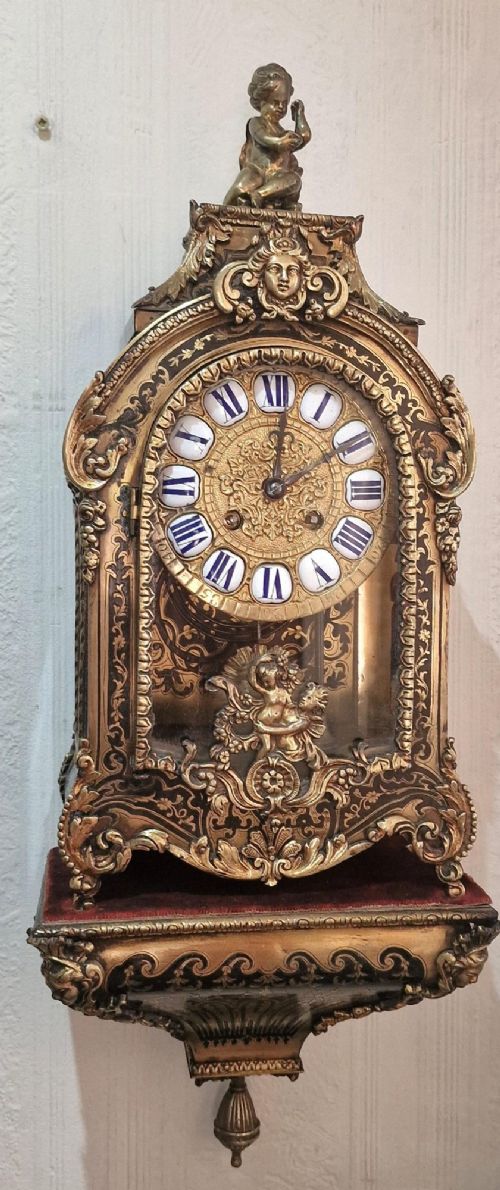
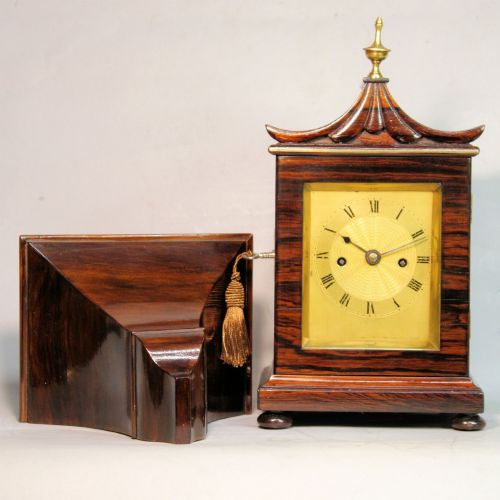
A bracket wall clock is an item of horology designed to sit on a matching wall shelf or be mounted directly onto a wall. These pieces bridge the gap between freestanding mantel clocks and traditional wall dials, often utilising matched wooden brackets to support their weight.
The versions met most frequently on this page span the Georgian, Victorian, and later nineteenth-century periods. They include English fusee movements in mahogany and rosewood alongside ornate French boullework and ormolu designs.
Beyond standard timepieces, the selection encompasses lantern clocks, hooded wall clocks, and miniature library pieces. Many retain their original wall brackets, preserving the complete ensemble intended by the maker.
How they were made
Cabinetmakers constructed the cases using dense hardwoods such as mahogany, walnut, and rosewood, frequently incorporating brass inlay, tortoiseshell, or ebonised finishes. French examples often deploy complex ormolu mounts and elaborate boulle marquetry across timber carcasses.
Mechanical construction relies on fusee movements to maintain even tension as the mainspring unwinds, ensuring accurate timekeeping. Dials feature hand-painted enamel, convex glass, and detailed brass bezels suited to the domestic interiors of the eighteenth and nineteenth centuries.
Some nineteenth-century French bracket clocks feature tortoiseshell cases that require careful polishing to maintain their amber glow.
What varies in quality
Quality rests in the harmony between the clock movement and its housing. Examples featuring signed movements by notable makers coupled with matching original wall brackets represent the upper tier of craftsmanship.
Cabinetwork precision and the preservation of original decorative elements dictate value. Pieces displaying crisp brass work, undamaged enamel dials, and intact veneer maintain greater integrity than heavily restored alternatives.
John Spershott of Titchfield·Henri Marc of Paris·Cording of London·Connell of London·Henry Deykin Worcester·Thomas Connold of Alysham·J. A. Wheatley Carlisle·John Seddon of London·J.W. Benson·Valiant Paris·Lenzkirch·Armstrong of Manchester·Vincenti and Cie·F B Adams of London·James Ritchie of Edinburgh·James Lindley of London·Arsandaux of Paris·Rossiter Weston-Super-Mare·Edward Fussell Brighton·William Coxhead of Reading·Martinot of Paris·Henri Dasson
The Bracket Wall Clock Glossary
- Fusee
- A conical pulley used in mechanical clocks to equalise the torque of the mainspring as it winds down. This mechanism ensures consistent force is delivered to the escapement throughout the running period.
- Boulle
- A form of marquetry developed in France using brass and tortoiseshell inlaid in counter-changed patterns. It is frequently seen on nineteenth-century French cases.
- Ormolu
- Gilded bronze used for decorative mounts and accents on clock cases. The technique involves applying a mercury-gold amalgam to the bronze base.
- Escapement
- The mechanical linkage that converts rotational force into controlled impulses to regulate the clock. Different styles include pinwheel and anchor variations.
- Lantern clock
- An early form of domestic brass clock designed to be hung on a wall. They usually feature an open weight-driven movement beneath a bell.
Bracket Wall Clock: Frequently Asked Questions
What is a bracket wall clock?
A bracket wall clock is a timekeeper designed to rest upon a dedicated wall bracket or shelf rather than standing on a floor or standard mantelpiece. These pieces combine intricate mechanical movements with decorative wooden or metal cabinetry.
Historically, the term applied to portable clocks placed on wall brackets to elevate them for better sound projection and visibility. Today, collectors look for pieces that retain their original supporting shelves and matching cases.
How do fusee movements work?
A fusee movement uses a conical pulley connected to the mainspring via a fine chain or cord. As the spring unwinds and loses tension, the chain moves to a wider section of the cone, maintaining steady power.
This clever mechanical arrangement prevents the clock from losing speed as the power runs down. It remains a hallmark of better quality British clockmaking throughout the eighteenth and nineteenth centuries.
Are wall brackets original to the clocks?
Many surviving bracket clocks retain their matching wall supports, though some were paired with shelves over time. Original brackets typically share the exact timber, finish, and decorative motifs of the clock case.
Matching patination, construction methods, and design elements help determine whether a clock and its bracket started life together. Finding an intact set is increasingly uncommon.
How should I care for an antique clock?
Antique clocks require stable environmental conditions away from direct sunlight, central heating sources, and damp walls. Sudden temperature shifts can affect the wood and delicate internal components.
Professional servicing every few years ensures the mechanical parts remain clean and properly lubricated. Winding the clock with care prevents undue stress on the mainspring and fusee chain.