
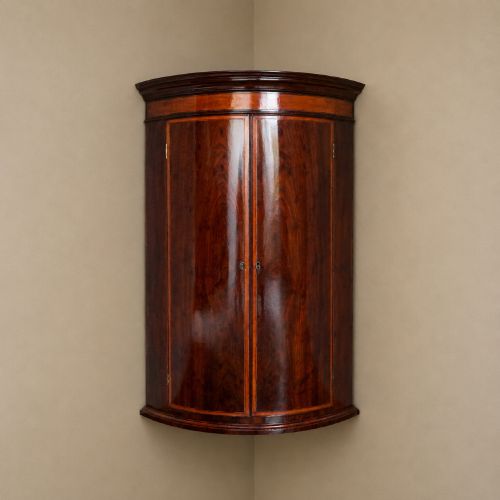
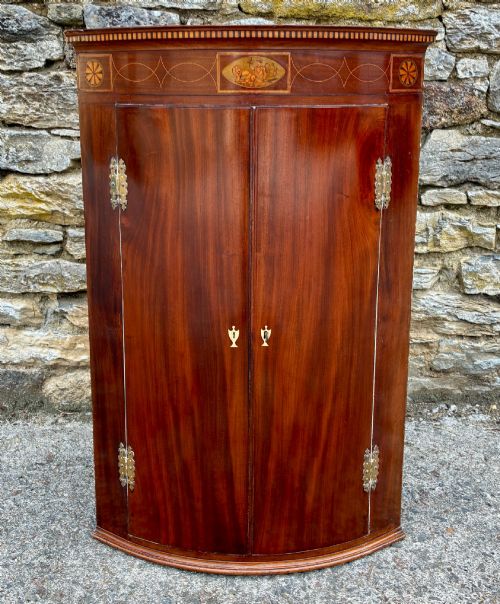
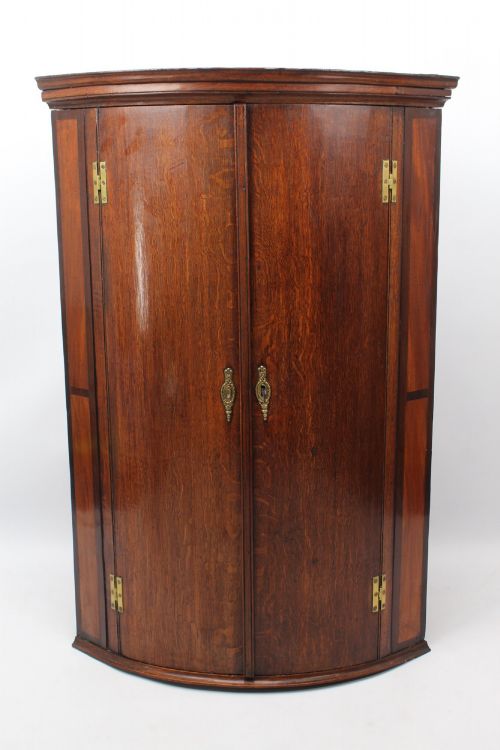
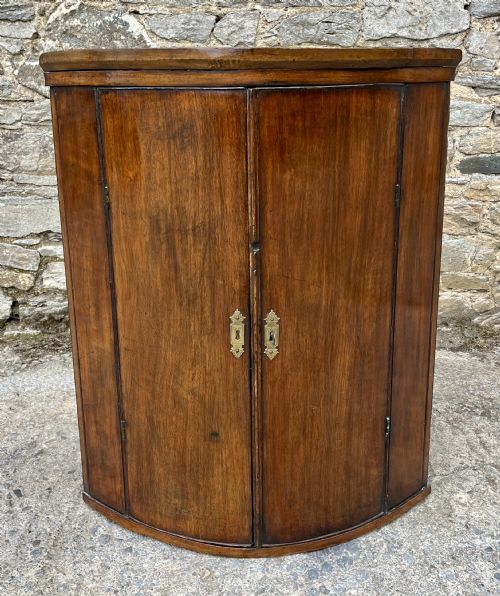
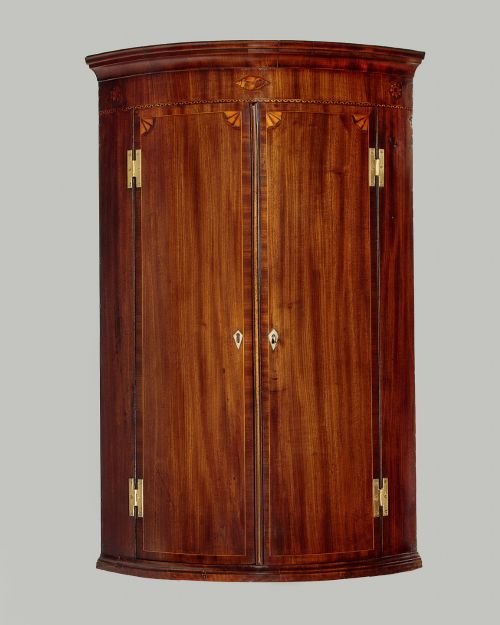
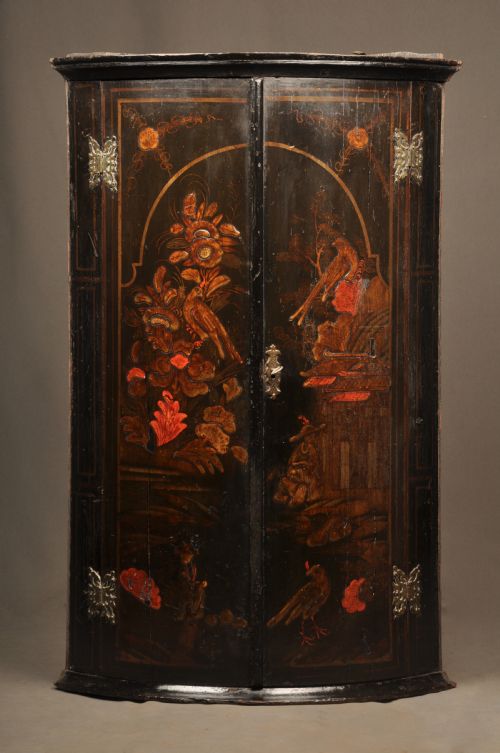
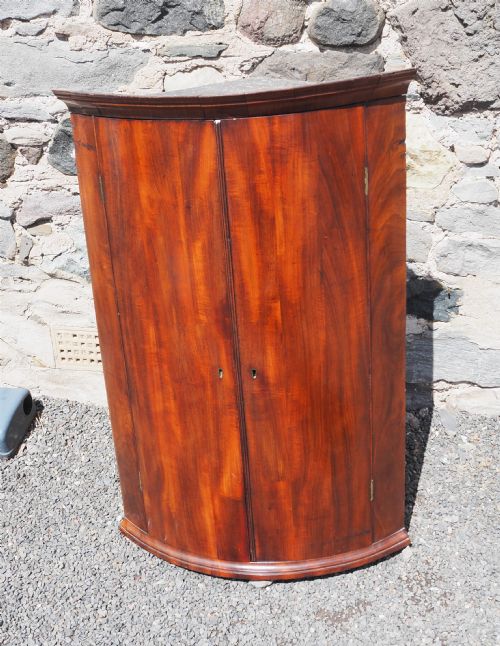


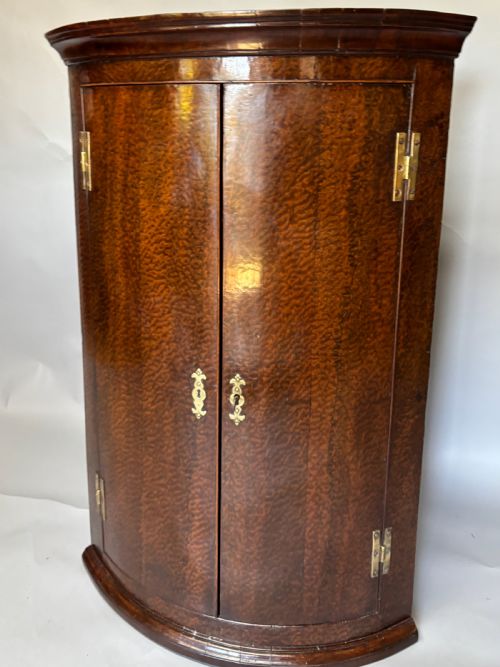
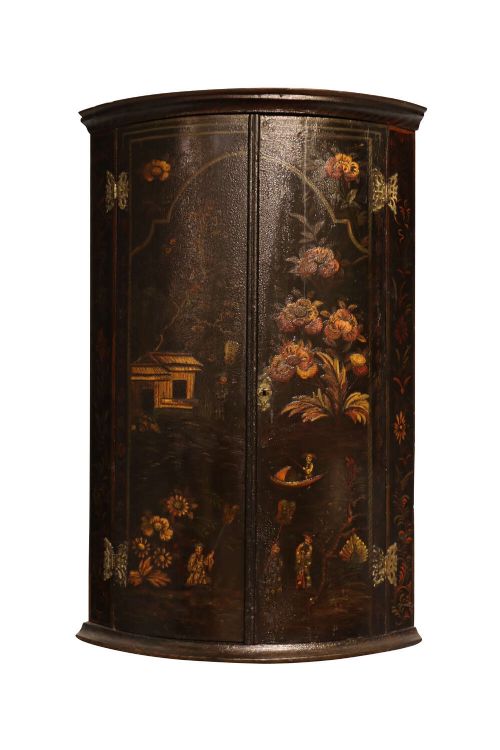
Bowfront Hanging Cabinet
A bowfront hanging cabinet is a wall-mounted storage piece designed for corners, offering rounded wooden doors that save room while housing cherished objects.
Bowfront Hanging Cabinet
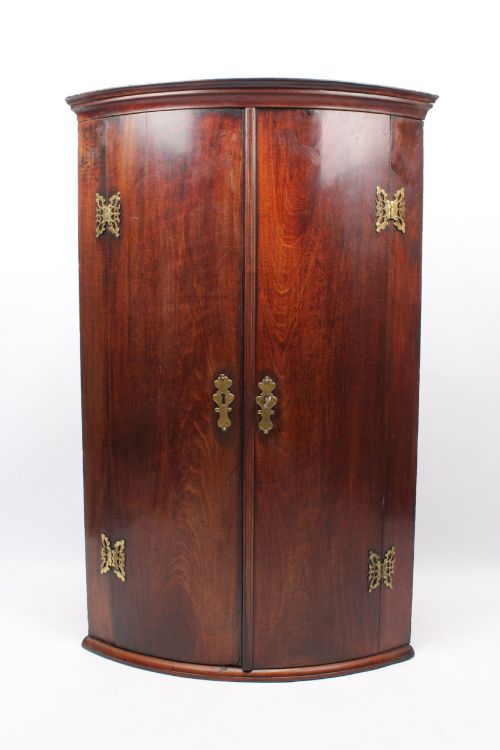
A bowfront hanging cabinet provides enclosed wall storage shaped with a convex front curve, most frequently encountered from the Georgian and Victorian eras. These pieces typically mount directly onto room corners to utilise awkward junctions and save floor space.
The selections span from plain oak and elm country cupboards to finely figured mahogany and burr oak examples made during the eighteenth and nineteenth centuries. Wall shelves and glazed display variations also appear alongside solid-door corner cupboards.
Materials and Construction
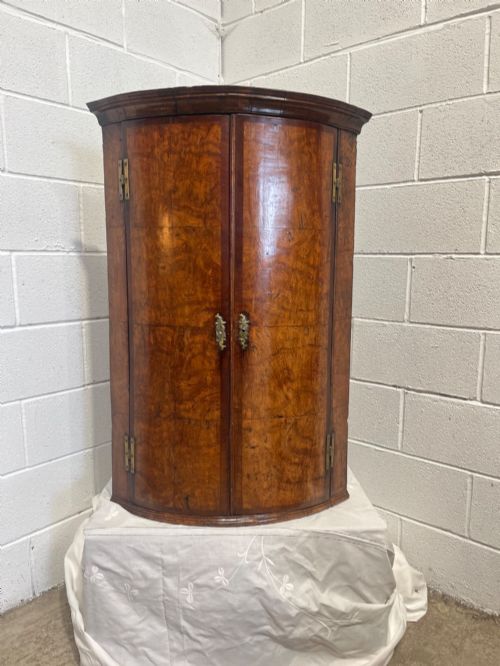
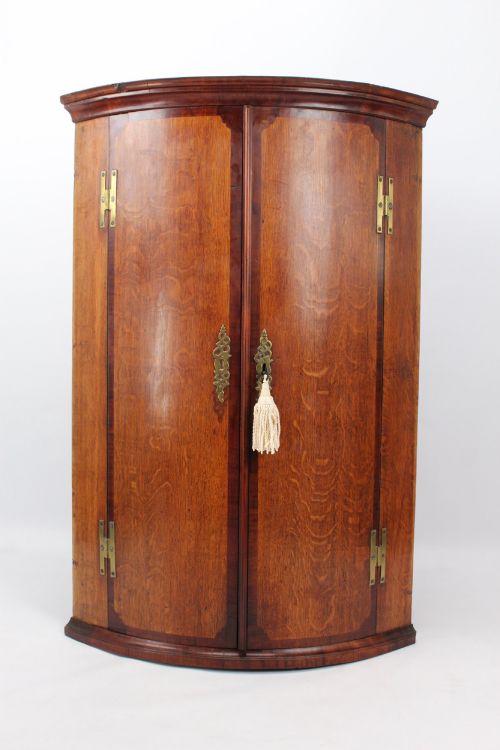
Cabinetmakers utilised native timbers such as oak, elm, and walnut alongside imported mahogany, applying veneers like plum pudding mahogany, flame mahogany, and burr oak to the curved door fronts. Brass hinges and escutcheons secure the doors, while boxwood stringing and inlay provide linear contrast.
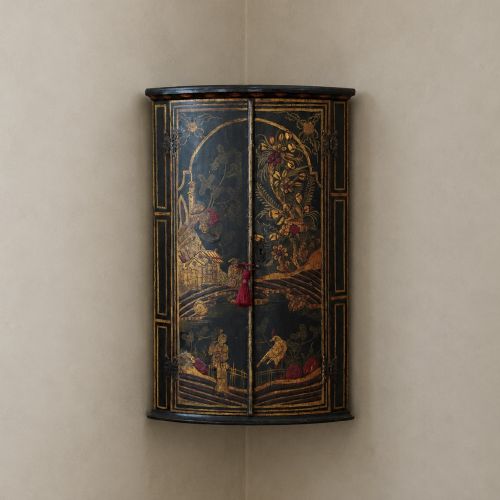
Surface treatments range from clear polish on timber grain to black lacquer, red paint, and japanned Chinoiserie decoration featuring raised oriental motifs. Construction relies on solid wood carcasses curved to form the characteristic bowfront profile.
Mahogany, oak, and japanned lacquer dominate the listings, spanning from early eighteenth-century Queen Anne pieces to Victorian interpretations.
Craftsmanship and Distinction
The distinction between standard examples and superior pieces rests on the choice of timber figure, such as richly patterned plum pudding mahogany or burr oak, paired with crisp boxwood inlay. Superior execution is visible in the smoothness of the curved door sweep and the precision of the mitred joints.
Decorative treatment further separates the range, distinguishing plain polished timber surfaces from elaborately hand-painted japanned Chinoiserie scenes with raised gilding. The sophistication of the brass hardware and interior shelf arrangement also marks the grade of the cabinet.
The Bowfront Hanging Cabinet Glossary
- Bowfront
- A convex curved front profile that projects outward, commonly seen on eighteenth and nineteenth-century cabinet doors. This shape softens room angles and provides extra internal depth.
- Japanned
- A European imitation of East Asian lacquerwork, created by applying layers of dark resin and hand-painted or raised metallic decoration. It appears frequently on eighteenth-century pieces.
- Inlay
- A decorative technique where contrasting woods like boxwood are inserted into recesses within the primary timber surface to form borders or geometric patterns.
- Plum Pudding Mahogany
- A richly figured timber variety displaying dense, circular markings that resemble the fruit in a Christmas pudding. Cabinetmakers reserved this prized grain for prominent door fronts.
- Corner Cupboard
- A storage unit built with a triangular plan specifically to fit room intersections, saving floor space while offering enclosed shelving.
Bowfront Hanging Cabinet: Frequently Asked Questions
How do I hang a bowfront hanging cabinet?
These cabinets feature internal fixing points or sturdy brackets fixed securely through the backboards into solid wall studs or masonry. Professional installation is essential due to the combined weight of the hardwood carcass and its contents.
Ensuring the unit is anchored at both top and bottom prevents strain on the historical hinges and keeps the curved doors aligned correctly during daily use.
Were these cabinets made for corners?
The vast majority of these pieces are specifically engineered with triangular backs to fit snugly into ninety-degree room intersections. This clever geometry maximises unused vertical space in smaller parlours and dining rooms.
While occasional flat-backed wall cabinets exist, the curved bowfront shape was predominantly paired with a corner footprint throughout the Georgian period.
What is the difference between oak and mahogany models?
Oak and elm examples generally originate from country workshops, displaying sturdy construction, simpler grain patterns, and occasionally painted finishes. They reflect regional British vernacular furniture traditions.
Mahogany and burr walnut versions typically represent urban cabinetmaking, often enhanced with fine veneers, satinwood stringing, or elaborate Chinoiserie decoration suited to formal reception rooms.
How do I care for the lacquer and paint?
Painted and japanned surfaces require gentle dusting with a dry, soft cloth and must be kept away from direct sunlight and excessive heat sources. Moisture and harsh cleaning agents can damage the delicate historical medium.
Applying microcrystalline wax sparingly helps preserve polished timber finishes without softening underlying varnishes or accumulating residue in carved details.