

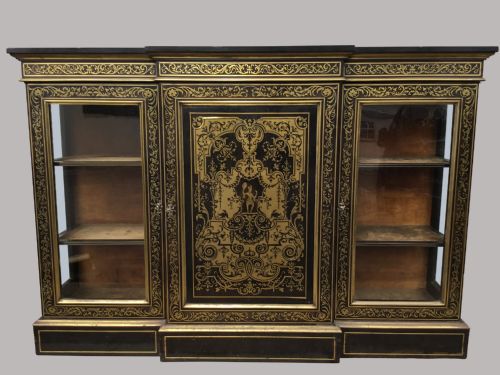


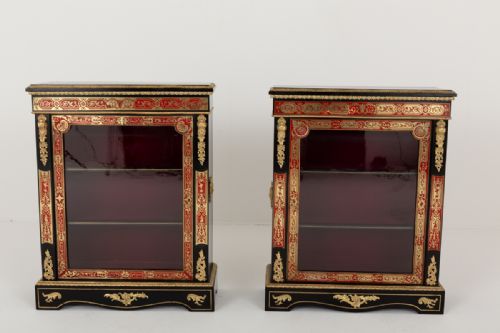


Boulle Display Cabinet
A boulle display cabinet brings together tortoiseshell and brass marquetry upon dark wood, offering a glittering stage for prized possessions.
Boulle Display Cabinet
A boulle display cabinet is a piece of furniture designed to showcase objects while displaying elaborate tortoiseshell and brass inlay across its surface. The items seen on this page span the nineteenth century, including Victorian examples alongside French Napoleon III and Louis XVI style pieces.
Buyers most frequently encounter forms such as pier cabinets, side cabinets, credenzas, and vitrines. These formats range from single door upright pier cabinets to larger breakfront side cabinets and bibliotheques.
Origin points divide broadly between English interpretations and French workshops. Many pieces date specifically from the decades around eighteen-fifty to eighteen-eighty, reflecting intense Victorian and French Revival enthusiasm for the technique.
Materials and construction
The technique relies on marquetry cut from sheets of tortoiseshell and brass, creating contrasting patterns of dark shell with gleaming metal. This detailed inlay decorates carcasses built from ebonised wood or ebony.
Mounts cast in ormolu frame the doors, corners, and feet, adding sculptural weight to the cabinets. Glass panels are fitted into doors to enclose the interior shelves, which are sometimes lined with velvet.
Materials recorded across the selection include brass, tortoiseshell, ormolu, ebonised wood, and velvet lining.
Distinguishing quality
Quality rests upon the precision of the marquetry cut and the crispness of the ormolu mounts. Finer pieces demonstrate meticulous alignment where the brass and tortoiseshell meet, with minimal filler.
The depth of the ebonisation and the richness of the tortoiseshell also set examples apart. Superior cabinets maintain structural integrity in the timber carcass alongside well-balanced proportions.
The Boulle Display Cabinet Glossary
- Boulle marquetry
- An inlay technique using brass and tortoiseshell, named after the French cabinetmaker André-Charles Boulle. It creates elaborate floral and geometric patterns across furniture surfaces.
- Ormolu
- Gilded bronze used for decorative mounts and accents on nineteenth-century furniture. It provides bright metallic highlights against dark ebonised wood.
- Pier cabinet
- A tall, narrow cabinet designed to stand against a wall pier between windows. These upright pieces often feature glazed doors for display.
- Credenza
- A low sideboard or cabinet used for storage and display, frequently fitted with multiple doors. In boulle work, these pieces display expansive marquetry fronts.
- Ebonised wood
- Timber treated with a dark finish to imitate expensive ebony. This dark ground makes the brass and tortoiseshell inlay stand out clearly.
Boulle Display Cabinet: Frequently Asked Questions
What is a boulle display cabinet?
A boulle display cabinet is a nineteenth-century furniture piece decorated with brass and tortoiseshell marquetry. These cabinets feature glass doors and shelves intended for showing off decorative objects.
They appear in various formats, from upright pier cabinets to wide credenzas, incorporating ormolu mounts and ebonised timber frames.
How do I date a boulle cabinet?
Dating relies on examining the timber construction, the style of the ormolu mounts, and historical design revivals. Most examples date from the Victorian era or the French Napoleon III period.
Details such as Louis XVI style influences help narrow down the decade of production within the nineteenth century.
Where should I place one at home?
These cabinets suit reception rooms, drawing rooms, or hallways where their reflective brass and tortoiseshell surfaces catch the light. Narrow pier cabinets fit well in compact wall spaces.
Keep them away from direct sunlight to protect the tortoiseshell and wood finishes from fading over time.
Are these cabinets French or English?
The tradition originates in France, and many pieces on this page are French Napoleon III productions. English makers also adopted the style during the nineteenth century.
Both origins utilise ebony or ebonised wood alongside brass and tortoiseshell marquetry.