


Boulle Marquetry Cupboard
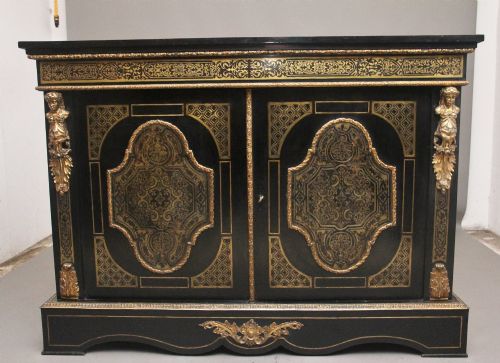
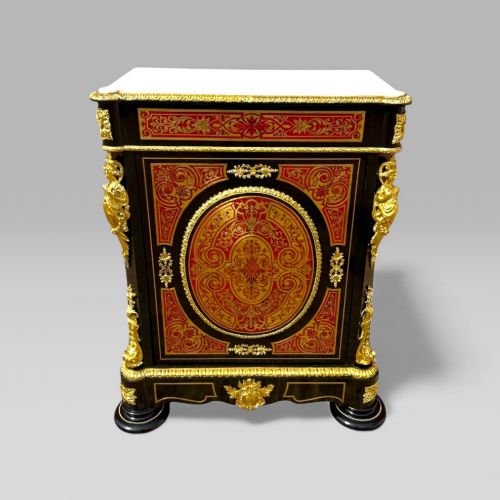
A boulle marquetry cupboard delivers high nineteenth-century drama through contrasting tortoiseshell and brass inlay set against deep ebonised wood.
Boulle Marquetry Cupboard
When you search for a boulle marquetry cupboard, you enter a world of nineteenth-century French Napoleon III and Victorian revival furniture designed to catch the candlelight in a formal interior. These pieces take the form of side cabinets, pier cabinets and display cabinets featuring rich decorative surfaces.
The versions you are most likely to meet on this page span the mid-nineteenth century, specifically around eighteen fifty to eighteen eighty, drawing heavily on earlier Louis XVI style vocabulary. They combine substantial timber carcasing with glass doors or marble tops to create functional display furniture.
Ebonised wood serves as the primary dark backdrop for these cabinets, creating a stark canvas that makes the metallic and organic inlay stand out. Makers utilised walnut for internal structures and secondary framing while keeping the exterior dark and polished.
How they were made
The distinctive surface of a boulle marquetry cupboard relies on precise cutting of tortoiseshell and brass sheets layered together and sawn simultaneously to create interlocking positive and negative motifs. Craftsmen then embedded these delicate patterns into the ebonised wood surface.
Gilt bronze and ormolu mounts punctuate the corners, frames and feet of the cabinet, adding sculptural weight and protecting vulnerable edges. Marble tops, often shaped with serpentine fronts, provide a heavy, cool surface that contrasts with the ornate woodwork below.
Tortoiseshell panels were sometimes backed with red pigment to make the amber shell glow under gaslight.
What varies in quality
Quality in these cabinets rests upon the crispness of the brass engraving and the depth of the tortoiseshell beneath. Superior pieces display finely articulated scrolls and figures where the metal sits completely flush with the surrounding ground.
The weight and chasing of the ormolu mounts separate standard production from finer examples, as does the selection of marble for the top. Heavier timber construction and cleaner joinery in the side cabinets indicate workshop standards of the highest order.
The Boulle Marquetry Cupboard Glossary
- Boulle marquetry
- An elaborate form of marquetry using brass and tortoiseshell developed in France and revived intensely during the nineteenth century. It creates a shimmering, high-contrast surface pattern across doors and panels.
- Ormolu
- Gilded bronze used for decorative mounts, feet and framing on nineteenth-century furniture. It provides a bright metallic accent against dark ebonised timber.
- Ebonised wood
- Timber treated to imitate ebony, giving a dense, uniform black finish. This dark ground forms the essential base for boulle inlay.
- Pier cabinet
- A piece of furniture designed to fit the wall space between windows. These cabinets often feature glazed doors and flat backs.
- Serpentine front
- A curved furniture front featuring a convex centre flanked by concave curves. This contour adds movement to the silhouette of a marble top.
Boulle Marquetry Cupboard: Frequently Asked Questions
What is a boulle marquetry cupboard?
A boulle marquetry cupboard is a nineteenth-century storage or display piece decorated with inlaid brass and tortoiseshell against an ebonised wood ground. These cabinets often feature glass doors and marble tops.
Originating in French Napoleon III aesthetics and adopted by Victorian cabinetmakers, they bring dramatic surface pattern and metallic contrast to a room.
How do I date these cabinets?
Dating relies on stylistic markers and material combinations pointing to the mid-to-late nineteenth century. Most examples on this market date from eighteen fifty to eighteen eighty.
Victorian revival pieces and French Napoleon III workshops dominated this period, utilising machine-sawn veneers and heavy ormolu mounts characteristic of the era.
Where were they placed originally?
These cabinets were built for formal reception rooms, drawing rooms and parlours where guests would admire their reflective surfaces. Pier cabinets specifically occupied the wall spaces between large windows.
Display cabinets and side cabinets served to house porcelain, books or decorative objects while adding architectural dignity to the interior.
What is the difference between brass and ormolu?
Brass appears flat and sheet-like within the marquetry inlay, forming intricate floral and scroll patterns across the cabinet doors and panels. It provides linear detail and bright contrast.
Ormolu refers to cast and gilded bronze used for three-dimensional mounts on corners and feet, adding sculptural weight rather than flat pattern.