
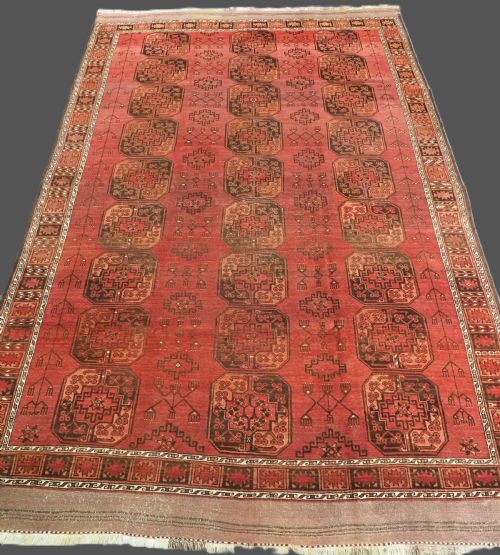


Bokhara Rug Wool
A bokhara rug wool piece offers traditional Central Asian tribal design and rich red colour, bringing historical warmth to any floor.
Bokhara Rug Wool
When you search for bokhara rug wool, you encounter antique Central Asian tribal carpets, dowry rugs, and smaller tent hangings originating from nomadic weaving traditions. The examples found here span from the mid nineteenth century through the early twentieth century, taking forms such as main carpets, runners, and square wedding rugs.
Most pieces on this page belong to the Tekke and Ersari Turkmen traditions, alongside Afghan village productions tied to these classical motifs. Buyers select these textiles for their characteristic octagonal gul patterns and deep madder red tones that anchor traditional and contemporary interiors alike.
How they were made
Weavers constructed these carpets using wool for the foundational warps, wefts, and dense pile, creating a durable surface designed for daily nomadic use. Certain specialised pieces incorporate cotton foundations or delicate silk highlights to accentuate specific motifs within the design.
Natural dye traditions yielded the characteristic warm red, burgundy, and gold shades found across the pieces, occasionally enhanced by cochineal highlights. Knotting techniques produced varying densities, ranging from standard village weaves to exceptionally fine dowry rug structures.
Some weavers added cochineal highlights to catch the nomad tent firelight.
What varies in quality
Quality in these textiles rests upon the density of the weave and the precision of the repeating gul motifs across the field. Finer pieces, such as dedicated dowry rugs and small torbas, demonstrate intricate handling of subsidiary border designs and tighter knotting.
The clarity and depth of the wool pile dye also distinguish individual examples, with superior pieces displaying luminous red tones and well-preserved structural integrity. Completeness affects standing, as intact main carpets and undamaged fragments represent different tiers within the weaving tradition.
The Bokhara Rug Wool Glossary
- Gul
- An octagonal medallion motif repeated across Turkmen carpets. Each tribal group utilised distinct variations of this geometric emblem.
- Dowry Rug
- A smaller textile woven specifically for a bride's wedding possessions. These examples often exhibit finer knotting and more deliberate artistic care.
- Torba
- A small storage bag face used within nomadic tents. Collectors prize these fragments for their concentrated design layouts.
- Beshir
- A style of carpet associated with Ersari weavers residing near the Amu Darya river basin. They frequently display less rigid geometric formats than Tekke equivalents.
- Main Carpet
- A large-scale floor covering produced for principal domestic use within a tribal household. These substantial formats required considerable time and cooperative labour to weave.
Bokhara Rug Wool: Frequently Asked Questions
What is a bokhara rug wool piece?
These items are antique hand-knotted floor coverings and hanging textiles originating from Central Asian tribal traditions. They are characterised by repeated octagonal motifs and warm red wool pile.
Nomadic weavers produced them for domestic utility, dowries, and tribal display across the nineteenth and early twentieth centuries.
How were these rugs used originally?
Nomadic families laid main carpets and village rugs within yurt dwellings to insulate earthen floors against cold weather. Smaller formats functioned as storage bags, tent furnishings, or wedding dowry gifts.
Their robust wool construction ensured they withstood heavy foot traffic and daily nomadic movement.
How do I live with an antique wool rug?
Place the textile in low-traffic or moderate-traffic zones to preserve the wool pile over decades of domestic use. Use an appropriate underlay to prevent slipping and cushion the historical foundation against hard modern flooring.
Vacuum gently without a rotating brush bar and keep the piece away from prolonged direct sunlight to protect the natural dyes.
How can I tell different tribal designs apart?
Examine the primary medallions and the secondary motifs arranged between them across the field. Tekke designs rely on precise, repeating octagonal guls, whereas Ersari and Afghan village variations often incorporate more open formats or alternative coloration.
Border patterns and structural quirks also help attribute pieces to specific regional weaving groups.