

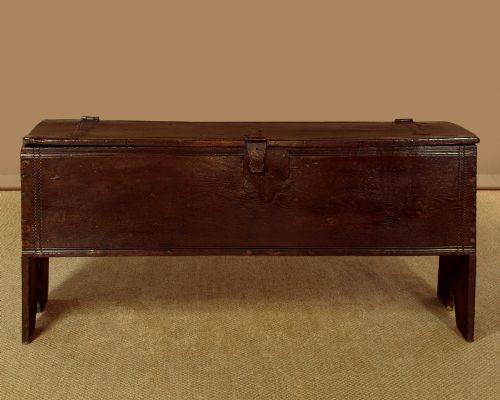
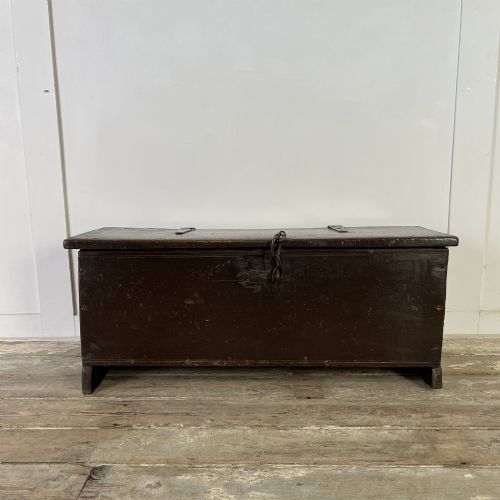
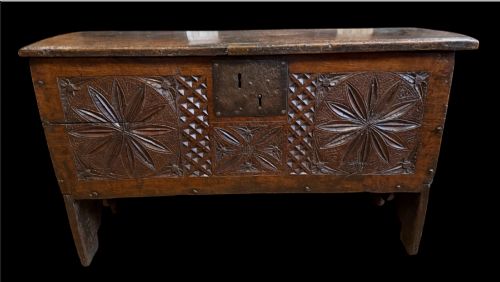
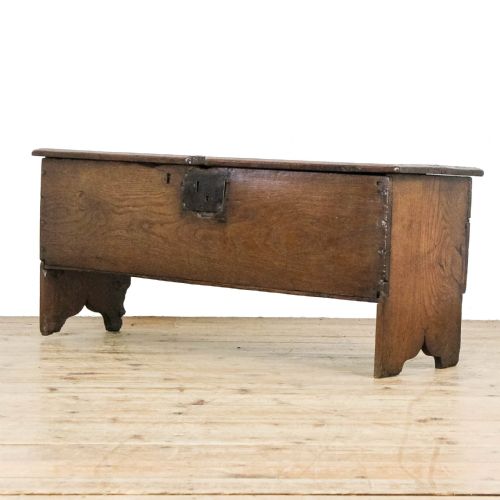


Boarded Oak Trunk
A boarded oak trunk is a sturdy vernacular storage piece built from solid planks, offering early domestic history for your home.
Boarded Oak Trunk
When you search for a boarded oak trunk, you encounter robust domestic storage pieces constructed from plain timber planks rather than framed panels. These utilitarian items served early households for safeguarding valuables, textiles, and documents.
The examples appearing on this page span several centuries, reaching back to Elizabethan, Tudor, and Jacobean periods alongside later Welsh vernacular and Georgian iterations. Most items you meet here take the form of simple six-plank coffers and sword chests dating from the sixteenth and seventeenth centuries.
How they were made
Maker construction relied heavily on solid oak boards joined at the edges, often reinforced with pegged joints or simple cut ends rather than complex cabinetry. These basic structural planks formed the base, sides, and lid of each trunk.
Metalwork played a functional role in holding the heavy timber together, utilising wrought iron hinges, straps, and occasional brass details to secure the lids. Blacksmiths forged these iron reinforcements by hand to withstand daily handling.
Many sixteenth-century chests still bear the exact tool marks of the pit-saw that cut their thick oak planks.
What varies in quality
The distinction between standard examples and superior pieces rests in the thickness of the surviving timber and the integrity of the original board construction. Pieces retaining untouched surfaces and early ironwork carry greater historical weight than those heavily restored.
Proportion and scale also dictate distinction, where rarer long sword chests or remarkably small boarded coffers demonstrate specialised regional forms from periods like the sixteenth century.
The Boarded Oak Trunk Glossary
- Boarded coffer
- A simple storage chest constructed primarily from flat planks of timber joined at the edges rather than set into a frame. These pieces represent some of the earliest surviving domestic furniture.
- Six plank construction
- A method of building chests using a single board for each of the four sides, plus a base and a lid. This straightforward technique defines early vernacular woodwork.
- Sword chest
- An elongated storage chest specifically designed to accommodate long edged weapons. Such forms appear frequently in seventeenth-century contexts.
- Vernacular furniture
- Everyday domestic pieces built by local tradesmen using regional materials and traditional designs rather than high-style metropolitan fashions. This category includes Welsh and country oak objects.
Boarded Oak Trunk: Frequently Asked Questions
What is a boarded oak trunk?
A boarded oak trunk is a heavy storage box built from solid timber planks pinned or nailed together at the edges.
These functional pieces date from early periods like the sixteenth and seventeenth centuries and serve as direct ancestors to modern cabinetry.
How were these trunks used originally?
Early households utilised these chests to store precious textiles, legal documents, and personal valuables securely.
Elongated versions specifically accommodated swords and other long implements in domestic or civic settings.
How do I date an antique oak coffer?
Dating relies upon examining the construction methods, tool marks left by early saws, and the type of ironwork.
Sixteen-century pieces often display simpler board arrangements and characteristic regional traits compared to later Georgian examples.
How do I live with a primitive chest?
These robust oak pieces function well as coffee tables, blanket boxes, or hallway storage benches in modern interiors.
Stable room humidity protects the historic timber and maintains the integrity of the original iron hinges.