
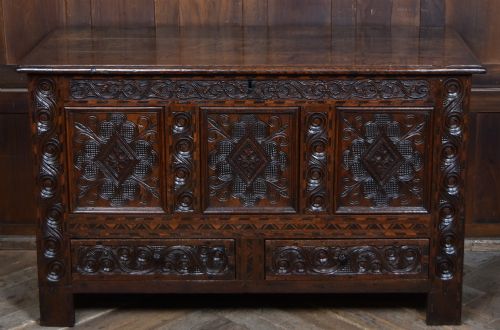
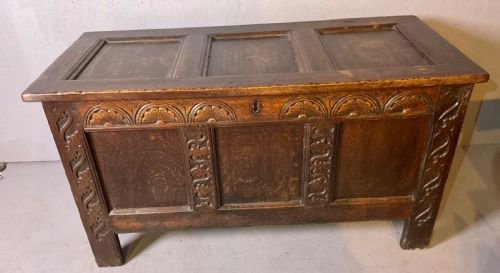


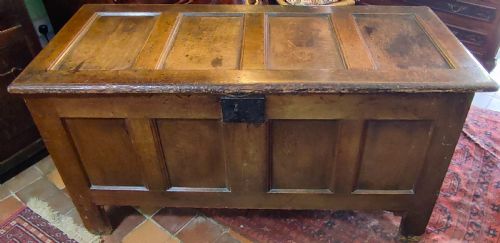


Historic Oak Trunk
A historic oak trunk brings centuries of utility and timber grain into a modern room, offering durable storage with deep historical character.
Historic Oak Trunk
A historic oak trunk encompasses robust storage pieces primarily recorded as coffers and chests spanning the sixteenth, seventeenth, and eighteenth centuries. These items serve as functional receptacles that transitioned from secure domestic vaults to blanket chests and mule chests over successive generations.
Buyers encountering this selection will most frequently find seventeenth century and eighteenth century oak coffers, alongside earlier Elizabethan boarded examples and later regional variants such as Lancashire coffers or sword chests. The forms range from plain boarded constructions to intricately carved and inlaid designs reflecting Tudor, Jacobean, and Georgian aesthetics.
How they were made
Construction relies heavily on solid oak timber shaped by hand using traditional joinery and boarding techniques, reinforced with iron, wrought iron, and occasional brass hardware. Surfaces display the distinct grain of oak, sometimes enhanced with wood inlay or detailed carving executed during the sixteenth and seventeenth centuries.
The fabrication method dictates the structural integrity, utilising heavy planks joined together to form durable receptacles capable of surviving centuries of domestic use. Metalwork such as iron hinges and fastenings secures the heavy lids while complementing the dense timber construction.
Materials across these listings exclusively feature solid oak combined with iron, wrought iron, brass, and wood inlay.
What varies in quality
Distinction across the range rests upon the depth and execution of period carving, the integrity of the original oak boards, and the survival of contemporary ironwork. Pieces exhibiting sophisticated Jacobean or Elizabethan ornamentation stand apart from simpler utilitarian boxes.
The degree of original surface preservation and the presence of period-appropriate joinery further differentiate examples. Alterations to hardware or timber replacement shift a piece away from those retaining their untouched sixteenth, seventeenth, or eighteenth century fabric.
The Historic Oak Trunk Glossary
- Cofer
- An archaic spelling often used to describe a strongbox or chest intended for storing valuables and textiles. These heavy wooden receptacles formed essential furniture in early households.
- Mule chest
- A storage chest featuring one or more drawers at the base beneath the primary compartment. This form bridges the evolution between the simple coffer and the modern chest of drawers.
- Boarded construction
- A method of building chests by nailing or pegging solid vertical planks together at the edges. This technique represents an early and robust style of cabinet making.
- Joined oak
- Furniture construction utilising interlocking mortise and tenon joints secured with wooden pegs rather than simple boards. It allows for lighter yet stronger panelled frameworks.
- Sword chest
- A narrow, specialised form designed to securely store sidearms. These elongated boxes appear within seventeenth century domestic settings.
Historic Oak Trunk: Frequently Asked Questions
How old are these trunks?
The pieces span from the sixteenth century through the eighteenth century, encompassing periods like the Elizabethan, Jacobean, and Georgian eras.
Dates are typically attributed through construction methods, joinery styles, and decorative motifs characteristic of these specific centuries.
Were they used for travel?
Most of these heavy oak receptacles were designed for static domestic storage rather than frequent travel. They held valuable textiles, documents, and household goods within secure rooms.
Lighter or smaller variants existed, but the majority functioned as stationary furniture pieces within historic homes.
How do I care for historic oak?
Maintaining these wooden pieces involves keeping them away from direct heat sources and sudden humidity changes. This protects the dense oak and prevents timber splitting.
Applying occasional appropriate wax preserves the surface sheen without damaging the historic finish.
What is a mule chest?
A mule chest combines a traditional lift-top compartment with one or more lower drawers. This design appeared as households sought easier access to stored clothing.
They bridge the functional gap between basic chests and modern drawer units.