
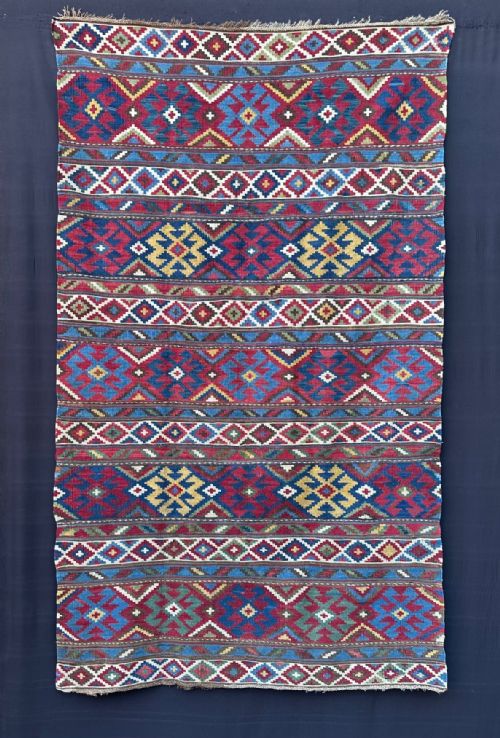

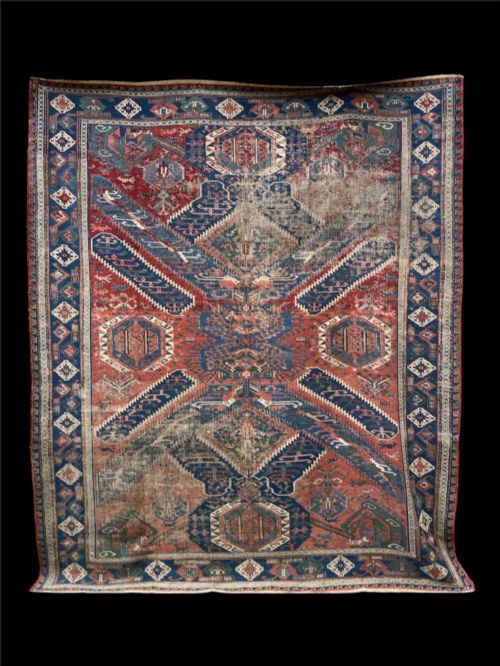


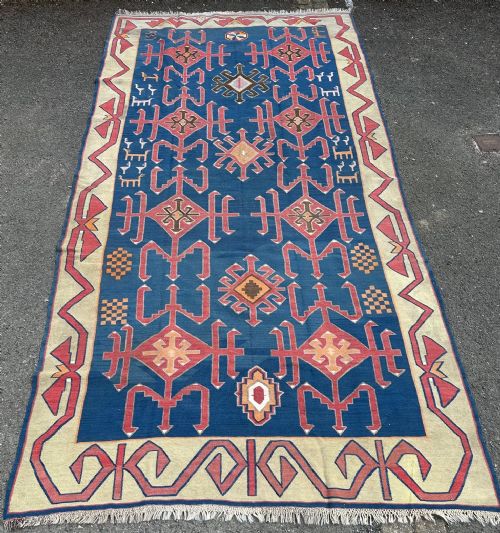


Blue Wool Kilim Rug
These flatweave floor coverings known as a blue wool kilim rug bring rich tribal geometry and practical durability into a modern interior.
Blue Wool Kilim Rug
When searching for a blue wool kilim rug, collectors encounter tribal flatweaves originating primarily from Persian, Caucasian, Anatolian, and Central Asian weaving traditions spanning the late nineteenth and early twentieth centuries.
The inventory on this page consists entirely of flatwoven textiles, ranging from large room-sized carpets and narrow runners down to smaller utilitarian objects such as bread sofrehs, storage bags, and cushions.
Tribal groups including the Baluch, Afshar, Shahsavan, and various Caucasian and Uzbek communities produced these works for domestic utility, utilising geometric motifs and banded designs suited to nomadic and village life.
Materials and construction methods
The foundational textiles rely on hand-spun wool and cotton, frequently incorporating natural dyes to achieve deep indigo blues alongside secondary earthy tones.
Weavers constructed these pieces using slit-tapestry techniques or supplementary weft-work, sometimes joining multiple narrow woven strips together to form larger panels, covers, or floor coverings.
Listings feature pieces spanning from the 1860s through the 1940s, originating across Persian, Caucasian, and Central Asian tribal regions.
Distinctions in execution and structure
The refinement of the weave determines much of the distinction, with tightly compacted weft-work and precise geometric lines separating standard village production from finer tribal workshop pieces.
The integrity of the natural dyes and the balance of the banded or shield designs dictate the visual impact, alongside the survival of original outer selvedges and structural joins across multi-part panels.
The Blue Wool Kilim Rug Glossary
- Kilim
- A flatwoven textile produced without a pile by tightly interworking warp and weft threads. These pieces function primarily as floor coverings, wall hangings, or covers.
- Sofreh
- A woven spread or cloth traditionally used for kneading bread, serving meals, or gathering food. These textiles often feature striking geometric borders and field patterns.
- Soumak
- A brocade-like flatweaving technique where pattern wefts are wrapped around the warp threads before being beaten down. This method adds structural weight and raised texture to the surface.
- Mafrash
- A large rectangular storage bag or chest panel used by nomadic tribes for bedding and household possessions. They often survive as individual side panels or complete paired units.
- Warp
- The stationary vertical threads stretched lengthwise on a loom before weaving begins. The weft threads pass alternately over and under these foundational strands.
Blue Wool Kilim Rug: Frequently Asked Questions
How do I clean a fragile flatweave rug?
Gentle surface vacuuming without a beater bar removes loose dirt from the weave. Professional textile cleaning remains the safest method for addressing deeper soils.
Water saturation and harsh detergents damage natural dyes and wool fibres. Specialist care preserves the structural integrity of antique flatweaves.
Where were these tribal textiles woven?
Nomadic and village weavers produced these pieces across Persia, the Caucasus, Anatolia, and Central Asia. Specific regions like Shirvan, Kerman, and the Chahar Mahal valley developed distinct weaving signatures.
Tribes such as the Shahsavan, Baluch, and Afshar utilised local materials to create utilitarian cloths and floor coverings.
Can I place a flatweave on a high traffic floor?
These sturdy wool textiles withstand regular walking when protected by a quality underlay. The tight flatweave construction offers notable durability for everyday room use.
Placing a non-slip pad underneath prevents sliding and reduces friction against hard flooring surfaces.
What is the difference between a rug and a sofreh?
Rugs function primarily as decorative floor coverings or pathway runners within a room. A sofreh served a specific domestic purpose as a spread for food preparation and dining.
Sofrehs often display narrower formats and specialised tribal symbols related to sustenance and nomadic hospitality.