
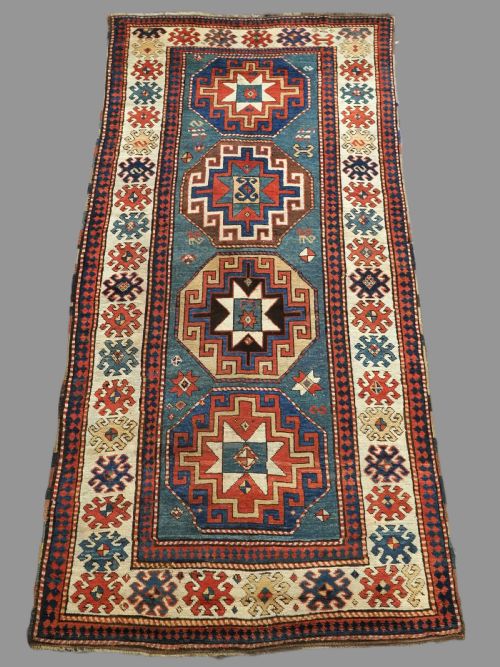


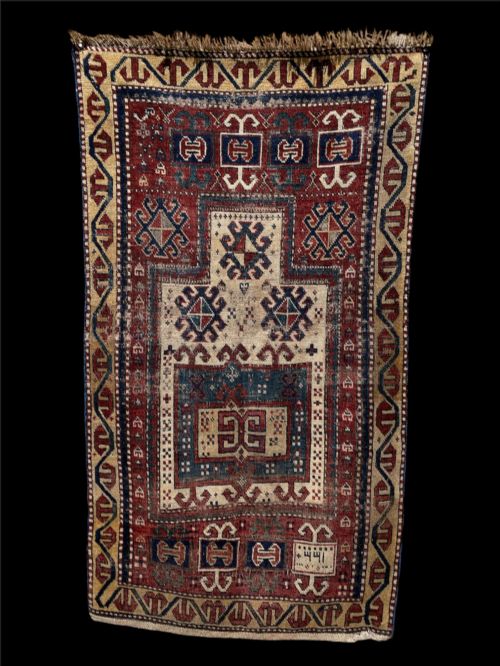


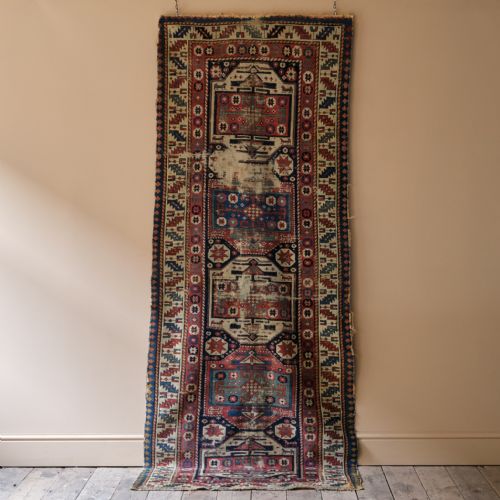
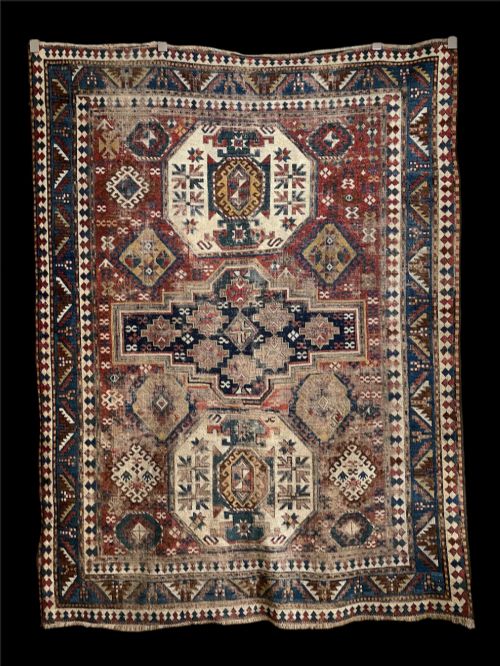


Blue Wool Kazak Rug
A blue wool kazak rug brings bold Caucasian geometry and saturated natural dyes straight to the floor.
Blue Wool Kazak Rug
A blue wool kazak rug is a tribal floor covering woven in the Caucasus region, most frequently appearing from the nineteenth century up to the early twentieth century. These pieces encompass specific regional styles such as Fachralo, Borchalu, Gendje, Karachov, Chelaberd, Moghan and Sewan. Buyers encounter formats ranging from square area rugs and long runners to specific prayer rugs featuring architectural mihrabs.
The aesthetic relies on strong geometric medallions, latch hooks, boteh motifs and Memling guls set against deep fields of colour. Most examples date between 1850 and 1900, reflecting traditional village production methods rather than urban workshop output. They serve as functional floor coverings that double as striking pieces of folk art.
Materials and technique
Weavers utilised hand-spun wool for the pile and foundation yarns, yielding a dense, resilient structure that absorbs natural dyes unevenly in a pleasing manner. Cotton occasionally appears in the foundation alongside wool warp and weft threads.
Natural dyes provide the characteristic saturated palette, fixing hues securely into the fibres over decades of use. The knotting technique remains strictly manual, executed on upright village looms by tribal makers.
The listings span from 1850 to 1930, utilising wool, cotton, and natural dyes across Caucasian tribal styles.
What separates the tiers
Quality rests in the crispness of the geometric drawing and the saturation of the natural dye palette. Tighter knotting and heavier wool density elevate certain pieces above looser, simpler village weaves.
The survival of original side cords and complete end finishes dictates desirability among collectors. Surface wear alters the impact, though even heavily used examples retain artistic merit.
The Blue Wool Kazak Rug Glossary
- Kazak
- A designation applied to rugs woven in the Caucasus region, known for bold geometric patterns and vibrant wool construction. These tribal pieces often display large medallions and latch hook details.
- Boteh
- A pear-shaped or almond-shaped motif with a curved upper end, frequently repeated in rows across runner rugs. This ancient Persian design element appears widely in Caucasian weaving.
- Mihrab
- An arched niche design at one end of a prayer rug, representing the direction of Mecca. Weavers often position this architectural feature centrally to guide the user during daily devotions.
- Latch hook
- A stepped, geometric extension attached to medallions and borders, characteristic of tribal weaving. This motif adds angular movement to the primary field design.
- Memling gul
- An octagonal guls motif featuring hooked appendages radiating outwards, named after the painter who recorded similar carpets. It serves as a central emblem on specific Moghan and regional pieces.
Blue Wool Kazak Rug: Frequently Asked Questions
How do I clean an old wool rug?
Surface dirt responds well to gentle, regular suction with a standard vacuum cleaner without a beater bar. Avoid aggressive chemical treatments that might strip the natural dyes from the hand-spun wool.
Professional textile conservators should handle deeper washing or stain removal. Keeping the piece away from direct, harsh sunlight preserves the saturated blue ground.
Are these rugs suitable for high traffic?
The robust hand-spun wool construction provides natural resilience that withstands moderate everyday foot traffic. Placing a suitable underlay beneath the piece prevents slipping and reduces internal fibre friction.
Runners and area rugs perform reliably in hallways and living spaces when treated with care. Their dense pile absorbs wear while maintaining the integrity of the tribal design.
How can I tell the age of a piece?
Dating relies on examining the natural dye variations, wool consistency, and structural characteristics unique to nineteenth-century production. Certain examples bear woven dates in older calendars, offering a precise point of origin.
Stylistic shifts from large tribal medallions to more repetitive patterns also help narrow down the decade of creation. Expert analysis of the foundation materials confirms whether a piece originates from the 1850s or later periods.
What causes the crooked shape in some rugs?
Tribal weavers working on traditional vertical floor looms without rigid architectural guides often caused slight natural shifts in width. These irregularities reflect the organic, non-industrial nature of village production.
Such deviations in symmetry are standard characteristics of authentic folk art rather than structural faults. Collectors value these subtle asymmetries as evidence of genuine hand-knotted heritage.