

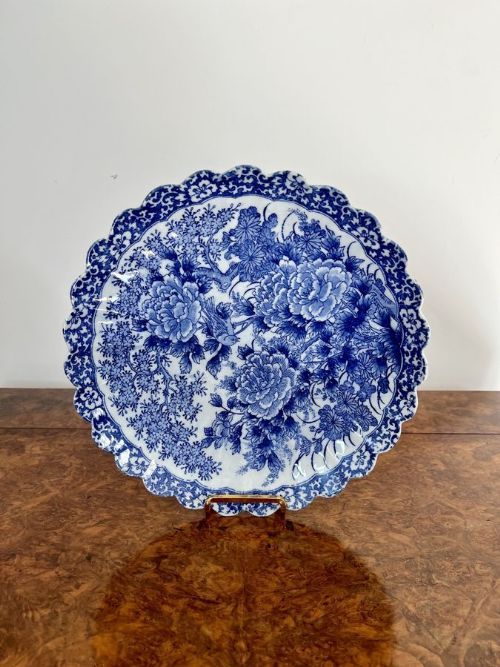


Blue White Imari Charger
A blue white imari charger brings bold painted ceramic artistry to a wall or table, offering rich contrast and historic depth.

Blue White Imari Charger
A blue white imari charger is a large circular decorative plate or platter, predominantly featuring cobalt blue alongside other pigments. These pieces are typically Japanese Arita ware or Chinese export porcelain, spanning periods from the seventeenth century through to the early twentieth century.
The version most commonly met on this page is the Japanese Arita or Meiji period charger, often decorated with hand painted designs within scrolling foliate borders. Alongside large chargers, the selection includes scalloped edge plates, octagonal porcelain plates, and decorative bowls.
Originating across distinct stylistic traditions including Japanese Imari, Edo, and Qing Dynasty eras, these objects served both domestic display and international trade. Buyers find them used as central table ornaments or mounted for wall presentation.
What varies in quality
Quality in a blue white imari charger rests upon the precision of the hand painted brushwork and the clarity of the cobalt underglaze. Finer examples display crisp botanical or figurative motifs, such as koi carp, set cleanly within scrolling foliate borders.
The refinement of the porcelain body and the successful integration of enamel and gold leaf details distinguish superior pieces. Early seventeenth and eighteenth-century examples often command attention for their historical depth and the robust throwing of large charger forms.
Watch closely for swimming koi carp painted across the porcelain, faithfully navigating centuries of cobalt currents without ever needing to surface.
The Blue White Imari Charger Glossary
- Charger
- A large decorative plate or platter traditionally used for ceremonial dining or wall display. These pieces measure significantly larger than standard dining plates.
- Cobalt Underglaze
- A blue pigment applied to raw porcelain pottery before the application of clear glaze and high-temperature firing. This technique protects the blue decoration beneath a glossy vitrified surface.
- Arita
- A Japanese town and production centre renowned for manufacturing porcelain since the early modern period. Arita wares supplied domestic markets and European export trade alike.
- Meiji Period
- The era in Japanese history spanning from 1868 to 1912, characterised by intense artistic production and international commerce. Pieces from this time often exhibit confident hand painted porcelain decoration.
- Imari
- A style of Japanese porcelain featuring cobalt blue and iron red, frequently accented with gold leaf. Named after the port from which these ceramics were shipped to Europe.
Blue White Imari Charger: Frequently Asked Questions
How do I hang a charger on the wall?
Displaying a large porcelain charger safely requires a specialist spring-loaded plate hanger that grips the rim securely without causing damage.
Ensure the wall fixing engages directly with solid masonry or a timber stud to bear the weight of heavy seventeenth or nineteenth-century ceramics.
Were these chargers used for food?
While originally designed as dining vessels or ceremonial serving platters in historic households, surviving examples are predominantly decorative objects today.
Hand-painted enamels and gold leaf accents on antique porcelain are vulnerable to cutlery scratching and aggressive modern detergents.
How do I tell Edo period pieces from Meiji items?
Edo period ceramics typically display looser, more robust brushwork and heavier potting traditions associated with seventeenth and eighteenth-century Arita kilns.
Meiji period pieces often show finer, denser hand painted details reflecting industrial expansion and refined export demands toward the end of the nineteenth century.
Can I clean antique porcelain safely?
Cleaning requires only lukewarm water and a gentle cloth, avoiding abrasive pads, chemical solvents, or immersion in automated dishwashers.
Careful maintenance preserves fragile enamel pigments and delicate gold gilt details applied over the glaze.