
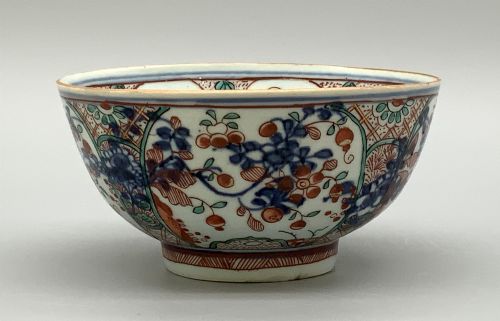

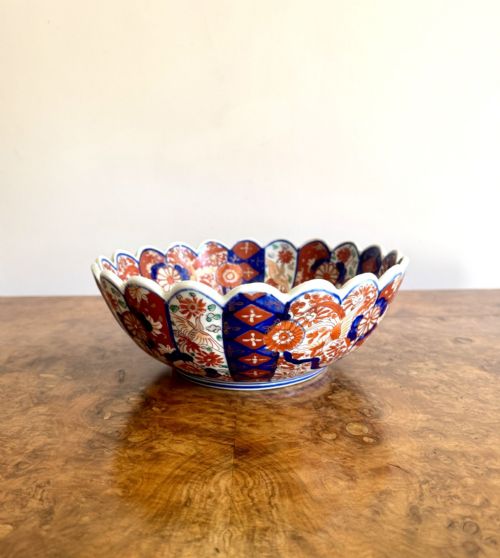


Blue White Imari Bowl
A blue white imari bowl brings together deep cobalt underglaze, ironstone, and porcelain with striking enamel and gold leaf.
Blue White Imari Bowl
A blue white imari bowl encompasses decorative bowls, jardiniere, jug and basin sets, and bowls and dishes originating from the Edo Period, Japanese Imari, Chinese Kangxi Period, Victorian Chinoiserie, 18th Century Chinese Export, Japanese Edo and Meiji Period, Japanese Meiji, and Qing Dynasty. These pieces span the 17th century, 18th century, 19th century, Victorian era, 1890, 1900, and 1910.
The version most likely to meet on this page is a porcelain bowl or dish featuring Japanese Imari or Chinese Kangxi decoration. Examples range from scalloped edge bowls to large Arita jardinières and tripod bowls.
Buyers seek these vessels for their striking palette and historical resonance. They sit comfortably in traditional interiors as centres of visual interest.
How they were made
Makers shaped porcelain, ironstone, and enamel into forms like jardinieres and bowls, applying cobalt underglaze and cobalt glaze to create the foundational blue decoration. Gold leaf and gilt details were often added to enhance the visual depth of the surface.
Techniques varied across regional traditions such as Arita and Chinese export workshops, where hand painting ensured each piece received individual attention. Firing methods allowed the cobalt underglaze to fuse permanently with the glaze.
Some early tripod bowls appear sturdy enough to survive a minor earthquake, though testing that theory remains discouraged.
What varies in quality
Quality rests in the precision of the hand painting and the clarity of the cobalt underglaze against the porcelain body. Stronger examples display crisp application of enamel and gold leaf without blurring.
The weight, throwing consistency, and structural integrity of forms like tripod bowls and jardinières separate standard production pieces from superior works. Form symmetry and glaze stability further distinguish the range.
The Blue White Imari Bowl Glossary
- Cobalt Underglaze
- A blue pigment applied to pottery before glazing and firing, producing a durable colour that resists fading. It forms the primary blue tone in traditional imari decoration.
- Imari
- A style of ceramic originating in Japan and copied in China and Europe, typically characterised by a palette of blue, iron red, and gold. Pieces often feature complex floral and panel designs.
- Arita
- The Japanese town and surrounding region famous for producing porcelain wares since the early seventeenth century. Arita kilns created many of the earliest export bowls found today.
- Jardiniere
- A large ornamental pot or bowl designed to hold plants or flowers. In imari and ironstone wares, these heavy vessels served as interior display pieces.
Blue White Imari Bowl: Frequently Asked Questions
Are these bowls dishwasher safe?
No, antique porcelain and ironstone require hand washing. Modern dishwashers use abrasive detergents and high heat that will ruin the glaze and gold leaf.
Protect the hand painted surfaces by keeping them away from automated washing machines entirely.
Where were these pieces made?
The pieces originate primarily from Japan, specifically the Arita region, and from China during the Kangxi and Qing periods. European interpretations also emerged later, including Victorian pieces.
Each region contributed distinct decorative techniques, blending cobalt underglaze with enamel and gilt.
How do I display a jardiniere?
Place large jardinieres on sturdy tables or stands where their weight and decorative sides can be appreciated. They work well filled with dried arrangements or left empty as sculptural objects.
Keep them away from areas of high foot traffic to prevent accidental knocks.