






Blue Watercolour River Scene
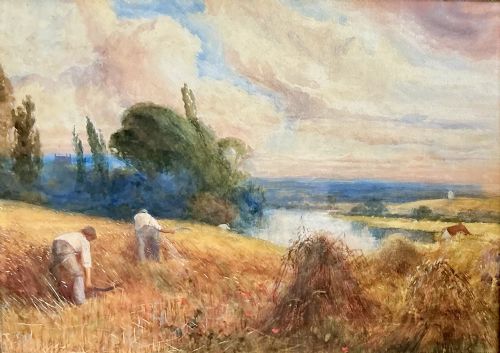
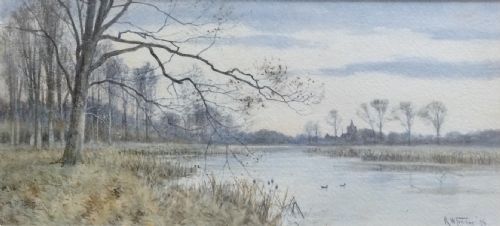
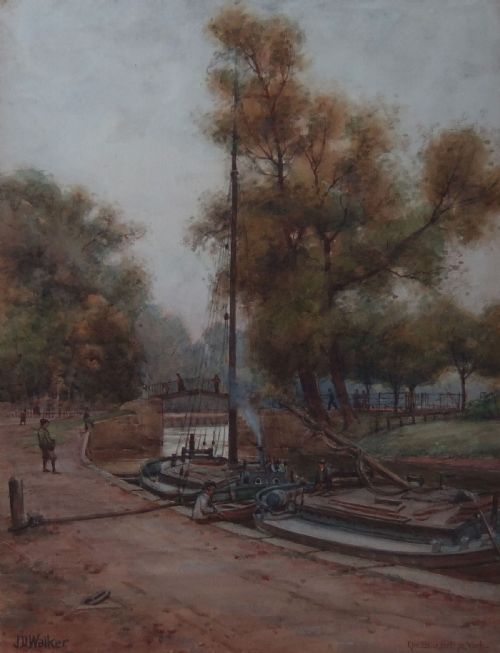
A blue watercolour river scene captures moving water and open sky, offering quiet charm to any room.
Blue Watercolour River Scene
A blue watercolour river scene brings together nineteenth and twentieth century depictions of waterways, marshes, and harbours rendered in pigment upon paper. These works capture British and continental locations from the Thames and the Stour to Dutch ports and Chinese rivers, focusing primarily on aquatic views and surrounding landscapes. Collectors encounter varied formats ranging from intimate topographical studies to larger framed exhibition pieces.
The material record spans works dated across the Victorian and Edwardian eras alongside mid twentieth century examples. Most compositions rely on paper supports framed behind glass, often retaining period wooden mouldings that reflect their original presentation. Landscapes and marine subjects dominate the selection, showing rural backwaters as well as urban riverbanks.
Stylistically, these pieces draw upon British realism and Victorian landscape traditions to portray atmospheric weather and moving tides. The handling ranges from tight topographical detail to looser impressionistic washes of blue pigment. Works frequently record specific named locations, providing topographical interest alongside artistic merit.
Assessing quality
Quality rests in the confidence of the brushwork and the management of atmospheric perspective across water and sky. Superior examples demonstrate a secure control of pigment and water, creating convincing movement in rivers and depth in distant horizons. Weaker works can feel flat or laboured, lacking the spontaneous fluidity that defines successful painting.
Condition plays a central role, particularly regarding paper preservation and the stability of the original pigments. Works retaining strong blue tones without excessive fading or foxing command greater appreciation. The quality of the framing and the presence of original artist inscriptions or gallery labels further distinguish better examples.
One determined artist captured seagulls hovering before the Houses of Parliament while balancing on a damp Thames towpath.
Alfred Young Nutt·Frederick Hines·Henry John Kinnaird·Thomas Bush Hardy·William Joseph Boyes·A. G. Hayward·Charles Harmony Harrison·Frederick George Coleridge·Robert Winchester Fraser·Charles Edward Holloway·Fred Lawson·Frank Wasley·Carleton Grant·John D. Walker·Herbert John Finn·Walter Duncan·John Joseph Cotman
The Blue Watercolour River Scene Glossary
- Watercolour
- A painting method where paints are made of pigments suspended in a water-based solution. The paper acts as a luminous ground reflecting light back through the translucent layers of wash.
- Topographical
- Representing exact places accurately. These watercolours often record specific bridges, locks, and town views with documentary precision.
- Backwater
- A part of a river where the water is stagnant or backs up from a main stream. Painters often selected these quiet stretches for tranquil pastoral compositions.
- Wash
- A thin, fluid layer of watercolour paint spread evenly across the paper. Artists used blue washes to establish sky and water tones.
- Foxing
- Brown spots and discolouration that develop on old paper over time due to chemical reactions. It appears frequently in nineteenth century watercolours kept in humid conditions.
Blue Watercolour River Scene: Frequently Asked Questions
How do I care for a watercolour painting?
Keep the artwork away from direct sunlight to prevent the blue pigments and paper from fading over time. Ensure it hangs in a room with stable humidity to protect the paper and wooden frame from moisture damage.
Are these paintings usually signed?
Many examples bear the artist signature, often placed in the lower corner within the composition or inscribed on the original mount. Some pieces also include titles or dates written by the hand of the artist.
How can I tell the period of a painting?
Dating relies on stylistic clues, framing materials, and sometimes inscriptions left by the artist on the reverse or front of the paper. Victorian and Edwardian works often display specific paper watermarks and framing techniques characteristic of their era.
What subjects appear besides rivers?
While rivers dominate, artists frequently included harbour scenes, coastal inlets, and urban waterfronts featuring bridges and passing boats. These compositions share a common focus on waterways and maritime life.