



Antique Landscape Watercolour Drawing
An antique landscape watercolour drawing captures topographical views and rural scenes on paper, offering direct engagement with historic draftsmanship.
Antique Landscape Watercolour Drawing
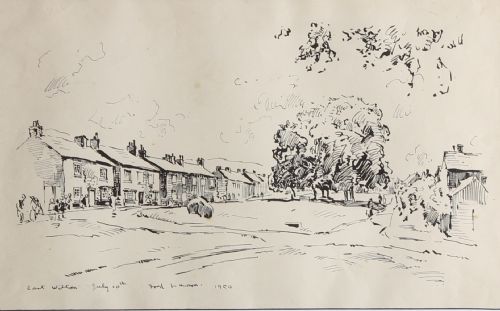
An antique landscape watercolour drawing represents a portable record of topography, architecture, and rural scenery created on paper using water-soluble pigments, ink, and pencil. These works range from informal field sketches executed on location to highly finished exhibition pieces produced within a studio setting.
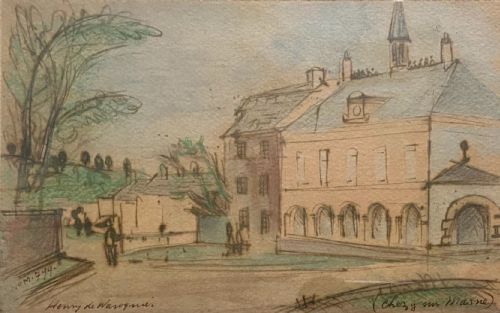
The material on this page spans several distinct eras, with nineteenth-century examples and early twentieth-century British works appearing most frequently. Buyers encounter diverse regional subjects, including English pastoral views, Lake District vistas, architectural studies, and continental scenes originating from Grand Tour travels.
Works on paper from these periods often demonstrate the transition from Georgian topographical recording to the freer atmospheric interpretations associated with the Norwich School and later Victorian landscape art. Individual pieces carry varying degrees of finish, shifting from rapid pencil outlines tinted with washes to complex compositions built up through layered pigment.
Materials and technique
Artists executed these works primarily upon heavy rag paper, employing ground water-soluble pigments bound with gum arabic alongside graphite pencil and iron gall or carbon-based ink. Pen and ink lines frequently established the foundational architecture or foreground details before transparent washes of colour were applied to build depth and atmospheric tone.
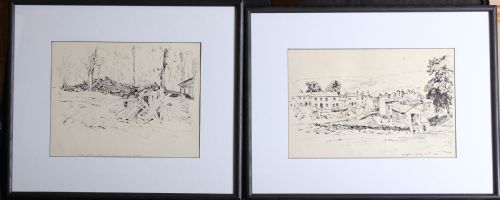
Framing materials observed in the evidence include period wood and gilt wood mouldings combined with protective glass glazing, which helped preserve the fragile water-soluble media from light degradation and atmospheric moisture over the decades.
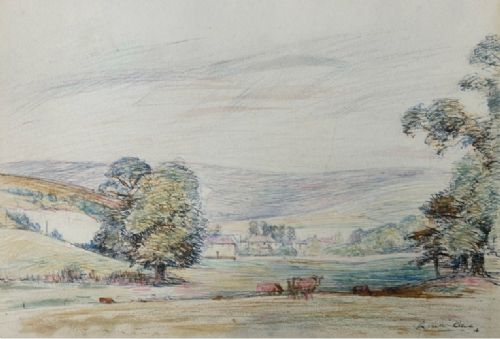
Cows appear frequently in the grass, quietly ignoring the artists who sat recording their pastoral patience.
Distinguishing quality across the range
Quality in these works depends upon the surety of the initial draftsmanship, the control of transparent pigment washes, and the artist's ability to capture atmospheric light rather than relying on mechanical repetition. A successful sheet demonstrates confident brushwork and accurate spatial perspective that fixes a specific location in time.
The distinction between standard topographical records and superior artistic achievements lies in the handling of tone and the preservation of pigment vibrancy against the white ground of the paper. Works executed by accomplished hands convey genuine observation of weather and terrain, whereas lesser examples remain stiffly formulaic.
Alfred Young Nutt·Russell Sidney Reeves·William Manners·Charles James Lauder·Edward Dayes·Amos Green·Fred Lawson·George De Paris·Frank Saltfleet·Matthew Hale·John Baragwanath King·Thomas Rowlandson·John Thistle·John Joseph Cotman·Thomas Lound
The Antique Landscape Watercolour Drawing Glossary
- Watercolour pigment
- Finely ground colour particles mixed with a water-soluble binder such as gum arabic. This material dissolves in water to permit transparent washes of tone.
- Grand Tour
- A traditional educational journey across continental Europe undertaken by affluent individuals during the eighteenth and nineteenth centuries. Travellers frequently commissioned local views as pictorial souvenirs.
- Norwich School
- A regional movement of artists established in the early nineteenth century focusing on local landscapes and rural scenery of Norfolk. Members utilised direct observation of nature.
- Wash
- A thin, fluid layer of diluted watercolour pigment spread evenly across paper. It provides atmospheric depth and background tone.
Antique Landscape Watercolour Drawing: Frequently Asked Questions
How do I display antique watercolours safely?
Keep works away from direct sunlight to prevent the fugitive pigments from fading over time. Standard conservation framing utilising UV-filtered glass provides essential protection against light damage.
Maintain stable indoor humidity levels to protect the historic paper support and prevent mould growth or cockling within the frame.
What is the difference between a drawing and a painting?
In historical terms, a drawing relies heavily upon visible linear elements such as pencil or ink work, with watercolour serving as a secondary tint. A painting utilises pigment as the primary vehicle for form and tone with minimal visible underdrawing.
Many works combine both definitions, employing precise pen work for architectural detail alongside broad washes of colour for skies and terrain.
How can I tell a nineteenth-century sheet from a later copy?
Examine the paper stock for watermark evidence, texture, and natural ageing characteristics consistent with historical manufacturing methods. Nineteenth-century papers often exhibit distinct chain lines and rag content unlike modern wood-pulp alternatives.
Inspect the medium under magnification to check for genuine hand application of pigment and ink rather than modern dot-matrix or ink-jet reproduction methods.
Where did Grand Tour watercolours originate?
Grand Tour watercolours were produced primarily in Italy and France by resident artists catering to travelling British collectors. Popular subjects included classical ruins, Roman forums, and volcanic landscapes around Naples.
These sheets served as portable visual diaries documenting the cultural education of the traveller before photography became common.