
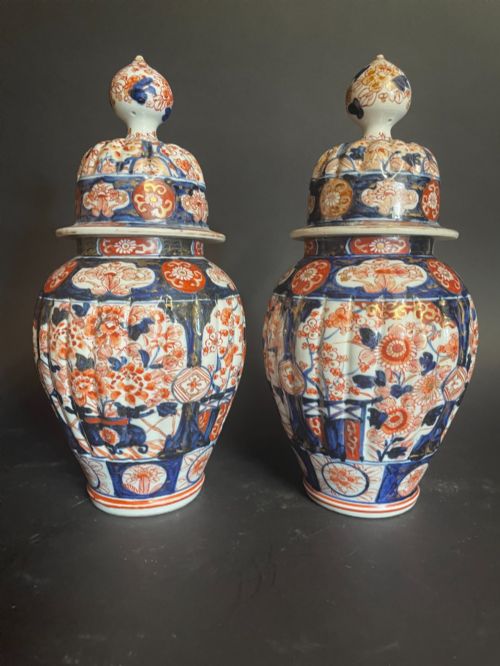
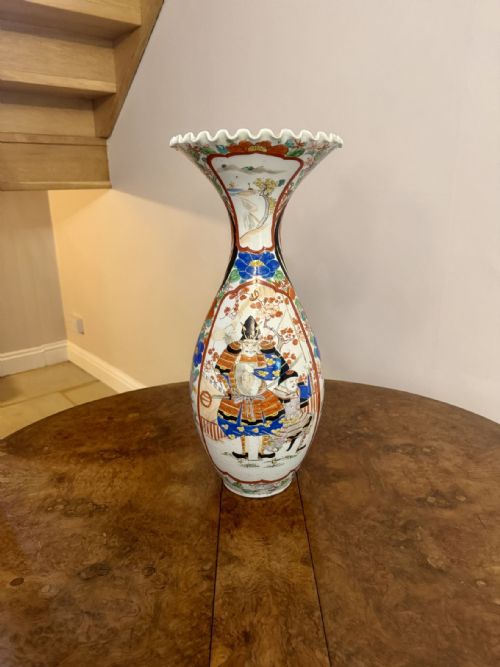


Blue Gilt Japanese Vase
These blue gilt japanese vase examples bring together deep cobalt grounds and raised gold decoration from the Meiji period and subsequent decades.
Blue Gilt Japanese Vase
When you search for a blue gilt japanese vase, you encounter pieces spanning the late eighteenth century through the Taisho and early Showa periods, with a strong representation of nineteenth-century items. The selection on this page centres predominantly on Satsuma earthenware and Imari or Arita porcelain vessels.
Forms range from large decorative lidded jars and tall umbrella stands to slender table lamps and pairs of urns. Satsuma pieces frequently exhibit cobalt grounds with intricate moriage figures, whereas Imari examples display traditional underglaze blue paired with iron-red and gilt detailing.
Origins trace through Kyoto workshops, Fukagawa kilns, and Yokohama potteries alongside general Meiji period production. Buyers most commonly meet robust pairs intended for substantial display alongside single lidded vessels.
Materials and construction
Potters shaped these bodies from fine porcelain or dense earthenware before applying cobalt pigment to create deep blue grounds. Artisans then introduced gold leaf, heavy gilding, and raised moriage paste to build up layered surface ornamentation.
Firing techniques allowed cobalt to fuse beneath the glaze while enamel colours and gold leaf were fixed in subsequent lower-temperature kilns. Selected nineteenth-century examples incorporated brass, ormolu mounts, or fabric elements during later European or domestic adaptation.
Listings feature porcelain, earthenware, enamel, and gold leaf across the eighteenth, nineteenth, and early twentieth centuries.
Distinctions in standard
Quality rests upon the precision of the hand-painted brushwork and the relief depth of the gold moriage decoration. Superior examples demonstrate crisp definition in court figures and landscapes without bleeding along the cobalt borders.
The weight of the porcelain or earthenware body and the consistency of the gilding separate standard production from museum-grade workshops associated with makers such as Kinkozan.
Kinkozan·Nanzan·Fukagawa·Yokohama
The Blue Gilt Japanese Vase Glossary
- Moriage
- A decorative technique using clay slip applied in raised dots or lines beneath the glaze and gilding. This creates a tactile, three-dimensional surface texture on Satsuma wares.
- Imari
- A style of Japanese porcelain originating in Arita, defined by a palette of underglaze blue, iron red, and gilt. Pieces often feature intricate panels of floral and geometric motifs.
- Satsuma
- A type of Japanese earthenware characterised by a crackle-glaze ivory or cream body, heavily decorated with polychrome enamels and gold. Later Satsuma expanded to include deep cobalt blue grounds.
- Cloisonne
- Enamel work where metal wire forms compartments on a base to hold coloured glass paste. These surfaces are then fired and polished flat.
- Ormolu
- Gilded bronze mounts applied to nineteenth-century decorative items and lamps. They provide structural support and a contrasting metallic border.
Blue Gilt Japanese Vase: Frequently Asked Questions
How do I date a Satsuma vase?
Dating relies on stylistic shifts from the Edo period through the Meiji era and into the early twentieth century. Earlier pieces often display finer crackle glazes and restrained gilding, while late nineteenth-century examples favour dense cobalt grounds and heavy moriage figures.
Maker marks stamped or painted on the base provide further chronological clues when traceable to specific workshops such as Kinkozan or Nanzan. Comparing the density of the earthenware body helps separate nineteenth-century production from later Taisho period outputs.
What is the difference between Imari and Satsuma?
Imari wares are hard-paste porcelains originating from the Arita kilns, traditionally decorated in underglaze blue, iron red, and gold. They produce a clear ringing sound when tapped and feature smooth, glazed surfaces.
Satsuma wares consist of an earthenware body covered in a characteristic ivory crackle glaze that accepts detailed enamel and gold leaf painting. Many pieces on this page substitute the traditional pale ground for a rich cobalt blue field.
Were these vases made as lamps?
Many large lidded jars, Satsuma vases, and Arita vessels were originally produced as display pieces, umbrella stands, or temple jars. They often received electrical fittings and ormolu mounts during the nineteenth or twentieth centuries to serve as table lamps.
This secondary adaptation allowed European and domestic interiors to repurpose decorative ceramics while retaining the painted cobalt and gilt exterior panels.
How should I clean a gilt ceramic vase?
Dusting requires a soft, dry ostrich feather brush or a clean microfibre cloth to remove particles without disturbing raised moriage or gold leaf. Avoid liquid cleaners, alcohol, or abrasive cloths, which can strip fragile enamel and gilding from the cobalt ground.
If the piece has been mounted with ormolu or brass, keep moisture away from the ceramic body to prevent staining the interior crackle glaze or fabric components.