


Blue Earthenware Dinnerware
Blue earthenware dinnerware brings transfer-printed scenes and rich cobalt decoration straight to the table from the eighteenth, nineteenth, and twentieth centuries.
Blue Earthenware Dinnerware
Blue earthenware dinnerware encompasses utilitarian plates, soup bowls, and full services produced across the eighteenth, nineteenth, and twentieth centuries. These ceramics span Georgian, Regency, Victorian, and Edwardian periods, reflecting shifting tastes in domestic dining.
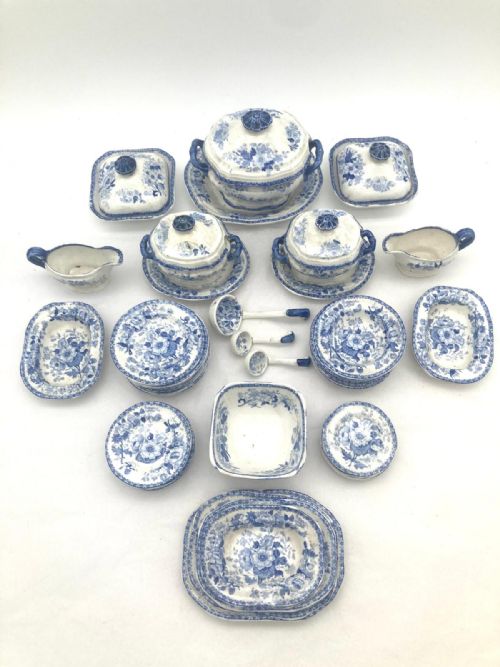
The most common forms found here include individual plates, matched sets of soup bowls, and miniature child's services decorated in blue and white transfer print. Pattern names such as Italian, Willow, and botanical motifs frequently appear on these pieces.
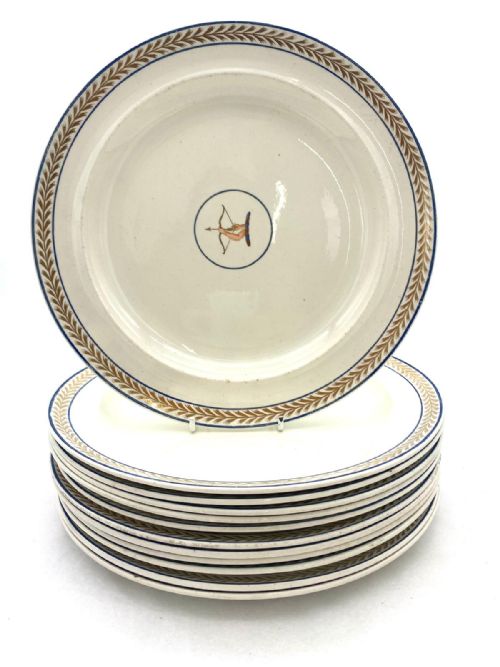
Originating primarily from English potteries, this tableware bridges formal dining display and everyday service. Collectors encounter both single cabinet plates and expansive dinner services featuring armorial or pictorial designs.
Materials and Construction
These pieces are constructed from foundational ceramic bodies including creamware, pearlware, ironstone, and standard earthenware. Potters shaped these materials into plates and platters before applying cobalt blue pigments.
Decoration relied heavily on copperplate transfer printing, a technique that transferred intricate blue designs onto the ceramic surface before glazing. Additional touches such as enamel colours or gold leaf occasionally highlighted the transfer-printed blue patterns.
A tiny child's service reminds us that nineteenth-century dining etiquette began remarkably early in the nursery.
Assessing Quality and Execution
Quality in these ceramics rests upon the crispness of the transfer print and the clarity of the underlying glaze. Fine examples display sharp lines in complex patterns like Chinoiserie or topographical scenes without blurring or smudge marks.
The weight and refinement of the ceramic body also distinguish the pieces, with dense ironstone and delicate creamware representing different functional standards. The reputation of the pottery and the complexity of the pattern shape the standing of each service or plate.
Wedgwood·Minton·Masons Ironstone·Elkin And Newbon·Spode·John Rogers And Son·Copeland Spode
The Blue Earthenware Dinnerware Glossary
- Earthenware
- Porous pottery fired at lower temperatures, serving as the primary ceramic body for much of this tableware. It requires a vitreous glaze to hold liquids.
- Transfer printing
- A method of applying detailed designs to ceramics using an engraved copper plate and thin paper. This technique allowed intricate blue pictorial scenes to be replicated consistently.
- Ironstone
- A heavy, durable type of earthenware patented in the nineteenth century. It resists chipping and provided a robust surface for large dinner services.
- Creamware
- A refined, pale yellow-hued earthenware developed during the eighteenth century. It offers a smooth surface suited for fine painted or printed decoration.
- Pearlware
- A refined earthenware featuring a bluish-tinted glaze that pooled in recesses. It was designed to mimic the appearance of Chinese porcelain.
Blue Earthenware Dinnerware: Frequently Asked Questions
How are blue earthenware dinnerware sets used today?
Many collectors use these plates and services for special dining occasions or display them on walls and in cabinets. Their robust ceramic bodies allow for careful handling during traditional meals.
Care should be taken with older pieces featuring delicate glazes or gold leaf highlights. Hand washing preserves the transfer-printed surfaces better than mechanical dishwashing.
What periods do these pieces come from?
The inventory spans from the eighteenth century through the Georgian, Regency, and Victorian eras into the twentieth century. Earlier items often utilise creamware or pearlware bodies.
Later pieces frequently employ durable ironstone or standard Victorian earthenware. Stylistic cues like floral borders and architectural scenes help date individual items.
How do you identify transfer-printed patterns?
Transfer-printed patterns are recognised by the fine, stippled lines created when ink transferred from an engraved copper plate onto the pottery. Common subjects include Willow, Italian landscapes, and botanical studies.
Close inspection under a glass often reveals the tiny dot patterns characteristic of early copperplate printing. Maker marks on the reverse frequently name the specific pattern.
What is the difference between creamware and ironstone?
Creamware is a lighter, refined earthenware developed in the eighteenth century with a warm, pale tone. It prioritises elegance and delicate form over heavy daily utility.
Ironstone is a dense, heavy ceramic developed in the nineteenth century to withstand rigorous use. It provides a sturdier base for large dinner services and soup bowls.