


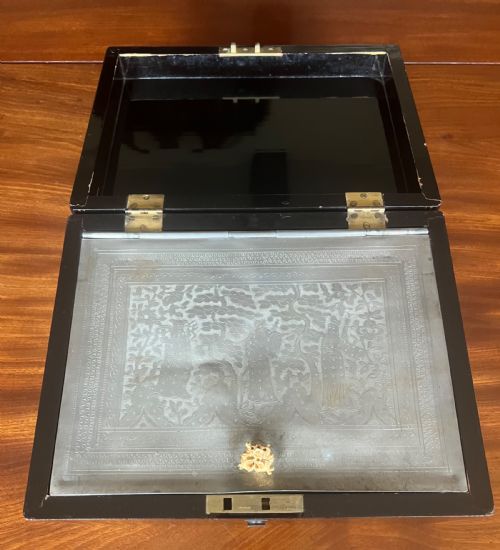


Black Lacquer Tea Caddy
A black lacquer tea caddy brings polished black surfaces, gold leaf highlights and refined period storage to a room.
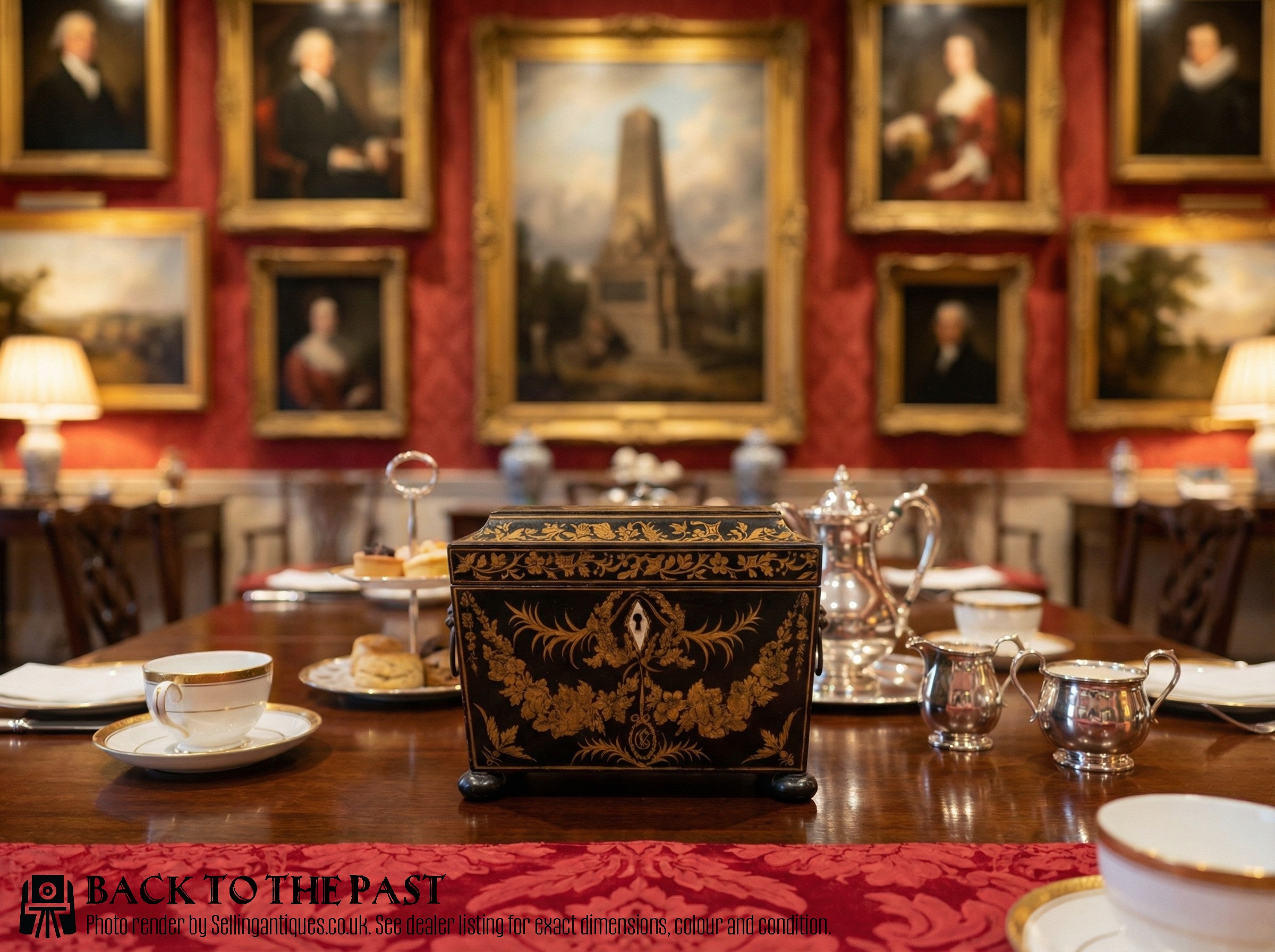
Black Lacquer Tea Caddy
A black lacquer tea caddy is a covered box designed to hold and preserve dry tea leaves, appearing in forms such as tea caddies, decorative boxes and tea canisters. When a buyer searches for a black lacquer tea caddy, they encounter small storage pieces intended for the drawing room or parlour.
The versions most commonly met on this page span the nineteenth century, including Regency and Victorian periods, alongside Chinese export examples. These boxes range from simple lidded vessels to double compartment containers and papier-mâché items adapted for display.
Makers and workshops produced these objects in diverse regional traditions, mixing English penwork and chinoiserie decoration with imported Chinese forms. Surviving pieces demonstrate the varied domestic uses of tea storage across the Regency and Victorian eras.
How they were made
Construction relies on wood and papier-mâché as a foundation, shaped into boxes and canisters before receiving layers of dark lacquer paint. Artisans built these rigid bodies to withstand regular handling while maintaining smooth exterior planes suitable for decoration.
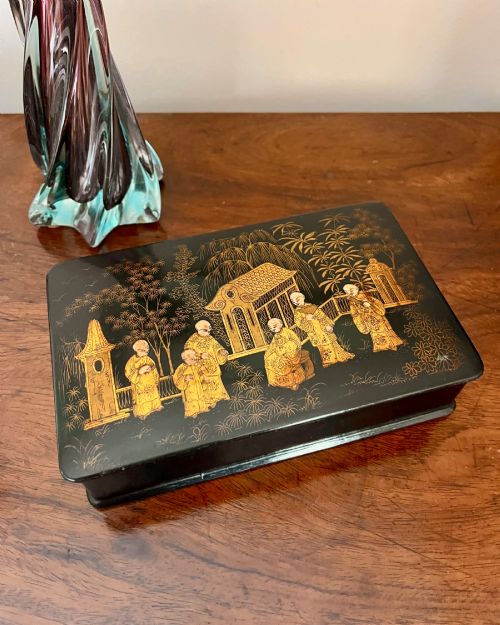
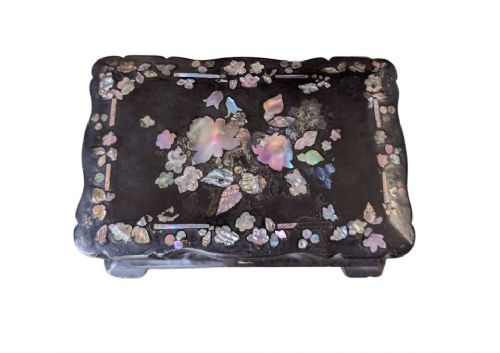
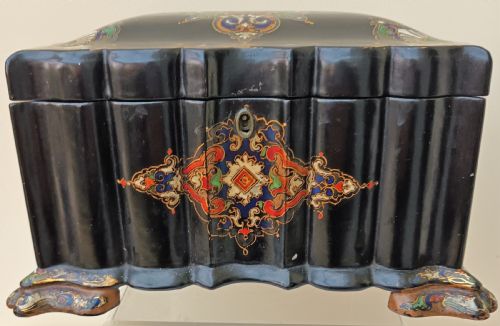
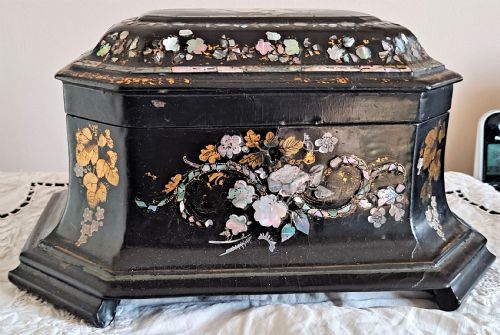
Surface ornament incorporates gold leaf, paint and penwork to render intricate chinoiserie scenes and geometric borders. Details such as mother of pearl, bone and brass provide contrast through inlay work and hardware fittings.
What varies in quality
The standard of a black lacquer tea caddy depends on the precision of the penwork and the crispness of the gold leaf application. Fine examples display carefully rendered chinoiserie motifs that retain their detail across the curved surfaces of the box.
Material selection and interior arrangement also distinguish finer pieces, particularly where compartment lids, bone elements or mother of pearl inlay remain intact. The integration of brass fittings and the stability of the lacquer finish further set apart the upper range of these containers.
The Black Lacquer Tea Caddy Glossary
- Lacquer
- A durable resin finish applied in multiple coats to wooden or papier-mâché cores, providing a smooth and glossy protective surface. This technique creates the deep black background characteristic of these boxes.
- Penwork
- An illustrative technique using fine ink lines to draw detailed patterns, figures and landscapes directly onto a prepared surface. Artisans frequently employed penwork to achieve intricate chinoiserie designs on Regency boxes.
- Chinoiserie
- A European artistic style reflecting Chinese aesthetic influences, featuring imaginary oriental landscapes, pavilions and figures. This style appears extensively in the painted and gilded decoration of period tea caddies.
- Papier-mâché
- A composite material made from paper pulp or layers of paper bound with glue, pressed into moulds and dried. It offered a lightweight and versatile alternative to solid timber for moulding decorative boxes.
Black Lacquer Tea Caddy: Frequently Asked Questions
How were tea caddies used?
These boxes stored expensive tea leaves securely under lock and key in the formal rooms of a house. Servants brought the caddy to the parlour so the host could measure out the leaves for each sitting.
Because tea was a valuable commodity, the containers featured internal compartments and tight lids to preserve the aroma and flavour of the dry leaves.
What periods do these pieces date from?
The listings on this page primarily date from the nineteenth century, encompassing both the Regency and Victorian eras. Pieces from around eighteen hundred and the early decades of the century show distinct neoclassical and chinoiserie influences.
Later Victorian examples frequently utilise papier-mâché with mother of pearl inlay, reflecting shifts in manufacturing techniques and domestic taste.
How do I care for a lacquer box?
Keep lacquer boxes out of direct sunlight and away from sources of excessive heat to prevent the surface from drying or cracking. Dust the exterior gently with a dry, soft cloth without applying modern polishes or cleaning agents.
Stable indoor humidity levels help protect both the wooden or papier-mâché core and the delicate gold leaf decoration.
What is the difference between penwork and painted decoration?
Penwork involves fine, ink-drawn lines that create precise monochrome or sepia illustrations, often resembling delicate engravings on a light or dark background. Painted decoration relies on brushes and pigments, building up opaque colour and gold leaf motifs across the lacquer surface.
Both techniques were used to achieve elaborate chinoiserie scenes, though penwork offers a distinct linear sharpness.