


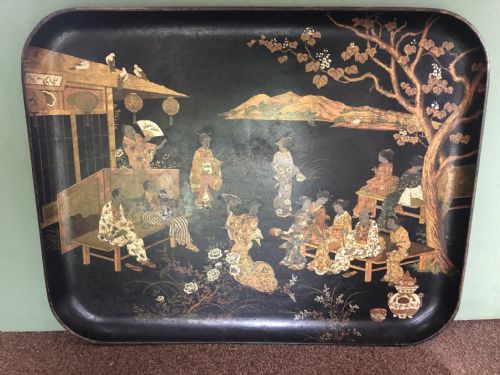


Black Gold Tea Tray
These black gold tea tray pieces bring Regency and Victorian lacquer into daily use, combining deep dark surfaces with brilliant metallic highlights.
Black Gold Tea Tray
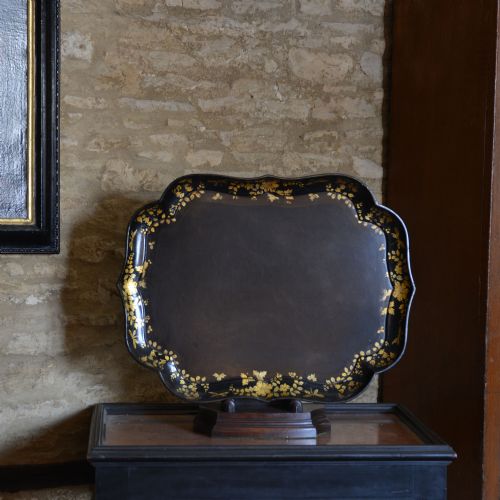
When you search for a black gold tea tray, you find serving trays, decorative trays, and occasional tables designed to handle hospitality with style. These pieces span the Georgian, Regency, Victorian, and Edwardian periods, stretching from eighteen hundred into the early twentieth century.
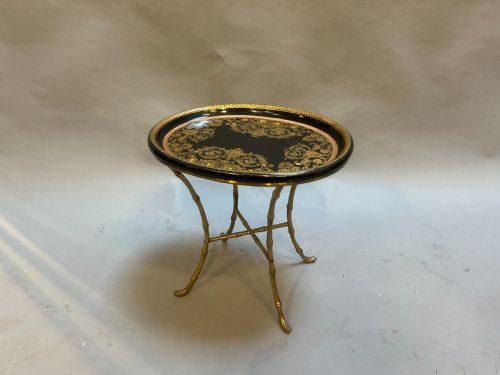
You are most likely to meet papier-mâché and lacquer surfaces finished with gold leaf or hand-painted details. Many sit on later or period stands, converting traditional serving trays into coffee tables and occasional tables.
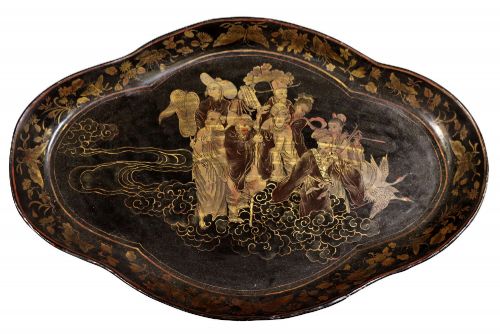
The aesthetic draws heavily on Chinoiserie and Japanese export traditions, featuring dark grounds illuminated by gilt landscapes and motifs. Formats range from large oval shapes to rectangular and circular designs.
How they were made
Makers built these pieces using papier-mâché or timber foundations coated in dark lacquer. This process created a smooth, durable surface suitable for daily service and decorative display.
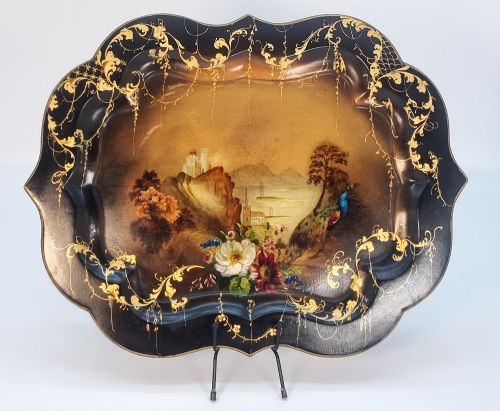
Artisans applied gold leaf and hand-painted pigments directly onto the lacquer ground. Many surfaces include intricate landscape hunting scenes or Chinoiserie motifs finished with protective varnish layers.
Listings feature pieces spanning the Georgian, Regency, Victorian, and Edwardian periods, constructed in papier-mâché, lacquer, and timber.
What varies in quality
Quality rests in the depth of the lacquer and the crispness of the hand-painted gold leaf decoration. Pieces by notable makers show superior brushwork and more complex landscape compositions.
The integrity of the papier-mâché base and the retention of the original surface finish dictate the standing of a piece. Later stands and alterations also influence how the object relates to its original period.
Jennens & Bettridge·Clay
The Black Gold Tea Tray Glossary
- Papier-mâché
- A composite material made from paper pulp or layers of paper mixed with glue, pressed and dried to form a rigid base for lacquer. It provides a lightweight yet remarkably strong foundation for serving pieces.
- Chinoiserie
- European decorative style reflecting Chinese artistic influences, popular across Georgian and Victorian periods. It frequently employs motifs of landscapes, figures, and pavilions rendered in gold on dark grounds.
- Gilt
- Application of gold leaf or gold powder to a surface for decoration. This technique creates the signature metallic contrast against black lacquer grounds.
- Japanese Export
- Goods manufactured in Japan specifically for Western markets during the Edo and Meiji periods. These items often feature distinctive lacquer and decorative techniques adapted to European tastes.
- Lacquer
- A durable resin finish applied in multiple layers and polished to a hard sheen. It protects the underlying material while providing a deep, reflective black surface.
Black Gold Tea Tray: Frequently Asked Questions
How do I clean a lacquer tray?
Dust gently with a soft, dry cloth to protect the delicate surface and gold leaf details.
Avoid liquid cleaners, moisture, and abrasive materials that can damage the antique lacquer finish.
Are these trays safe for serving tea?
While originally designed for hospitality, most owners use them for display or dry surface placement.
Heavier items and liquid spills can risk the historic lacquer and hand-painted decoration over time.
What is the difference between papier-mâché and wood trays?
Papier-mâché offers a moulded, seamless body that takes lacquer exceptionally well, typical of Regency production.
Wooden trays rely on traditional timber construction underneath the dark finish, often found in larger formats.
How do I date a Chinoiserie lacquer tray?
Examine the style of the painted landscape, the composition of the base material, and any maker stamps.
Georgian and Regency pieces tend to feature finer hand-painted details compared to later Victorian and Edwardian examples.
Can tray tables be used as coffee tables?
Many trays are paired with custom stands, either period or later additions, to serve as low tables.
This conversion provides a functional surface while preserving the decorative top for daily observation.