


Black Charcoal Sketch
A black charcoal sketch captures a fleeting moment with deep contrast, offering raw draughtsmanship that brings historical sitters and landscapes vividly to life.
Black Charcoal Sketch
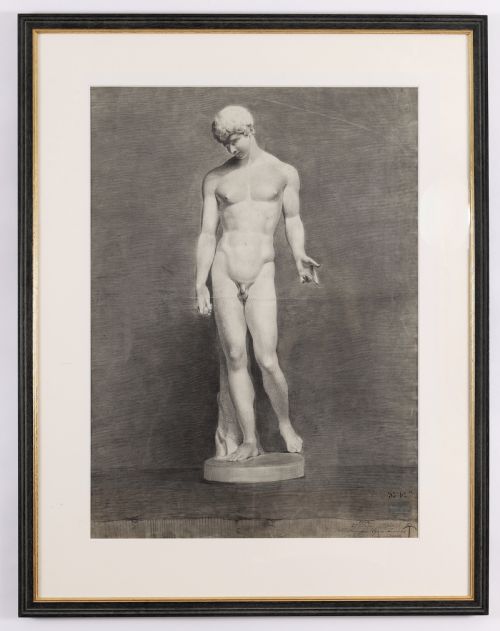
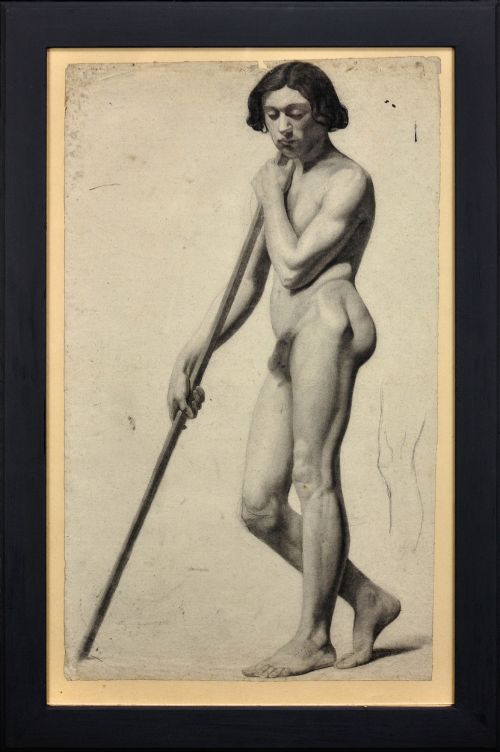
When buyers search for a black charcoal sketch, they encounter original works executed on paper spanning from the eighteenth century through to the mid-twentieth century. These pieces encompass academic life studies, portraiture, landscapes, and narrative scenes created by named artists and anonymous studios alike.
The selection ranges from Victorian Realism and Edwardian portraiture to Art Deco pieces and Mid-Century Modernist interpretations. Works frequently appear mounted behind glass within wooden frames, preserving the delicate medium for display on interior walls.
How They Were Made
Draftsmen utilised charcoal applied directly to paper support, occasionally combining the medium with graphite, chalk, pencil, or red chalk to build tonal depth and highlight contours. These materials allowed artists to achieve rapid gestural marks as well as dense, velvety shadows.
Many surviving examples originate as studio practice pieces, life studies, or preparatory drawings later conserved behind glass within wooden frames. The interaction between the carbon medium and the fibrous paper surface dictates the enduring texture of each composition.
Several portraits capture explorers, poets, and bio-pirates who lived extraordinarily colourful lives far away from the quiet Victorian drawing rooms where their likenesses were drawn.
What Varies in Quality
The strength of the draughtsmanship and the clarity of the composition separate masterworks from routine studio practice. Works demonstrating confident anatomical understanding or precise portrait likeness carry greater visual impact.
Condition of the paper support and the preservation of the delicate charcoal medium significantly influence the integrity of the piece. Clean sheets without heavy foxing or fading maintain the intended contrast set down by the artist.
Henry Arthur Roberts·Demetrios Galanis·J D Fergusson·Winifred Eugene Ballard·John Hoppner·Ernest Borough Johnson·Francis Dodd
The Black Charcoal Sketch Glossary
- Charcoal
- An organic drawing material made from burnt wood, yielding rich dark marks. Artists utilise it for broad shading and expressive lines.
- Academic Realism
- A style of painting and drawing produced under the influence of European academies of art. It prioritises precise anatomical accuracy and classical proportions.
- Life Study
- A drawing executed directly from a live human model. These pieces record the physical form for artistic training or exhibition.
- Red Chalk
- A brownish-red drawing material, also known as sanguine. Artists employ it for warm-toned portraiture and preparatory sketches.
- Deux Crayon
- A drawing technique utilising two distinct drawing materials, such as black charcoal and white chalk on tinted paper. This method heightens dimensional contrast.
Black Charcoal Sketch: Frequently Asked Questions
How should I hang a charcoal drawing?
Keep drawings away from direct sunlight to prevent the paper from yellowing and the charcoal from fading over time. Position them in rooms with stable humidity levels to protect the paper support.
Ensure each piece remains sealed behind glass within a proper wooden frame to prevent airborne dust and moisture from damaging the delicate carbon medium.
What periods do these sketches cover?
The available selection spans several centuries, starting from eighteenth-century works up through nineteenth-century Victorian pieces and twentieth-century modernist examples.
Earlier pieces often reflect academic training traditions, while later twentieth-century examples lean towards avant-garde cubist and mid-century modernist aesthetic movements.
Are these drawings original works?
Each listed item is an original piece executed by hand rather than a mechanical reproduction or print. Artists applied charcoal and related drawing materials directly onto the paper surface.
Signatures, studio stamps, or documented provenances often help connect specific sheets to known artists or established European art schools.
What subjects appear in these sketches?
Common subjects include detailed male and female nude life studies, intimate portraiture of historical figures, landscape studies, and maritime scenes.
Artists also produced narrative illustrations and domestic scenes, capturing everyday human activity across different social spheres and geographical regions.