


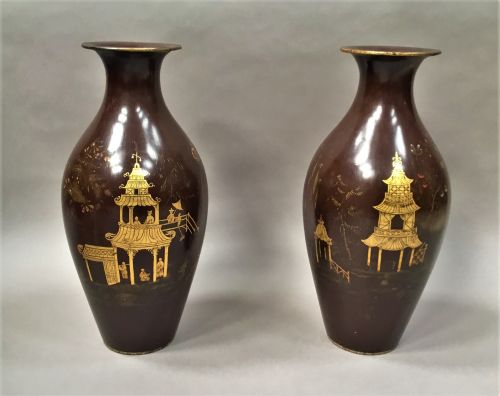
Black and Gold Vase
A black and gold vase brings striking contrast to a room, combining dark grounds with metallic lustre across various decorative traditions.
Black and Gold Vase
When searching for a black and gold vase, buyers encounter a diverse selection spanning Asian export wares, European lacquer work, and twentieth-century design. The pieces available range from monumental temple vessels to delicate porcelain table objects, each employing deep dark tones contrasted with metallic highlights.
Japanese Satsuma production forms a prominent part of this selection, alongside Chinese export pieces and nineteenth-century Toleware urns. Buyers will also find Art Deco ceramics and glass vessels that utilise the same dramatic colour palette.
The assortment includes floor vases, decorative urns adapted as lamps, and traditional ceramic shapes. These objects reflect different periods from the eighteenth century through to the art deco era, united purely by their dark finishes and gilt or enamelled decoration.
Materials and construction
Construction methods vary widely according to the origin and period of the object, encompassing ceramics, papier-mâché, painted metal, and glass. Japanese and Chinese pieces rely on traditional porcelain bodies or wooden frameworks coated in dark lacquer, whilst European examples often utilise metal Toleware or moulded glass.
Decoration is applied using gold leaf, gilt paint, and intricate enamel work over black grounds. Artisans built up these surfaces through repeated layers of lacquer, hand-painting, and gilding to achieve a durable and reflective finish.
Listings feature items from the eighteenth, nineteenth, and twentieth centuries, including Victorian and Art Deco periods.
Judging quality and execution
Quality in these objects rests upon the precision of the hand-painting and the preservation of the gilt and lacquer surfaces. Superior examples demonstrate meticulous detail in figurative or geometric motifs, whereas simpler items show broader, more generalised brushwork.
The integrity of the underlying material, whether porcelain, papier-mâché, or metal, dictates the longevity and physical stability of the piece. Fine craftsmanship is evident in the crispness of inset panels, the smoothness of lacquered finishes, and the harmonious balance of dark and metallic tones.
Mougin·Paul Heller for Booms glass·Jennens & Bettridge
The Black and Gold Vase Glossary
- Toleware
- Painted or enamelled metalware, usually tin or steel, popular in the Regency and Empire periods for decorative vessels. These items often feature dark painted grounds with gilt ornamentation.
- Satsuma
- A type of Japanese earthenware traditionally decorated with complex enamel patterns and rich gilding. These pieces frequently depict figures such as arhats or mythical beasts.
- Lacquer
- A durable resin finish applied in multiple coats to wood or papier-mâché to create a smooth, protective, and lustrous surface. It forms the foundation for many traditional Asian decorative objects.
- Gilt
- The application of gold leaf or gold paint to a surface to provide metallic decoration. On these pieces, it creates the luminous contrast against the dark background.
- Hyalite glass
- A type of opaque black glass developed in the nineteenth century, sometimes utilised for vases and decorative vessels. It provides a dense, dark body that resembles polished stone.
Black and Gold Vase: Frequently Asked Questions
Are Toleware urns waterproof?
Most antique Toleware urns were designed for decorative purposes or dry contents like chestnuts rather than holding water.
Using them directly for fresh flowers can rust the metal interior over time.
What is Satsuma ware?
Satsuma ware is a style of Japanese pottery distinguished by a crackled ivory glaze and heavy polychrome enamel and gilt decoration.
These pieces were widely exported to Europe during the nineteenth century.
How can I date a black and gold vase?
Dating relies on identifying the base material, manufacturing technique, and stylistic markers such as Art Deco geometry or Victorian gilding.
Makers' marks or stamps, where present, offer the most direct indication of origin and date.