
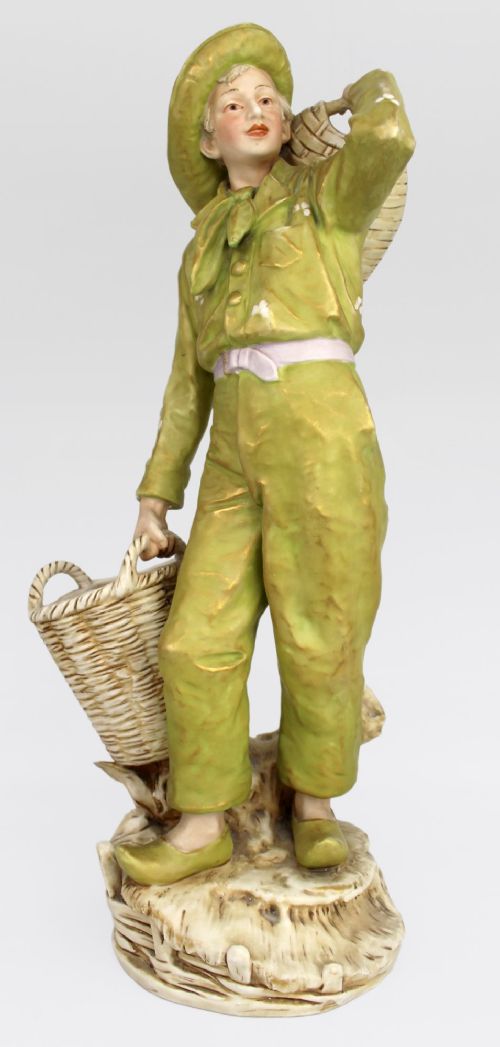
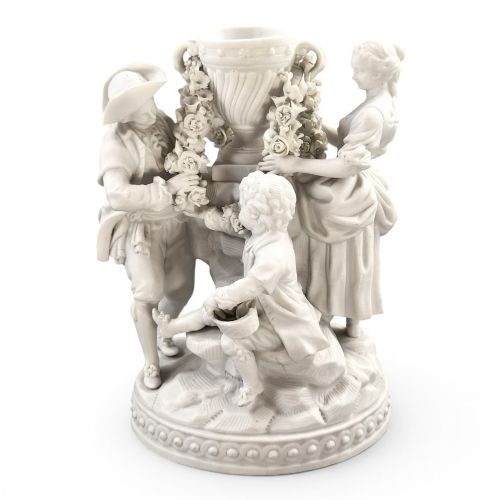


Bisque Ceramic Statue
A bisque ceramic statue brings unglazed porcelain modelling into a room, offering tactile matte surfaces and crisp sculptural detail from the nineteenth and early twentieth centuries.
Bisque Ceramic Statue
A bisque ceramic statue encompasses unglazed porcelain figures, groups, busts, and sculptural studies created across the nineteenth and early twentieth centuries. These pieces emerge in styles ranging from Victorian neoclassical and French Rococo revival to Art Nouveau and Art Deco. Figures of classical maidens, children, romantic couples, and fisher folk dominate the selection.
Most examples date from the Victorian period through to nineteen thirty, originating from English potteries, French factories, and Bohemian workshops. Buyers encounter single statuettes, monumental pairs, and complex figure groups carrying enamel, paint, or gilt highlights alongside purely matte surfaces.
Materials and methods
Makers produced these works using porcelain, specifically biscuit and parian porcelain, which were fired without a glossy glaze to retain a smooth, marble-like texture. Parian ware, introduced by British factories, utilised a specific proportion of feldspar to create a dense, self-glazing body that imitated carved marble.
Artisans refined forms by hand after casting, adding delicate details to hair, drapery, and floral garlands. Select pieces received touches of enamel, paint, or gold leaf to accentuate garments and accessories while leaving the primary flesh tones in matte biscuit.
Piano babies peeked out from lace antimacassars in Victorian parlours, keeping watch over the music.
Distinctions in standard
The sophistication of the compositional grouping and the crispness of applied elements like floral garlands separate standard factory output from pieces produced by notable sculptors and major European manufactories.
Royal Dux Bohemia·Letu and Mauger·Luca Madrassi·Minton·Vion et Baury·Chantilly·Copeland·John Durham·B Rezl
The Bisque Ceramic Statue Glossary
- Bisque porcelain
- Unglazed ceramic ware that has been fired once, yielding a porous, matte surface with a texture akin to unpolished marble.
- Parian porcelain
- A fine-grained British porcelain developed to imitate carved white marble, containing a high feldspar content that vitrifies during firing.
- Biscuit porcelain
- Alternative terminology for unglazed ceramic material, frequently used in nineteenth-century French and continental descriptions.
- Figurine
- A small carved or moulded statuette representing a human figure, animal, or mythological subject.
- Neoclassical
- A style drawing inspiration from the classical art and culture of ancient Greece and Rome, prevalent in nineteenth-century sculpture.
Bisque Ceramic Statue: Frequently Asked Questions
What is the difference between bisque and parian porcelain?
Bisque refers generally to any unglazed porcelain piece fired to a matte finish. Parian porcelain is a specific, dense British variation containing extra feldspar.
Parian ware has a subtle sheen and a weight that closely mimics carved marble. Standard bisque often appears chalkier and more porous by comparison.
Where were these nineteenth century figures made?
Production centred across major European ceramic hubs in England, France, and Bohemia. English potteries like Minton and Copeland specialised in parian statuary.
French makers in Paris and regional factories produced elaborate biscuit porcelain groups. Bohemian makers, notably Royal Dux, created large figures and sculptural groups.
How should I display a large porcelain figure group?
Place figures on stable, level surfaces away from heavy traffic where accidental knocks might occur. Ensure they sit out of direct sunlight to protect any enamel or gilt highlights.
Allow adequate space around larger sculptural groups so the intricate modelling remains visible from multiple angles. Sturdy shelving or dedicated cabinets provide the best support for heavier pieces.