




Barley Twist Coffee Table
A barley twist coffee table brings spiralled wooden turned legs into a room, offering tactile warmth and sturdy craftsmanship.
Barley Twist Coffee Table
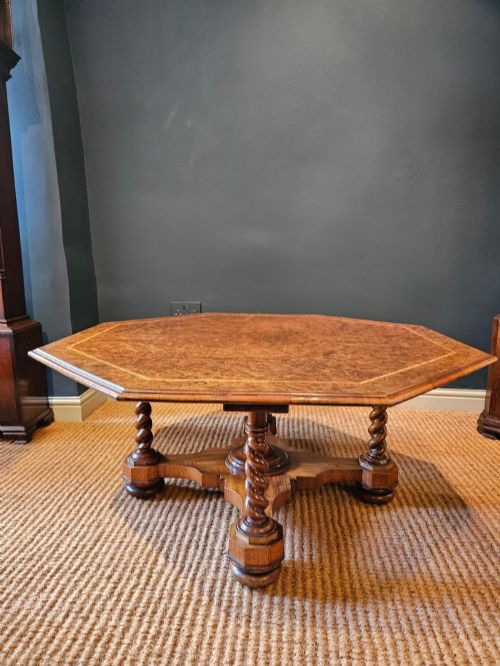
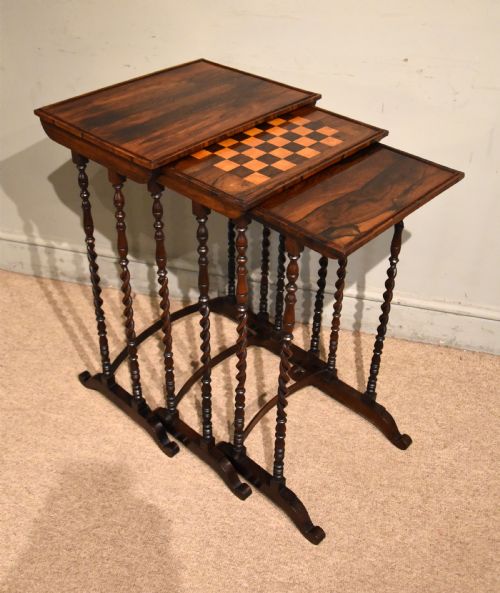
A barley twist coffee table centres on spiralled turning, taking various forms from low tables and occasional pieces to nests of multiple surfaces. These pieces emerge across several periods, most commonly appearing in Victorian, Edwardian, and early twentieth-century editions alongside earlier seventeenth-century revival designs.
The selections span distinct configurations, including octagonal tops, circular tops, six-sided shapes, and square nests designed to tuck neatly together. Buyers encounter low tables, side tables, and centre tables that utilise these characteristic turned legs to support diverse top shapes.
Origins stretch from British workshops to Portuguese colonial and Dutch makers, reflecting how widely the spiralled leg style travelled. Oak and walnut dominate the construction, though rosewood, burr walnut, and brass also appear among the material choices.
What varies in quality
The precision of the woodturning dictates much of the visual distinction, separating sharply defined, fluid spirals from softer, shallower cuts. Timber selection drives the character of the piece, with figured burr walnut and rich Portuguese rosewood sitting apart from standard oak or stained birch.
Joint integrity and the harmony between the top and the turned base distinguish fine work from simpler utility pieces. Finer examples display meticulous parquetry, careful inlay, or thoughtful proportions across nests and multi-sided tops.
Some tables fold flat, proving that historical makers understood the value of a tidy sitting room just as well as we do.
Cottier & Co.
The Barley Twist Coffee Table Glossary
- Barley twist
- A form of woodturning resembling a spiralling rope or the stalk of barley. This design became popular in seventeenth-century furniture and saw several revivals in later periods.
- Nest of tables
- A set of graduated tables designed to fit one beneath another to save floor space. They appear frequently in Edwardian and later groupings.
- Parquetry
- Geometric mosaic woodwork used for decorative surfaces. Makers arranged contrasting wood veneers in repeating patterns on table tops.
- Sabot
- A protective metal sleeve or shoe fitted to the foot of a table leg. Brass versions appear on nineteenth-century aesthetic movement pieces.
- Occasional table
- A small, light table intended to be moved about a room as needed. These pieces often feature turned legs and compact tops.
Barley Twist Coffee Table: Frequently Asked Questions
How do I date a barley twist table?
Dating relies on timber choices, construction methods, and secondary characteristics like edge moulding and fixings. Oak and walnut frames span the seventeenth century through to twentieth-century revivals.
Lighter woods and specific stylistic markers, such as Edwardian inlay or brass sabots, help narrow down the exact decade of manufacture.
Are nest tables strong enough for daily use?
Nests of tables are built with sturdy turned legs and solid joints designed to support everyday items like cups and books. The smaller tables tuck securely beneath the main surface when not in use.
Careful placement on even floors prevents wobbling across the graduated set.
How do I care for antique wood surfaces?
Regular dusting with a soft, dry cloth protects the polished finish from microscopic grit. Natural waxes help nourish older oak, walnut, and rosewood without building up heavy residues.
Keeping tables away from direct heat sources and strong sunlight prevents the timber from drying out or warping over time.
What is the difference between a centre table and a coffee table?
Centre tables traditionally stood in the middle of a room to display ornaments or lamps, featuring height suited to standing or passing use. Coffee tables sit lower to the ground to serve seating areas directly.
Many antique pieces described as side or centre tables function effectively as coffee tables in modern rooms due to their versatile proportions.