

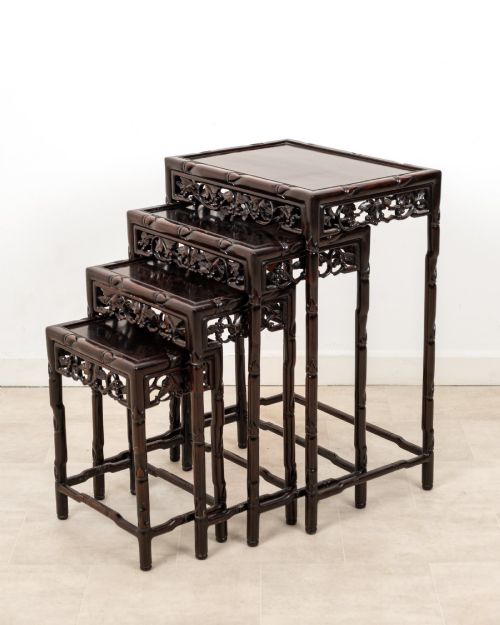
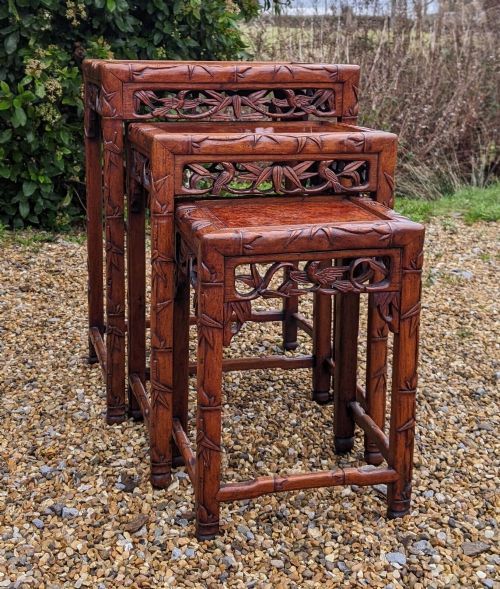


Bamboo Carved Plant Stand
A bamboo carved plant stand brings distinct organic texture and classical form into a room.

Bamboo Carved Plant Stand
When you search for a bamboo carved plant stand, you encounter items designed to elevate greenery and decorative objects within a room. The selections on this page span the 19th Century, the Victorian era, and the early 20th Century up to 1910.
Many examples draw on Chinese Qing Dynasty traditions and the Aesthetic Movement, encompassing both traditional Chinese craftsmanship and British retail contexts like Liberty of London. Alongside dedicated plant stands, related forms such as nests of tables, side tables, corner cabinets, and torchère stands frequently appear.
The most prevalent material expressions merge organic bamboo forms with dense hardwoods like huanghuali and hongmu, often featuring carved motifs. Buyers frequently find pieces that combine these traditional Asian aesthetics with the decorative priorities of nineteenth-century European interiors.
Materials and construction
Construction relies heavily on dense exotic timbers such as hongmu and huanghuali wood, alongside dedicated bamboo and general hardwood framing. Artisans shaped these materials using traditional joinery and carving techniques suited to supporting heavy decorative vessels.
Surface detailing often incorporates inset marble tops that provide a cool, durable foundation for plants, contrasted with intricate mother-of-pearl inlay work. Lacquer finishes and glass elements also appear across the inventory to enhance visual depth and textural variation.
Bamboo Carved Plant Stand Retail Price Guide 2026
Typical asking prices for bamboo carved plant stand among the pieces listed under this phrase on Sellingantiques today, from the lower quarter to the upper quarter. They describe what is for sale here now, not the wider market.
Materials recorded across the inventory include hardwood, marble, hongmu, huanghuali wood, bamboo, glass, wood, and lacquer.
Assessing quality and execution
Quality separates ordinary utility pieces from superior examples through the crispness of the carving and the natural figure of the timber. Dense hardwoods like huanghuali display exceptional colour and grain that elevate the visual weight of the stand.
The integration of inset marble tops and secure mother-of-pearl inlay indicates higher workshop standards during the Qing Dynasty and Victorian periods. Structural rigidity in slender bamboo-turned frames and nested configurations marks the distinction between standard production and finer craftsmanship.
The Bamboo Carved Plant Stand Glossary
- Hongmu
- A category of dense, dark tropical hardwoods prized in traditional Chinese furniture making for its weight and durability.
- Torchère
- A tall, slender stand originally designed to hold a candle or lamp, later adapted for displaying decorative plants or urns.
- Aesthetic Movement
- A late 19th-century design philosophy that emphasised visual beauty and Japanese-inspired motifs over moral narrative in art and interiors.
- Qing Dynasty
- The final imperial dynasty of China, spanning from 1644 to 1912, whose stylistic vocabulary heavily influences much of this furniture.
Bamboo Carved Plant Stand: Frequently Asked Questions
What is a bamboo carved plant stand?
A bamboo carved plant stand is a decorative furniture piece built to elevate potted plants, urns, or display objects. These items typically combine organic plant forms with traditional joinery.
They appear in various heights and silhouettes, incorporating materials like hard woods, marble inserts, and mother-of-pearl inlay to suit formal parlours or drawing rooms.
How were these plant stands used historically?
Historically, these stands served as functional pedestals to showcase prized botanical specimens or decorative art pieces within the home. Their raised platforms protected delicate flooring while drawing the eye upward.
They occupied corners or focal points in Victorian and Aesthetic Movement interiors, often matching nests of tables or side cabinets.
How do I live with a plant stand?
Living with these stands involves placing them in stable environments away from extreme temperature shifts that affect timber and bamboo. They function effectively as corner accents or lamp tables.
When using them for actual plants, protective saucers prevent moisture damage to antique wood and marble surfaces.