




Austrian Porcelain Urns
These Austrian porcelain urns bring classical form and hand-painted detail to any room, offering the decorative presence that collectors seek.
Austrian Porcelain Urns
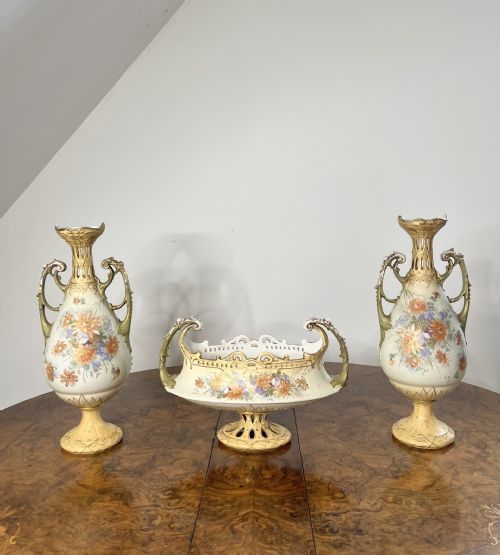
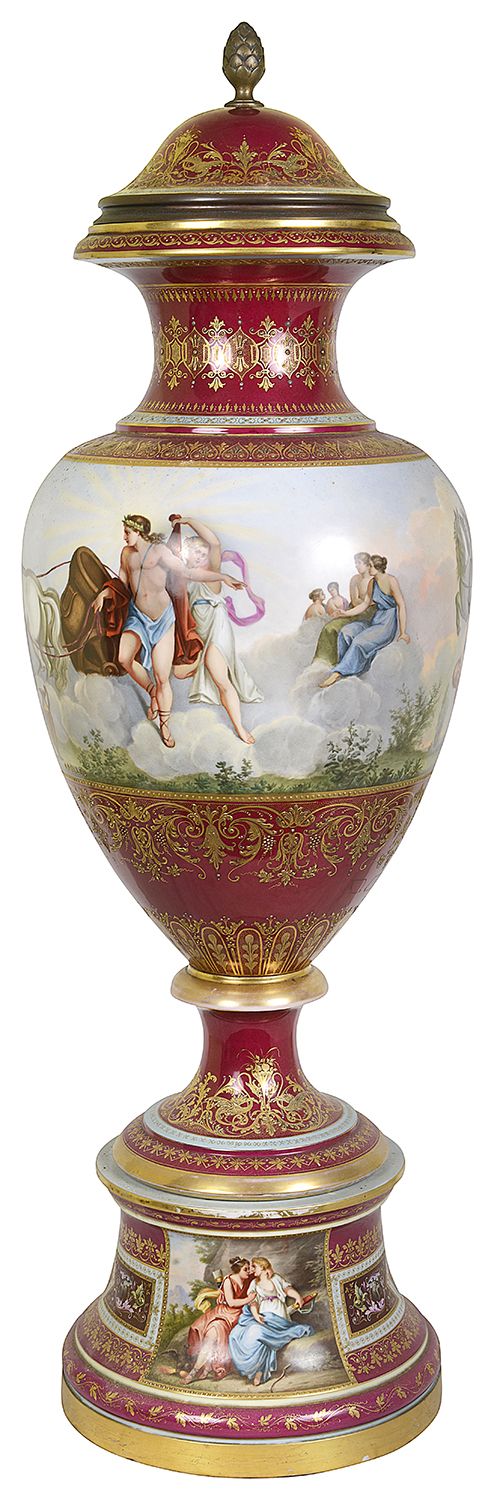
Austrian porcelain urns encompass decorative vessels and lidded urns originating across the nineteenth century, including examples from the eighteen-seventies through to nineteen hundred. The versions most commonly met on this page are Vienna and Royal Vienna style pieces, frequently presented as pairs or garniture sets.
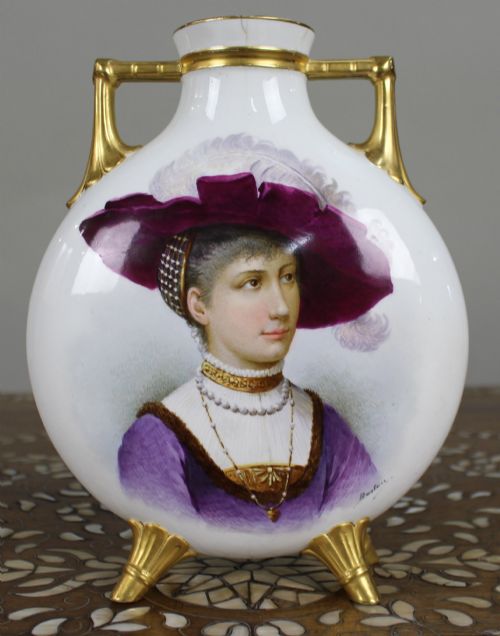
Makers and decorators working within Austria produced diverse forms ranging from moon flasks and ewers to cornucopia vases and large centrepieces. These objects bridge classical revival tastes and the flowing organic lines of the Art Nouveau movement.
The aesthetic vocabulary draws heavily from Neoclassical and Rococo revivals, incorporating hand-painted portrait subjects alongside rich gilding. Such pieces served primarily as decorative garnitures for mantelpieces and large tables in period interiors.
How they were made
The manufacture of these ceramics relies on ceramic bodies finished with detailed glaze and enamel layers, upon which artists applied intricate hand-painted designs. Firing techniques allowed for smooth white surfaces suited to miniature portraiture and classical scenes.
Gilding forms a primary decorative element across the pieces, utilising gold leaf and applied gilt highlights to frame painted panels and accentuate handles, necks, and pedestal bases. Enamel work further builds texture and colour depth across floral and figurative motifs.
Some nineteenth-century decorators snuck tiny hidden signatures onto the folds of painted robes just to prove they were paying attention.
What varies in quality
The distinction between standard production and the finest output rests in the execution of the hand-painted decoration and the precision of the gilding. Master artists achieved remarkable detail in facial expressions and drapery, elevating the piece beyond factory standard output.
Proportion and the handling of classical motifs also define the upper tier of these vessels, where heavy gilding remains crisp and well-preserved without rubbing. The weight and stability of the ceramic body, particularly in large lidded urns, reflect superior original potting.
Ernst Wahliss·Alexandra Porcelain Works·Royal Vienna·Baston
The Austrian Porcelain Urns Glossary
- Garniture set
- A matching group of three or more decorative vessels, typically comprising a central urn flanked by smaller matching vases or ewers.
- Moon flask
- A flattened circular flask vase with a short neck and foot, often mounted on handles and decorated with painted panels.
- Ewer
- A large jug with a wide spout and elaborate handle, traditionally used for holding water but produced here purely for decorative display.
- Cornucopia vase
- A horn-shaped vessel associated with abundance, designed to hold floral arrangements or stand as an ornamental centrepiece.
- Gilding
- The application of gold leaf or powdered gold suspended in a medium to ceramic surfaces, enhancing decorative borders and handles.
Austrian Porcelain Urns: Frequently Asked Questions
What are Austrian porcelain urns?
These items are decorative ceramic vessels and lidded urns produced in Austria during the nineteenth century, often reflecting classical Vienna styles or Art Nouveau aesthetics.
They encompass a variety of forms including garniture sets, ewers, and moon flasks, typically embellished with hand-painted scenes and gilding.
How were these urns used?
Historical interiors utilised these urns primarily as decorative mantelpiece ornaments, centrepieces, or flanking elements on side tables and sideboards.
Because of their elaborate hand-painted decoration and delicate gilt surfaces, they functioned as display pieces rather than utilitarian containers.
How do I live with Austrian porcelain?
Display these pieces away from direct sunlight to protect the integrity of the hand-painted enamels and gold leaf highlights over time.
Place them on stable surfaces where their weight and delicate handles are secure from accidental knocks, using soft dusting cloths for routine maintenance.
How do I tell periods apart?
Earlier nineteenth-century pieces tend to feature strict Neoclassical or Rococo revival motifs, focusing on classical figures and heavy symmetrical gilt borders.
Pieces moving towards nineteen hundred frequently adopt the flowing, asymmetrical lines and naturalistic subject matter characteristic of the Art Nouveau movement.