
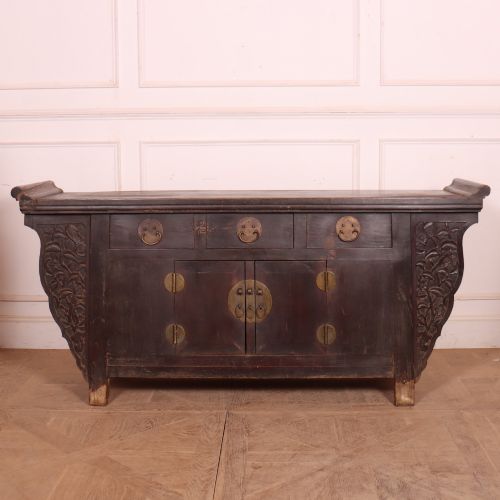
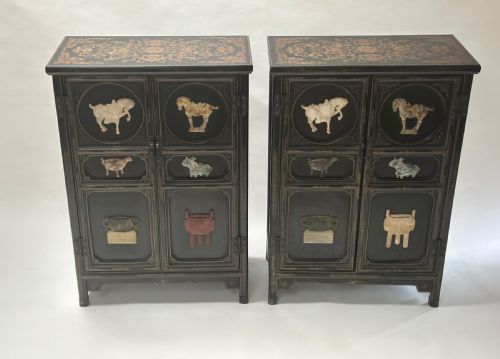


Asian Lacquer Credenza
An asian lacquer credenza brings depth and colour to a room through centuries of refined regional woodworking and surface finishing.
Asian Lacquer Credenza
When you search for an asian lacquer credenza, you are looking at substantial storage forms including sideboards, side cabinets, chests of drawers, and cabinets on stands. These functional items range from provincial utility pieces to grand decorative furniture.
The versions most frequently met on this page include Chinese side cabinets and Chinoiserie cabinets from the nineteenth century, alongside items dated around nineteen twenty. Elm and softwood form the carcasses for these substantial storage pieces.
Origins span classical Chinese provincial workshops and Qing Dynasty production, alongside British or European interpretation via Chinoiserie styles. Each piece serves as a focal storage point with distinct cultural and historical resonance.
What varies in quality
The refinement of the surface decoration largely determines the standing of a piece, separating basic provincial items from elaborately carved and gilded examples. Depth in the lacquer work and precision in the applied hardstone or gilt details signal superior craftsmanship.
Structural integrity of the underlying timber, particularly elm frameworks and associated stands, dictates durability and historical preservation. Original brass mounts and untouched finish layers retain greater integrity than heavily restored surfaces.
Styles represented across current items include Chinoiserie, Qing Dynasty, and Chinese provincial designs applied to cabinets and sideboards.
The Asian Lacquer Credenza Glossary
- Lacquer
- A durable resin finish applied in multiple layers to wood, providing a smooth, protective, and decorative surface. This technique requires considerable drying time between coats.
- Chinoiserie
- European artistic styles reflecting Chinese motifs and decorative techniques, popular across furniture and interior design. These pieces often feature painted or lacquered scenic panels.
- Qing Dynasty
- The final imperial dynasty of China, lasting from sixteen forty-four to nineteen twelve, known for prolific decorative arts. Furniture from this era often incorporates rich carving and gilding.
- Hardstone
- Minerals such as jade or agate used to create inlaid decorative motifs on wooden furniture surfaces. These stones are meticulously shaped and fitted into panels.
- Elm
- A resilient hardwood native to temperate regions, frequently utilised in traditional Chinese cabinet making for its strength and grain. It forms sturdy carcases that resist warping.
Asian Lacquer Credenza: Frequently Asked Questions
What is an asian lacquer credenza?
These pieces function as large storage units, incorporating sideboards, side cabinets, and chests of drawers finished with decorative lacquer surfaces.
Originating across the nineteenth and early twentieth centuries, they combine practical utility with traditional Asian and Chinoiserie aesthetics.
How do I clean lacquered furniture?
Dust surfaces gently with a soft, dry cloth to protect the delicate lacquer layers from abrasion.
Avoid chemical cleaners and moisture, as harsh agents can degrade historical finishes and gilding over time.
Where should I place a cabinet?
Position these cabinets away from direct sunlight and heat sources to prevent the lacquer from cracking or fading.
They serve well as focal storage units in reception rooms, dining spaces, or hallways where their rich colour and finish stand out.
How do I identify Qing Dynasty pieces?
Look for characteristic construction methods, traditional motifs, and specific carving techniques associated with nineteenth-century production.
Examination of the timber, particularly elm, and the depth of the red or black lacquer helps establish the period.