
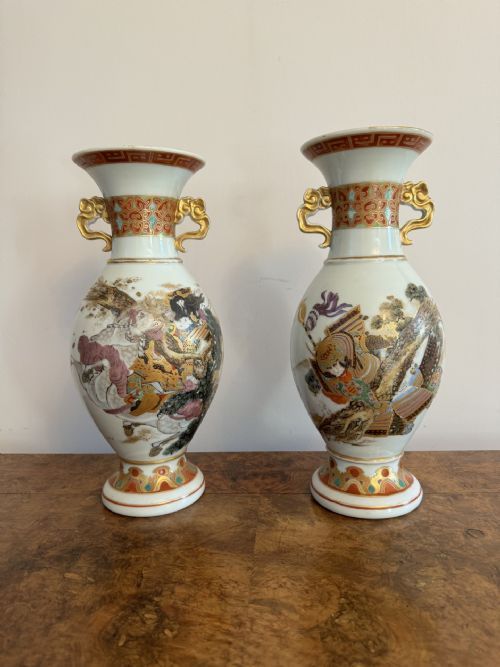


Asian Export Porcelain Urns
Asian export porcelain urns are decorative vessels made in China and Japan for Western markets, prized for their rich enamel palettes and intricate forms.
Asian Export Porcelain Urns
Asian export porcelain urns encompass a diverse selection of vases, temple jars, and vessels originating from various Eastern traditions. Buyers seeking these items will encounter Chinese and Japanese works spanning the seventeenth through the early twentieth centuries.
The objects frequently appear in forms such as bottle vases, spill vases, and hexagonal vessels. Japanese examples often reflect the Meiji and Edo periods, while Chinese pieces display Qing dynasty influences and classic blue and white painting.
Many of these vessels arrive paired, making them suitable for mantelpieces or side tables. Occasional pieces also feature custom stands or later adaptations as table lamps.
How they were made
Makers shaped these vessels from fine porcelain and earthenware before applying mineral glazes and cobalt blue underglaze decoration. Skilled artisans then added detailed polychrome enamels and gold leaf highlights by hand.
Kiln firing fixed the cobalt designs beneath the glaze, while subsequent low-temperature firings set the delicate enamel colours and gilding on the surface. Certain items incorporate carved wooden stands or gilt wood mounts tailored to the ceramic body.
A few towering spill vases stretch past ninety centimetres in height, demanding serious mantelpiece clearance.
What varies in quality
The distinction between standard production and superior craftsmanship lies in the precision of the brushwork and the complexity of the enamel palette. Finer examples display crisp detail in figural or floral motifs, with carefully controlled cobalt blue and generous application of gold leaf.
Subtleties in the porcelain body and the throwing of the vessel also separate ordinary wares from exceptional pieces. Heavier potting, well-balanced proportions, and even glaze distribution elevate the visual presence of the object.
Hattori
The Asian Export Porcelain Urns Glossary
- Imari
- A traditional Japanese style of porcelain decorated in underglaze blue, iron red, and gold. This palette was widely produced for export to European markets.
- Satsuma
- A type of Japanese earthenware featuring a crackled ivory glaze decorated with polychrome enamels and gilt. It gained immense popularity during the Meiji period.
- Celadon
- A term for ceramics denoting a pale green or grey-green transparent glaze. The subtle colour imitates the appearance of jade.
- Famille verte
- A Chinese porcelain palette dominated by green enamels, complemented by other colours such as iron red, yellow, and blue. The style developed largely during the Qing dynasty.
- Blue and white
- A decoration technique involving cobalt pigment applied directly to the clay body before glazing and firing. This method produces deep blue designs against a white ceramic ground.
Asian Export Porcelain Urns: Frequently Asked Questions
How do I identify Satsuma ware?
Satsuma ware is typically recognised by its characteristic ivory-coloured earthenware body covered in a fine, network of microscopic crackles. The surface is then painted with detailed enamel scenes and gold leaf.
Unlike hard-paste porcelain, this earthenware has a softer appearance and tactile warmth. Pieces frequently originate from the Meiji period.
Where should I place these vases?
These decorative vessels suit prominent display areas such as sideboards, mantels, and occasional tables. Large pairs look particularly effective when balanced on either side of a fireplace or architectural feature.
Some examples have been adapted as table lamps, allowing them to function as direct sources of illumination while retaining their decorative ceramic bases.
How do I distinguish Imari from Kutani?
Imari porcelain is defined by its characteristic tripartite palette of underglaze cobalt blue, iron red, and gilt highlights. The designs are typically crisp and geometric or floral.
Kutani ware, conversely, often relies on a broader, heavily gilt palette dominated by intense reds and greens, frequently depicting figural scenes. The clay and glaze textures also differ between the two regional traditions.