
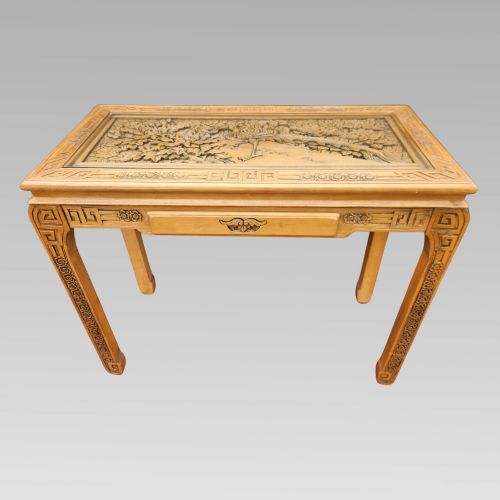


Asian Entry Table
An asian entry table is a substantial piece meant to ground a hallway, most often taking the form of a Chinese elm or hardwood console.
Asian Entry Table
When you search for an asian entry table, you are looking at console tables, altar tables, and side cabinets derived from Chinese traditions. These pieces function primarily as statement furniture in hallways or living spaces, offering a flat surface for display.
The versions you are most likely to meet on this page span the nineteenth century and the early twentieth century, encompassing Qing Dynasty designs and Chinese provincial forms. Elm and hardwood dominate the selection, alongside occasional lacquered wood surfaces.
Makers shaped these tables for specific domestic or ritual settings, ranging from narrow altar tables to three drawer console tables. Their proportions suit modern entryways precisely because they provide surface area without projecting too far into a corridor.
Materials and construction
Construction relies heavily on traditional joinery applied to elm, rosewood, camphorwood, and general hardwoods. Artisans selected these dense timbers to ensure stability across long, narrow rectangular tops.
Surface treatments include red lacquer and clear finishes that highlight the grain of the wood. Carved detailing frequently decorates the apron beneath the table top, drawing on Qing Dynasty and Chinese traditional motifs.
Listings feature nineteen-century elm and hardwood tables alongside red lacquer finishes and Qing Dynasty stylistic influences.
Evaluating craftsmanship and condition
Quality separates through the crispness of the carved details on the apron and legs, and the selection of timber. Dense hardwoods and well figured elm indicate a higher grade of manufacture than plain utility pieces.
The integrity of the original lacquer or polish influences desirability. Pieces retaining their early surface patination hold greater visual depth than those with modern refinishing.
The Asian Entry Table Glossary
- Console table
- A table designed to stand against a wall, frequently supported by wall brackets or legs at the front. These form the majority of narrow hallway tables.
- Altar table
- A traditional rectangular table featuring upturned flanges at the short ends or elaborate carved aprons. They originated in domestic or temple spaces.
- Elm
- A resilient native timber utilised extensively for Chinese provincial furniture. It accepts carving well and shows a distinct grain pattern.
- Qing Dynasty
- The final imperial dynasty of China, spanning from sixteen forty-four to nineteen twelve. Pieces from this era often display formal carved motifs.
- Lacquer
- A durable finish applied in multiple layers using natural resin. Red lacquer is typical of Chinese export and regional pieces.
Asian Entry Table: Frequently Asked Questions
How do I style an asian entry table?
Position the console flat against a prominent hallway wall to create a focal point upon entering the home. Balance the linear wood surface with a single tall ceramic vase or a table lamp.
Keep the space beneath open or pair the table with a low stool. Avoid overcrowding the surface so the carved apron remains visible.
What is the difference between a console and an altar table?
Console tables feature flat rectangular tops designed primarily for domestic display against walls. Altar tables often incorporate distinctive upturned flange ends and deeper carved aprons derived from ceremonial use.
Both serve effectively in modern entryways, though altar tables generally present a more architectural silhouette.
How can I tell a nineteenth century table from a later piece?
Nineteenth century pieces typically display traditional mortise and tenon joinery combined with hand-cut timber grain and genuine patination from age. Wear patterns on the feet and edges indicate long domestic use.
Later reproductions often utilise machine sawn timber and uniform factory finishes lacking the depth of older examples.