


Art Deco Sideboard Bar
An art deco sideboard bar brings serious presence to a room, combining architectural timber work with ingenious hidden storage for spirits and glassware.
Art Deco Sideboard Bar
When you search for an art deco sideboard bar, you are looking at substantial entertaining furniture designed to hold bottles, glasses, and barware. These pieces merge the form of a traditional sideboard with the specialised interior fittings of a cocktail cabinet.
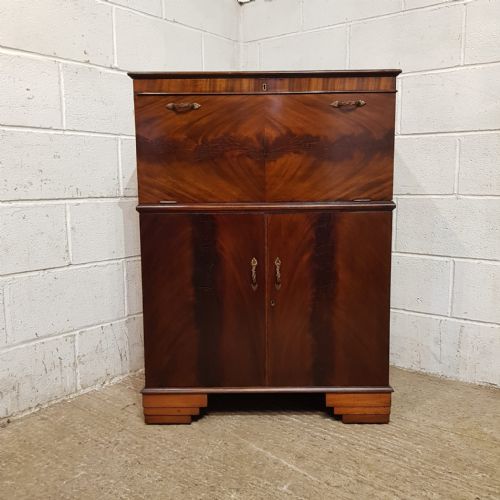
The versions you are most likely to meet on this page date from the 1920s and 1930s. They take the shape of drinks cabinets, cocktail cabinets, and cocktail chests, often standing on dedicated bases or double bow fronts.
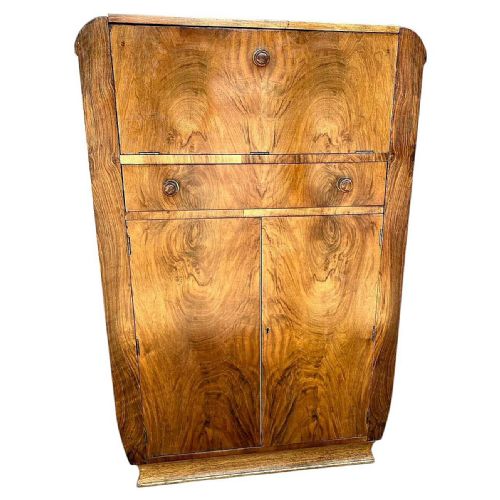
Makers working in this style utilised striking grain patterns to create visual impact. You will encounter forms ranging from freestanding cabinets to corner units designed to maximise interior space.
How they were made
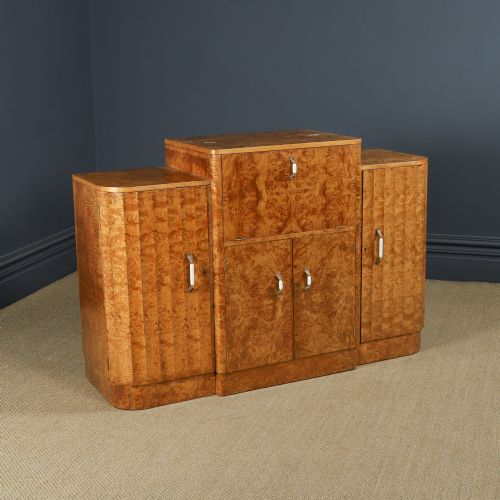
Cabinet makers constructed these pieces using solid timbers like oak and mahogany as a stable carcase, then applied decorative veneers. Burr walnut and walnut veneer dominate the surface work, chosen for their complex, swirling grain patterns.
Designers incorporated functional modern elements alongside traditional woodworking. Brass hardware, mirrored interior panels, glass shelving, and electrical components appear regularly within the fitted compartments.
Listings span the 1920 and 1930 periods, highlighting the transition toward streamlined entertaining furniture.
What varies in quality
The tier of a piece often rests on the ambition of its veneer work and timber selection. Highly figured burr walnut and satinwood demand superior skill in matching grain across symmetrical doors and curved surfaces.
Internal complexity sets finer examples apart from standard production. Cabinets featuring specialised lighting, mirrored backings, pull-out preparation slides, and fitted glass holders represent more elaborate workshop execution.
Harry and Lou Epstein·Waring and Gillow
The Art Deco Sideboard Bar Glossary
- Art Deco
- A design style dominant in the 1920s and 1930s characterised by sleek geometric shapes, streamlined forms, and modern industrial materials. It marked a departure from heavier historical revival styles.
- Cocktail Cabinet
- A specialised piece of furniture designed specifically for the storage and mixing of drinks. These units typically feature drop-down serving flaps and mirrored internal compartments.
- Burr Walnut
- A timber harvested from walnut tree growths, producing intricate, swirling patterns full of movement and depth. It was heavily favoured by high-end cabinet makers for statement veneer surfaces.
- Bow Front
- A convex, outwardly curved furniture front that softens the hard angles of a room. This shape required advanced joinery to veneer smoothly.
Art Deco Sideboard Bar: Frequently Asked Questions
What is an art deco sideboard bar?
An art deco sideboard bar is a dual-purpose piece of furniture that functions as a serving sideboard while housing a dedicated cocktail cabinet. These units combine robust external cabinetry with specialised internal storage for bottles and glassware.
They emerged strongly during the interwar period when home entertaining became a focal point of modern social life. The design prioritises striking wood grains and geometric silhouettes over traditional ornamentation.
How were these cabinets used originally?
In period homes, these cabinets served as the centrepiece for pre-dinner drinks and social gatherings. The drop-down front often functioned as a preparation shelf for pouring spirits and mixing cocktails.
Interior lighting and mirrored backs were integrated to display glassware and bottles dramatically when the doors were opened. Lower cupboards and drawers provided storage for surplus bottles and bar accessories.
How do I distinguish 1920s pieces from 1930s pieces?
Pieces from the 1920s often retain transitional elements that bridge earlier traditional styles with modernist geometry. They frequently employ heavier proportions and darker mahogany or oak foundations.
By contrast, 1930s examples lean further into streamlined aesthetics, frequently showcasing lighter burr walnut veneers, curved double bow fronts, and integrated electrical fittings.