
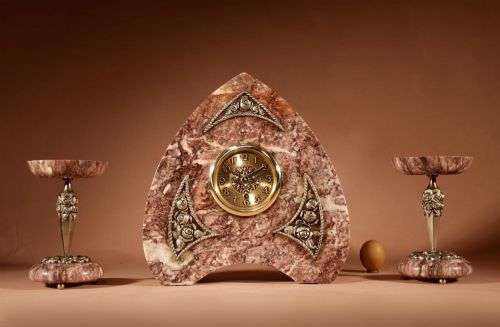


Art Deco Clock Set
An art deco clock set brings symmetry and striking geometry to a mantelpiece, combining a central timepiece with matching garnitures.
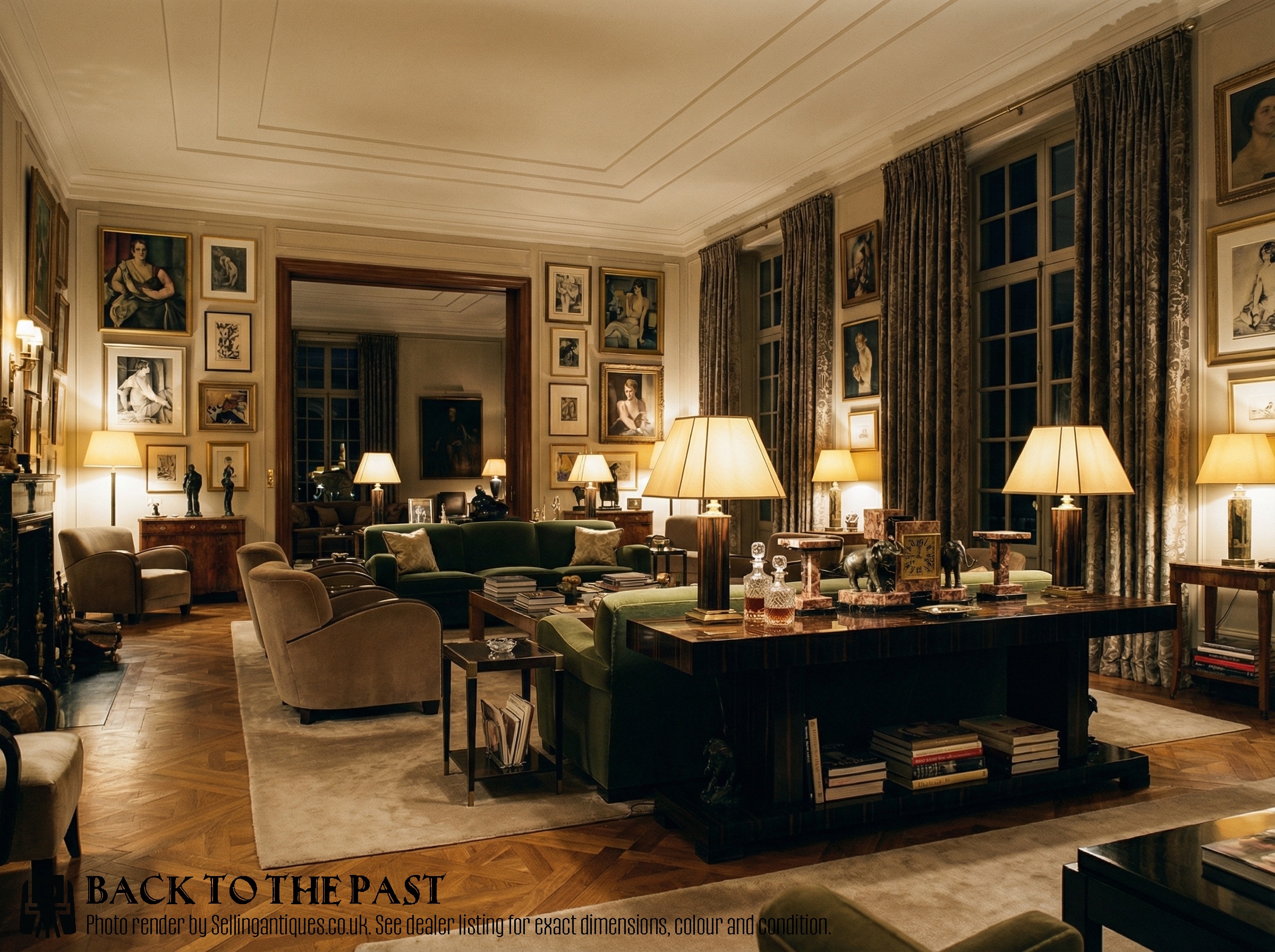
Art Deco Clock Set
An art deco clock set comprises a central timepiece accompanied by matching side ornaments, often styled as garnitures, lamps, or obelisks. These three-piece ensembles create a balanced, symmetrical arrangement designed for display on a mantelpiece or sideboard.
The versions most commonly met on this page originate from France and England, dating predominantly from the 1920s and 1930s. They frequently incorporate sculptural figures of animals, dancers, or abstract subjects alongside the main clock face.
How they were made
Makers utilised contrasting materials such as marble, onyx, and coloured stone for the architectural bases, pairing them with metal elements in brass, chrome, or silver-plated bronze. The structural bodies often display bold geometric lines typical of the period.
Figural elements cast in spelter or bronze depict subjects ranging from greyhounds and panthers to human dancers and mythological scenes. Enamel dials and glass components complete the construction of the timepieces and their matching side pieces.
Listings feature pieces spanning the 1910s, 1920s, and 1930s, constructed from marble, brass, onyx, glass, spelter, metal, chrome, and enamel.
What varies in quality
The calibre of the sculptural work distinguishes finer sets from standard production, particularly when signed by known modellers or cast in bronze rather than spelter. The weight, grain, and selection of the marble or onyx also indicate higher grade manufacturing.
Integration of the set determines overall cohesion, where matching materials and unified design across the clock and both side pieces demonstrate deliberate composition. Simpler mass-produced items rely on basic stone blocks with minimal cast ornamentation.
Michel Decoux·P. Sega·Suzanne Bizard·Hugues·Balleste
The Art Deco Clock Set Glossary
- Garniture
- A matching set of ornamental objects designed to be displayed together on a mantelpiece or sideboard, usually consisting of a central clock flanked by two matching side pieces.
- Spelter
- A zinc alloy commonly utilised as a less expensive alternative to bronze for casting decorative figures and sculptural mounts on period clocks.
- Breccia marble
- A composite stone made of broken rock fragments embedded in a fine-grained matrix, prized for its variegated and colourful patterned surface.
- Obelisk
- A tall, four-sided, narrow tapering monument that ends in a pyramid-like top, occasionally utilised as a matching side ornament in Egyptian revival sets.
Art Deco Clock Set: Frequently Asked Questions
What is a clock garniture?
A clock garniture is a decorative grouping that places a central timepiece alongside two matching side ornaments, such as urns, lamps, or obelisks. These companion pieces echo the materials and design of the clock to provide visual balance on a mantelpiece.
Originally popular in grand formal rooms, the three-piece arrangement creates a unified focal point. In art deco examples, the side pieces often take the form of matching animal sculptures or geometric bookends.
Where should I place a clock set?
These sets are proportioned for prominent display surfaces such as a living room mantelpiece, a wide sideboard, or a large console table. The central clock sits flanked by its matching side ornaments to maintain symmetry.
Because the pieces are matched in stone and metal, they require sufficient surface area to be viewed as a single composition. Placing them away from direct sunlight protects vulnerable enamel dials and coloured stone surfaces.
How do I date a 1920s clock set?
Dating relies on stylistic markers, material choices, and construction techniques characteristic of the interwar decades. Pieces from the 1920s frequently exhibit classical or Egyptian revival influences alongside emerging modernist geometry.
Later sets from the 1930s tend towards sleeker cubist forms, streamlined chrome, and simplified stone bases. Signatures from period sculptors found on the bronze or spelter figures also help establish a precise decade of manufacture.
What materials were used?
Makers combined heavy natural stones such as marble, onyx, and breccia for the architectural foundations of the clock and its side pieces. These dense materials provided a stable base for the mechanical movements and metal ornamentation.
Metals including brass, chrome, and silver-plated bronze formed the structural accents, while figural sculptures were cast in bronze or spelter. Details like enamel dials and glass covers added functional finishing touches.