


French Art Deco Garniture
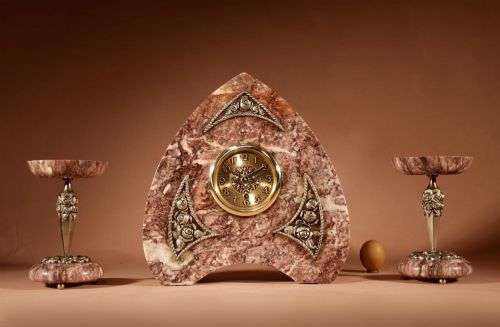
These French art deco garniture sets anchor a room with geometric presence, combining a central timepiece with matching side vases or companion figures.
French Art Deco Garniture
When searching for a French art deco garniture, a buyer encounters matching sets composed of a mantel clock accompanied by a pair of side pieces, such as urns, vases, or sculptural figures. These arrangements typically date from the 1910s, 1920s, and 1930s, reflecting the predominant design ethos of the era.
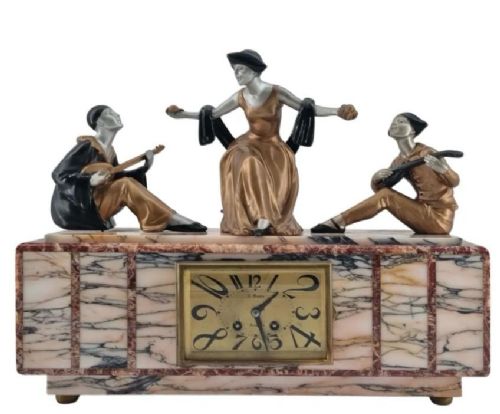
The version most commonly met on this page is a three-piece clock set featuring a marble body paired with brass, chrome, or spelter elements. Sculptural subjects frequently include figurative works depicting dancers, Pierrot and Columbine, or animals such as greyhounds, German shepherds, and elephants.
Individual mantel clocks without matching side elements also appear within these listings, alongside complete garniture sets that retain their original companion pieces. The physical scale of these objects ranges from substantial marble mantel arrangements to more compact timepieces.
Distinctions in craftsmanship
The caliber of a French art deco garniture depends significantly on the selection of materials and the fidelity of the sculptural casting. Dense, variegated marble bases with precise geometric cutting represent a higher standard than simpler, uniform stone blocks.
Pieces featuring named sculptural works by identified artists or detailed metalwork in bronze rather than standard spelter distinguish the upper tier of the range. Furthermore, the harmonious proportion between the central clock and its matching side garnitures dictates the visual balance of the complete set.
Several mantel pieces feature surprisingly vigilant greyhounds and German shepherds standing guard over the ticking clock face.
Michel Decoux·Odyv·Sega
The French Art Deco Garniture Glossary
- Garniture
- A set of matching decorative objects for a mantelpiece, consisting of a central clock flanked by twin vases, urns, or figures.
- Spelter
- A zinc alloy commonly used in art deco manufacturing as a cost-effective alternative to bronze for sculptural castings.
- Breccia marble
- A decorative stone composed of angular rock fragments embedded in a fine-grained matrix, frequently seen in 1920s clock cases.
- Onyx
- A banded variety of chalcedony utilised by period makers for smooth, polished clock bases and garniture bodies.
French Art Deco Garniture: Frequently Asked Questions
What is included in a complete garniture set?
A complete garniture set consists of a central mantel clock accompanied by two matching side pieces, which may take the form of vases, urns, or sculptural ornaments.
These three components were designed to be displayed together on a mantelpiece or sideboard to create a balanced decorative arrangement.
How do I identify the production period?
Production periods are typically identified through a combination of material choices, stylistic motifs, and structural forms characteristic of the early twentieth century.
The presence of characteristic geometric lines, specific marble types, and figural subjects helps distinguish pieces originating from the 1910s, 1920s, and 1930s.
Where were these clock sets originally displayed?
These decorative sets were primarily placed on the mantelpiece above a fireplace in domestic reception rooms or parlours.
Their substantial marble and metal construction allowed them to serve as the dominant visual focal point of the room's interior design.
Are the side garnitures always matching vases?
While many side pieces take the form of matching vases or urns, others are sculptural figures depicting animals or human dancers.
These companion pieces are styled to echo the materials and artistic motifs of the central clock.