


Armchair for Upholstery
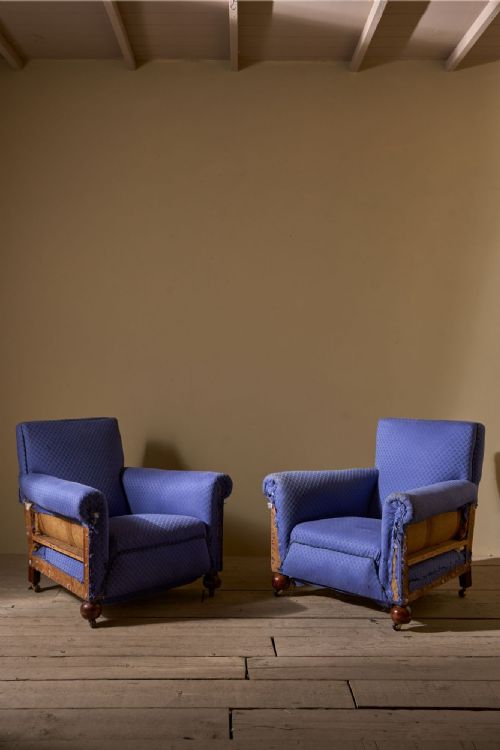
An armchair for upholstery offers a blank canvas for fabric, revealing the timber frame beneath.
Armchair for Upholstery
An armchair for upholstery presents the underlying wooden skeleton of a seat, stripped or ready for new covering.
Pieces span from the eighteenth century through the Victorian and Edwardian eras into Art Deco designs.
Materials and Construction
Frames rely on hardwoods such as mahogany, walnut, and birch to support the structural weight and tension.
Traditional foundation work uses materials like hessian, calico, and brass tacks to secure the internal stuffing before outer fabric is applied.
Some library chairs come equipped with built-in reading stands for serious scholars.
Assessing the Frame
The integrity of the timber frame dictates the standard of the piece, looking for solid joints rather than modern replacements.
Carving detail on exposed arms and legs, along with well-proportioned curves, separates standard frames from finer workshops.
Howard and Sons·Gillows·Holland and Sons
The Armchair for Upholstery Glossary
- Hessian
- A coarse woven fabric typically used for the inner stuffing and webbing support of traditional seats.
- Calico
- A plain-woven cotton cloth placed over the internal stuffing to hold the shape before the final decorative fabric is fitted.
- Wing armchair
- A fireside seat featuring protective side panels designed to shield the occupant from draughts.
- Library chair
- A sturdy seating form created for reading rooms, often featuring padded arms and substantial timber construction.
Armchair for Upholstery: Frequently Asked Questions
What is an armchair for upholstery?
An armchair for upholstery is a historical seating frame offered without its final decorative fabric covering.
Buyers acquire these pieces to apply bespoke textiles that match their interior decor.
How do I choose the right period?
Selecting a period involves matching the timber frame style, such as Georgian mahogany or Victorian walnut, to your room.
Consider the depth and height of the seat to ensure it suits modern sitting comfort.
Can I use modern fabrics?
Modern textiles work exceptionally well on antique frames, creating a striking contrast between old timber and contemporary design.
Ensure the chosen fabric meets current fire safety regulations for domestic upholstered furniture.
What woods are common?
Mahogany, walnut, and beech appear frequently across the historical frames available in this category.
These hardwoods provide the structural strength required to maintain tension in traditional upholstery.